Last Updated on February 8, 2022 at 9:15 pm
The Navi US Total Stock Market Fund of Fund will track the CRSP US Total Market Index by investing 95% to 100% of its assets in either the Vanguard Total Stock Market ETF (VTI) or the Schwab Total Stock Market Index Fund (SWTSX).
Assuming the AMC will choose the Vanguard Total Stock Market ETF (VTI) the total expense ratio of an investment in the fund will be 0.06% charged by NAVI plus 0.03% charged by the ETF. That is significantly less expensive than the 0.52% charged by Motilal Oswal for its S&P 500 fund (direct plan).
So does this mean Navi US Total Stock Market Fund of Fund is an “obvious buy”? Let us hold our horses, tone down our enthusiasm and consider the matter carefully.
Can I use Navi US Total Stock Market Fund of Fund for “international diversification”?
🔥Secure your future with our Robo-advisory tool trusted by over 3,500 investors and advisors. From effortless retirement planning to funding your children’s biggest dreams, turn your financial goals into reality. 🔥
Subscribe for money management solutions via email! (Link takes you to our email sign-up form) Join 32,000+ readers in our community.
👉 New Tool Alert! NaviPlan: A Privacy-Focused Multi-asset Tracker and Goal Planner 👈
When investors say they want diversification (of any nature), 99% of them just want a slice of something that is shiny. So in this context, it refers to the top few stocks of the US stock market. Most such investors are clueless about how to check the extent of portfolio diversification and will not regularly rebalance the portfolio fearing taxes. International equity funds do not enjoy the Rs. one lakh tax-free capital gain limit and are taxed about 6-8% higher than equity funds after indexation.
Those who appreciate the pros and cons of diversification and associated responsibilities can consider international (US) equity funds.
Will I get better diversification of the US stock market with Navi US Total Stock Market Fund of Fund than an S&P 500 passive fund?
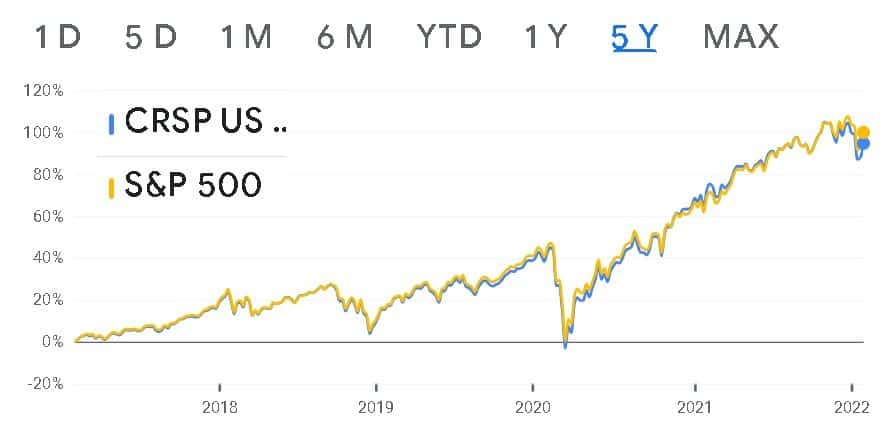
No. This is self-evident from the following screenshot from Google Finance comparing CRSP US Total Market Index (the benchmark for Navi US Total Stock Market Fund of Fund) vs S&P 500. This is because of market capitalization based weighting.
Will Navi US Total Stock Market Fund of Fund have a lower tracking error than Motilal Oswal for its S&P 500 fund?
Tracking error is defined as the standard deviation of fund monthly return minus benchmark monthly return. As pointed out by Siva from AIFW (private communication), a fixed expense removed daily from the NAV will not contribute to the tracking error.
Tracking error will be defined by the amount flowing into the fund and out of the fund and how efficiently the fund manager is able to buy and sell proportional ETF units via their broker during US market hours. It also depends on how efficiently USD-INR changes are tracked.
So we do not if the Navi fund will have a lower tracking error.
But Motilal Oswal needs to buy US stocks and manage them whereas Navi only has to buy a single ETF. Will this not make a difference to the tracking error?
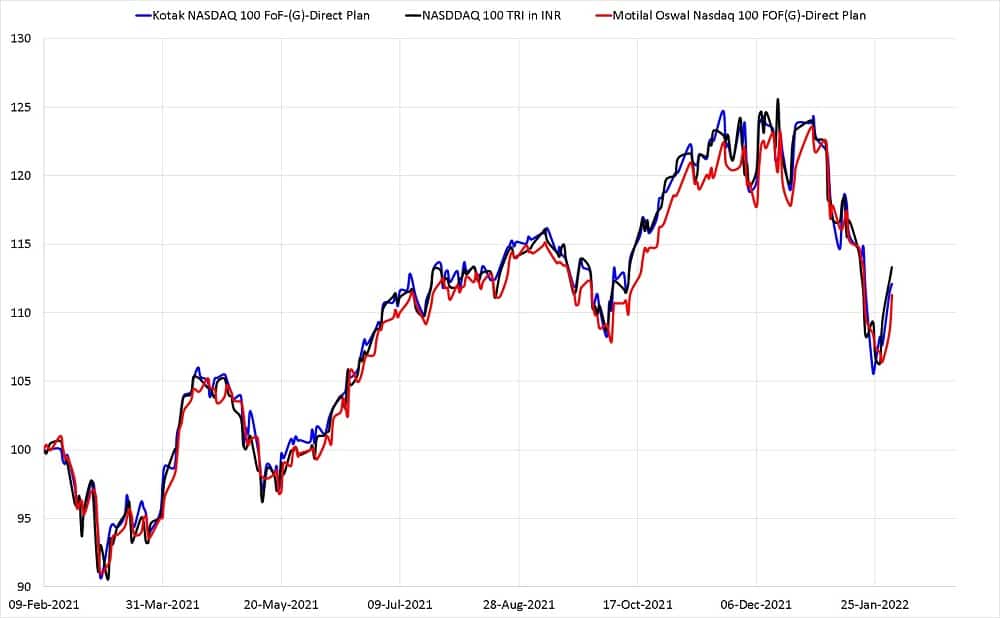
No, it need not. Take the case of Kotak’s Nasdaq 100 FoF. That invests in iShares NASDAQ 100 UCITS ETF with a TER of 0.33%. On top of this Kotak charges an additional 0.27%. So a total of 0.6%.
Motilal Oswal charges a total of 0.68% for its Nasdaq 100 FOF (0.58% for the ETF + 0.1%). Motilal manages the ETF in house.
The tracking error since 1st March 2021 (soon after the Kotak fund launched) based on monthly returns is 1.69% for Kotak NASDAQ 100 FoF-(G)-Direct Plan and 1.56% for Motilal Oswal Nasdaq 100 FOF(G)-Direct Plan. So it is not “obvious” that a fund that “simply” invests in a US ETF will do better.
Yes, Navi US Total Stock Market Fund of Fund has a lot of good things going for it. One of the best in class underlying funds with low fees and therefore the FOF also has low fees. On that basis, it is certainly not a bad buy. However, it would be a mistake to assume it is the superior choice without data.
Will I not get better more returns from Navi US Total Stock Market Fund of Fund because of low fees?
That depends on the tracking error. In the above example, the more expensive Motilal Fund has marginally outperformed the Kotak fund to date. Again it is good that Navi has a low fee to begin with. So even with a high tracking error outperformance is possible. However, the proof of the pudding is in the NAV movement.
Krishnakumar Chandrasekaran on AIFW clarified the following on dividend taxation: When US companies pay dividends to US ETF/mutual fund, there is no tax withheld. The ETF/MF passes on the dividend on a quarterly basis. US residents pay tax on dividends at the applicable rate while for Indian FOF dividend is passed on after 25% withholding tax. In case an Indian fund invests directly in US companies, the dividend paid by each company is received after 25% withholding tax. In both cases, there is only one level of withholding tax.
Furthermore, Krishnakumar adds that the US ETFs will also need to pass on capital gains to investors! This has no withholding tax like dividends but the FOF will have to reinvest them and can contribute to the tracking error. These gains though small (due to low churn) can make a difference over several years.
What about the limitations on overseas investments? Will not affect FOFs investing in international ETFs?
We have discussed this detail a few days ago: Can I now invest in Fund of Funds that buy US ETFs?
In the case of funds investing in international ETFs, the current limit per fund limit is just $300 million! This is less than Rs. 2300 Crores! Residents investing abroad is a tricky issue involving the govt, RBI and SEBI.
While everyone hopes that the limit for investing in international stocks will soon be enhanced (from 1 Billion USD and 7 Billion USD industry-wide), the limit for investing in international ETFs may not be immediately increased as that is not in any danger of being breached (USD $300 million per Mutual Fund, within the overall industry limit of US $1 billion).
So sooner than later the limit for international ETFs will also be breached and will start the waiting game again. Also, the govt may consider increasing the tax on such funds.
In summary, Navi US Total Stock Market Fund of Fund is a good offering but it should only be considered by those who understand the pros and cons of including such a fund in the portfolio.
For example, if you wish to “diversify” your equity portfolio with say 20% of US stocks, then you will have to regularly rebalance to maintain it at 20% without worrying about paying tax.
The US market is not a bed of roses. The coming year with the expected rate hikes may not be productive. Investors must appreciate the risks involved. See: Motilal Oswal S&P 500 Index Fund: What return can I expect from this?
As with all acceptable NFOs, we recommend waiting and watching the tracking error for at least a few months by which time we will also have some clarity on the revised overseas investment limits.
We would like to caution those who invest either now or later not to feel superior about their choice. The ups and downs of tracking an international index can throw up some surprises that defy intuition or commonsense.