Last Updated on August 22, 2022 at 11:12 pm
The Nifty Next 50 is a unique index. The index can provide joy and frustration in equal measure to its investors. At the time of writing, it has failed to beat the Nifty 50 for the last five years. We address the question asked by two worried investors: is it time to exit Nifty Next 50 (NN50)?
Technically a large cap index, a closer inspection of the impact cost (liquidity) reveals that Nifty Next 50, in fact, a midcap index in terms of risk and reward. Although a market capitalization-weighted index, several of its stocks have nearly equal weight. So unlike the Nifty, which can move up if just the top 3 stocks move up, NN50 requires a lot more of the “next 50” segment to perform.
The underperformance of the Nifty Next 50 stems from the lack of momentum in the Nifty 100 universe aside from the top few stocks of the Nifty from last 2017. Readers may recall our Dec 2019 that the return difference of Nifty 50 vs Nifty 50 Equal-weight index at an all-time high! This was clear evidence that Nifty (or Sensex) returns were propelled only by a few stocks.

Just three months later, the market crash destroyed the two-year imbalance among Index stocks. The Nifty 50 fell as much as Nifty Next 50 because of this imbalance in March 2020. In Feb 2021, we reported that the Nifty 50 equal-weight index surged past Nifty 50 due to the market rally. As of April 28th 2021, The Nifty 50 and NIfty 100 equal-weight indices have outperformed Nifty 50 and Nifty 100 over the last year (all returns in this article refer to total returns with dividends included).The image below shows the trailing returns as of April 28th 2021. The entries in red correspond to underperformance. Please note all returns depend on the trailing base date (April 2021) and can be completely different when computed on a different day.
🔥Secure your future with our Robo-advisory tool trusted by over 3,500 investors and advisors. From effortless retirement planning to funding your children’s biggest dreams, turn your financial goals into reality. 🔥
Subscribe for money management solutions via email! (Link takes you to our email sign-up form) Join 32,000+ readers in our community.
👉 New Tool Alert! NaviPlan: A Privacy-Focused Multi-asset Tracker and Goal Planner 👈
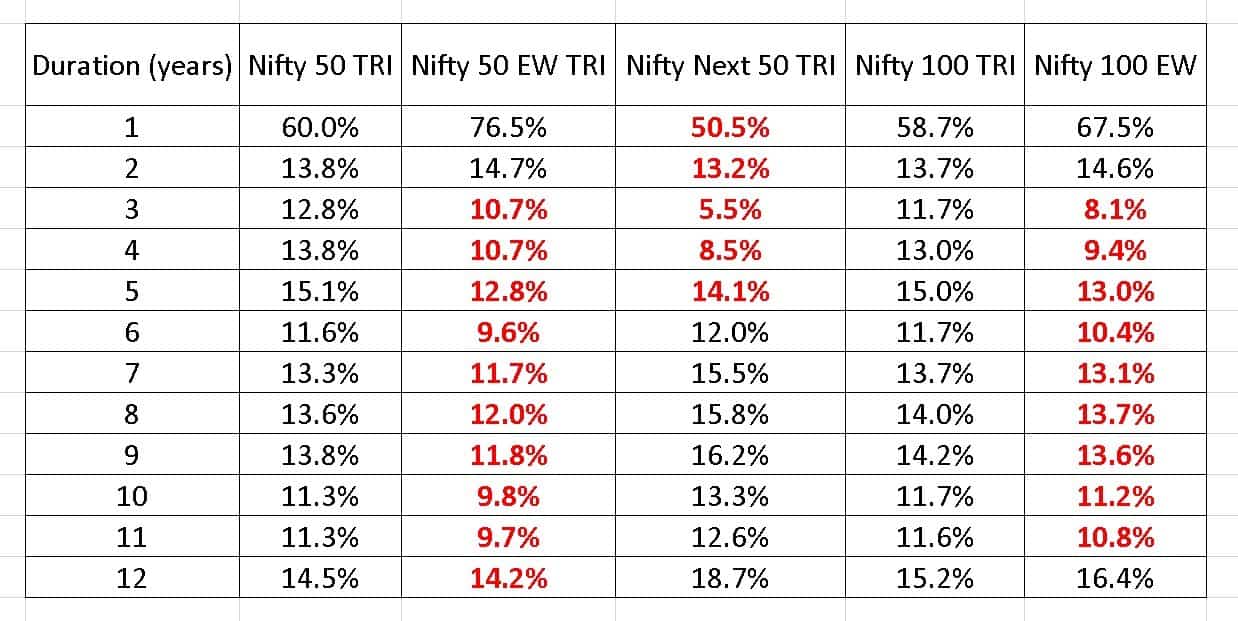
The equal-weight indices have recovered over the last two years, but the Nifty Next 50 is not quite there yet. If we look at 5-year rolling returns of the Nifty Next 50, this underperformance is not new.
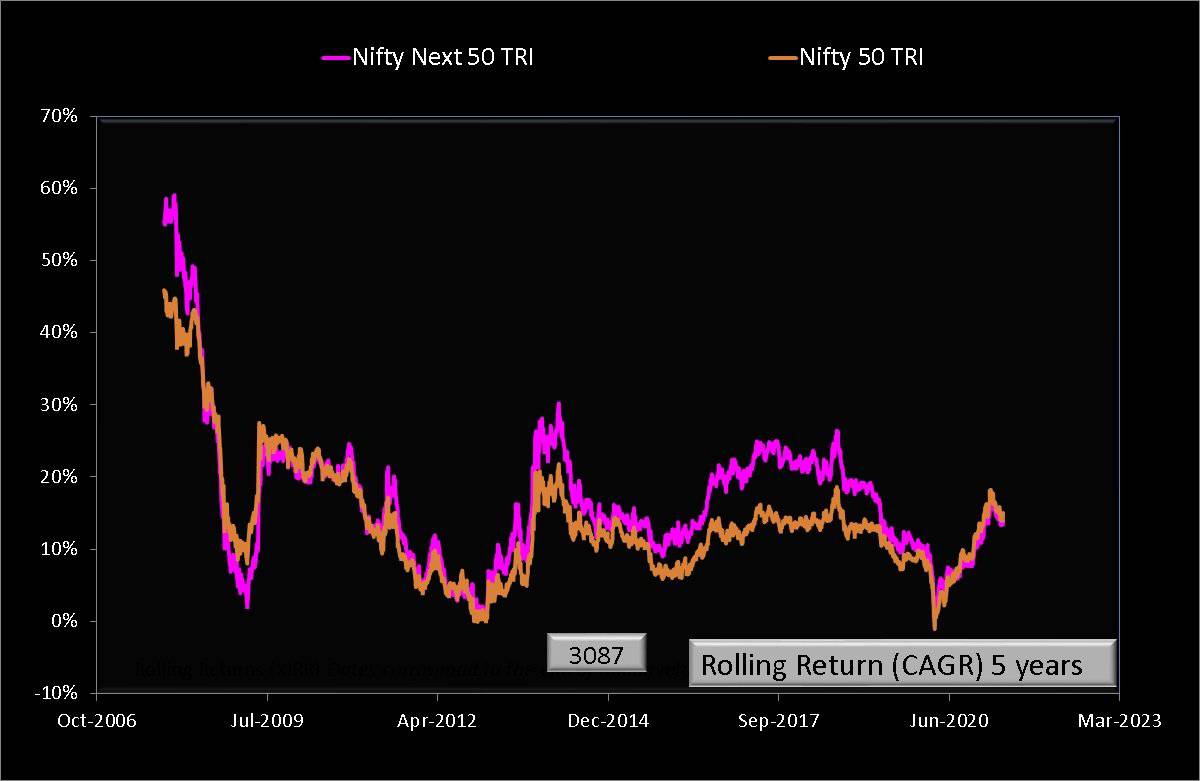
Between Dec 2012 to about early 2019, the Next 50 index outperformed the Nifty. On either side of this window, the story is similar. If we consider ten-year rolling returns, NN50 has done much better.
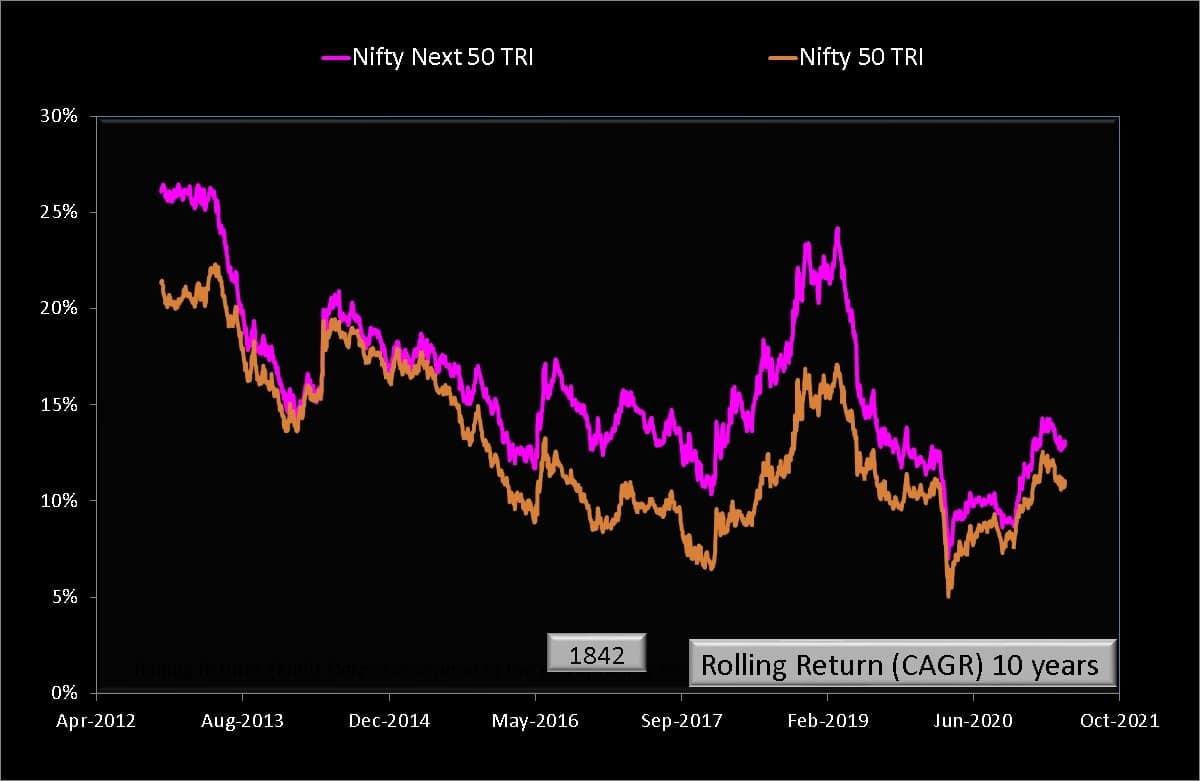
The question is, are you willing to beat this pain of underperformance for potential outperformance over longer durations? At this point, it is also fair to ask, why compare Nifty Next 50 and Nifty 50? There is no overlap between them anyway.
As an analyst, yes, the comparison does not make much sense. As an investor, I pay higher fees for the Nifty Next 50 fund (compared to a Nifty 50 or Sensex). I take on a higher risk than the NIfty. So I expect a higher reward. If I do not get it for five years, it is fair enough to wonder if it is time to exit.
The question may be reasonable, but the answer is far from clear. If your goal is several years away and you do not mind holding on, you can wait for the turnaround. It may take a while, though, considering the second wave and the associated economic slowdown.
Some young earners hold too much of Nifty Next 50. If the wait has been frustrating, you can increase exposure to Nifty 50 (assuming these are only two funds you hold!)
This is a perfect example of time risk in stocks. As we have seen before – Timing the market will work but not the way we imagined – a large positive return is followed by a large negative return and vice-versa. However, an extended period of poor returns (in this case, relative) can be quite frustrating. There is nothing wrong with holding Nifty Next 50 in addition to the Nifty/Sensex, but investors must be ready to go through such periods of frustrating underperformance.