Last Updated on April 27, 2025 at 9:03 pm
Parag Parikh Arbitrage Fund aims to “generate capital appreciation and income by predominantly investing in arbitrage opportunities in the cash and derivatives segment of the equity market, and by investing the balance in debt and money market instruments”. The NFO period of the fund is from Oct 23rd to Oct 27th 2023, and the scheme aims to re-open from 3rd Nov 2023.
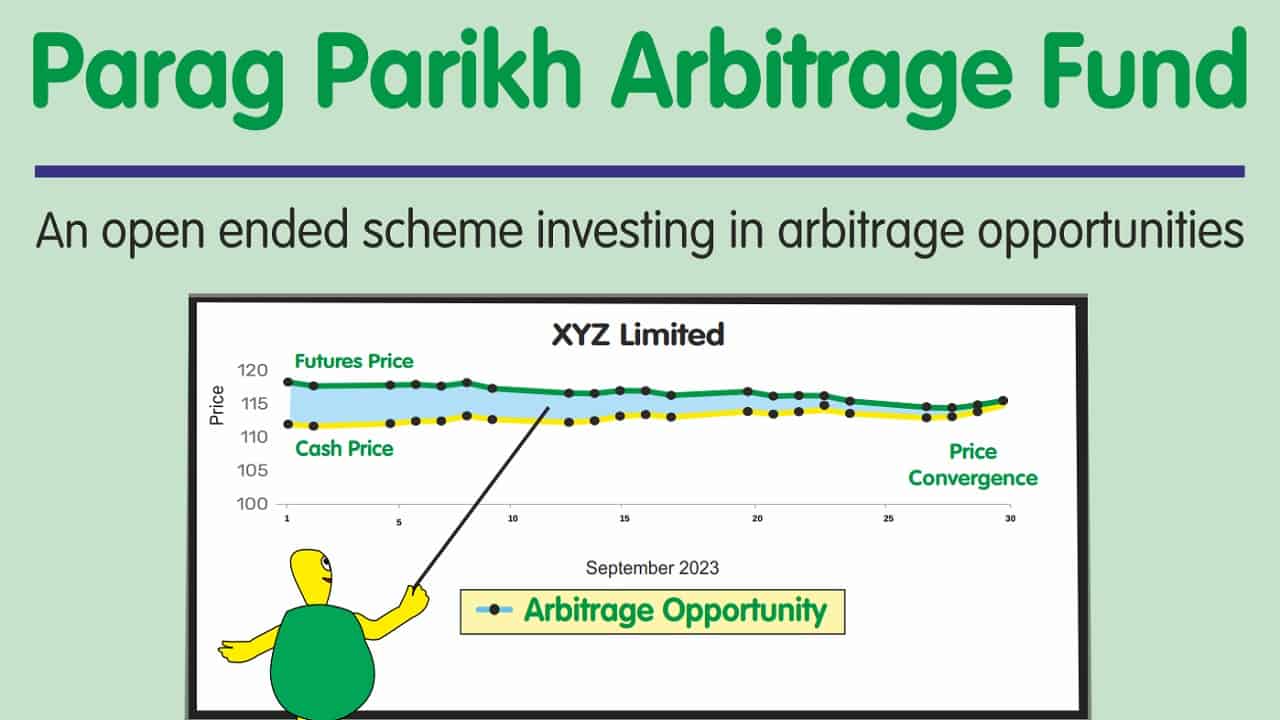
An arbitrage fund simultaneously buys and sells the same asset in different markets (e.g., cash and derivative markets) to exploit small price differences. A detailed explanation with examples can be found here: How Arbitrage Mutual Funds Work: A simple introduction (the tax rules have changed since this article was written).
This difference in price and its convergence over time is well depicted in the cover image of the Parag Parikh Arbitrage Fund flyer.
Since mid-2018, arbitrage funds have been classified as hybrid funds. They can hold up to 35% in bonds. This is primarily because arbitrage opportunities in the market have come down due to higher market participation. This brings along two undesirable consequences.
🔥Secure your future with our Robo-advisory tool trusted by over 3,500 investors and advisors. From effortless retirement planning to funding your children’s biggest dreams, turn your financial goals into reality. 🔥
Subscribe for money management solutions via email! (Link takes you to our email sign-up form) Join 32,000+ readers in our community.
👉 New Tool Alert! NaviPlan: A Privacy-Focused Multi-asset Tracker and Goal Planner 👈
(1) The bond portfolio can have interest rate and credit risk. Most arbitrage funds tend to buy short-term bonds to minimise interest rates. However, some AMCs dabble in credit risk. Given its track record with its liquid fund and conservative hybrid funds, we can expect PPFAS AMC to keep credit risk low.
(2) Some arbitrage funds buy their debt funds! This is unfair to the arbitrage fund unit holder as they have to pay the expense ratio of the debt fund. See: Why are arbitrage mutual funds holding debt mutual funds in their portfolios? I hope PPFAS does not do the same!
Arbitrage funds are now marketed as a tax-efficient liquid fund (they are taxed like an equity fund, although its risk profile is similar to that of a debt fund ~ ultra short-term or money market fund kind of volatility) and usually popular among high net-worth individuals.
It must be understood that there is nothing special about the Parag Parikh Arbitrage Fund (at least at the time of writing). There is no compelling reason to choose it over existing choices, assuming you need an arbitrage fund.
When does one need an arbitrage fund? For those who appreciate the associated risks (see below), It can be used as a tax-efficient debt fund in the last phase of an accumulation portfolio. Returns may be slightly more than liquid funds, but that should not matter at that stage. A retiree can withdraw from it occasionally or regularly for income. It can be used as a short-term savings instrument, a component of your emergency fund.
There is little difference between the risk and reward profiles among the funds in this category (barring a credit event). So don’t worry too much about star rating and such.
Arbitrage funds primarily invest in a complex product that brings along new risks. For example, returns would suffer if the fund is forced to liquidate the arbitrage position due to redemptions. Naturally, such risks are present in all mutual funds. The point is there can be situations where the risk is suddenly higher than usual.
These funds can deliver negative returns over a month, a quarter or longer depending on interest in the derivatives segment. See: Arbitrage mutual fund returns reduced due to negative spreads. So we recommend only experienced investors buy these funds.
Those who need an arbitrage fund in their portfolio and are interested in the Parag Parikh Arbitrage Fund may wait a few months to see where and how they invest before making a call. We reiterate that there are good options currently available in the category. Investors can opt for those instead after studying their portfolios.