Last Updated on June 3, 2022 at 11:13 pm
The idea behind Quantum Equity Fund of Funds is fantastic. This is a mutual fund that invests in diversified equity mutual funds (other than Quantum), so instead of worrying about which fund to buy and sell, you can just buy this one fund of fund and let the fund manager do the job for you. Has this strategy delivered? Does the fund need a makeover? Let us find out.
Before we begin, do check out my talk on momentum and low volatility stock investing in India and these five videos to start your retirement planning. Regular readers may be aware that I had suggested this fund as a turnkey mutual fund solutions to beat inflation in Aug 2015 and had reviewed it in June 2014. Let us take a relook.
Quantum Equity Fund of Funds Investment Strategy
1. Fund selection
- Select all the open-ended equity funds
- Remove all the funds, which are not categorized as diversified equity funds (such as sector, thematic and global funds) from the above list.
- From the above list, choose only those funds are considered which have a 3-year track record
- Remove the funds holding a concentrated stock portfolio.
- Rank the funds based on their performance across time frames.
- Thereafter, the short-listed funds are evaluated based on qualitative criteria. The qualitative parameters will largely judge the fund on the parameters like fund house’s investment systems and processes, consistency in characteristics of its portfolio among others. Funds that emerge as the top performers shall form part of the final portfolio.
2. Portfolio Construction
🔥Secure your future with our Robo-advisory tool trusted by over 3,500 investors and advisors. From effortless retirement planning to funding your children’s biggest dreams, turn your financial goals into reality. 🔥
Subscribe for money management solutions via email! (Link takes you to our email sign-up form) Join 32,000+ readers in our community.
👉 New Tool Alert! NaviPlan: A Privacy-Focused Multi-asset Tracker and Goal Planner 👈
- The portfolio will have 5 to 10 open-ended diversified equity mutual fund schemes.
- The Scheme shall not invest more than 20% of its assets in a single scheme with a 3-year track record.
- The overall exposure in the schemes with a 3-year track record shall not exceed 40% of the Portfolio.
- The Scheme shall not invest more than 25% of its assets in a single scheme with a 5 years track record.
- Quantum schemes will not be chosen!
Quantum has always had a thing about the taxation status of Quantum Equity Fund of Funds – like that of a debt fund. A mutual fund investing in 65% of Indian stocks is taxed as an equity fund but one that invests in 65% of Indian mutual funds is taxed like a debt fund. That is bizarre logic.
Of course, the government changes tax laws only when it suits them. When it wanted retail participation in the PSU disinvestment, it started CPSE ETFs. Then it subsequently allowed equity tax status to a fund of fund investing in Indian ETFs (not just CPSE ETFs). That the ruling took financial years to implement is another matter: Equity fund of fund taxation rule changed: Can we invest in them now?
Is it time for Quantum Fund of Funds to convert to an ETF based FoF like
A total expense ratio of 0.51% (0.75% regular plan) is just a bit too much considering the direct plans that it invests in will also have TER of their own. A bit much especially because the fund has slipped in performance.
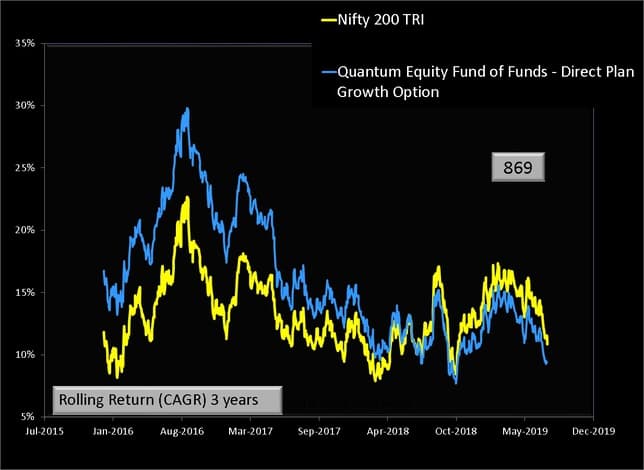
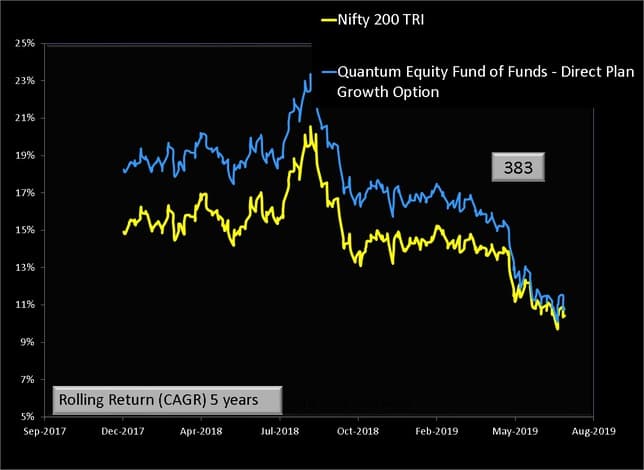
Shown below is every possible 3Y and 5Y return since inception. For example, the graph immediately below, 869 three-year returns of Quantum Equity Fund of Funds is compared with Nifty 200 TRI. The five year data is shown in the graph below.
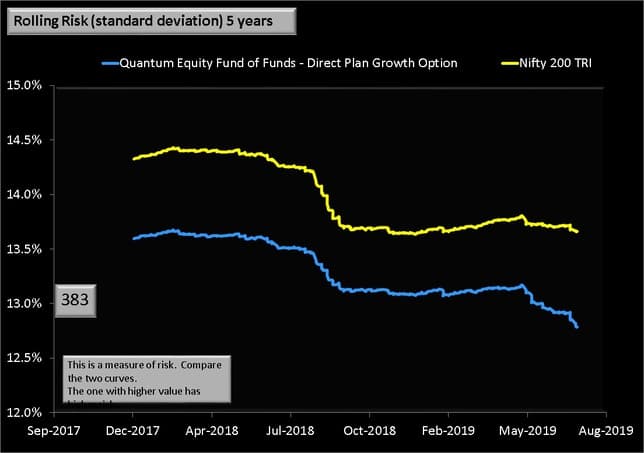
In terms of risk, the fund is only marginally less volatile than the NIfty 200 TRI index. Over 383 possible five year periods, the fluctuations in month returns are quantified in terms of the standard deviation and plotted below. The line lies lower has the lower risk.
This is because it holds too many diversified equity funds. This, for instance, is the June 2019 portfolio:
1. Kotak Standard Multicap Fund-Direct Plan-Growth Option 14.37%
2. Mirae Asset Large Cap Fund – Direct Plan Growth Option 14.24%
3. ICICI Prudential Bluechip Fund – Direct Plan Growth Option 14.05%
4. Invesco India Growth Opportunity Fund – Direct Plan Growth Option 13.88%
5. Aditya Birla Sun Life Frontline Equity Fund – Direct Plan Growth Option 13.82%
6. Franklin India PRIMA Fund – Direct Plan Growth Option 13.70%
7. L&T Mid Cap Fund – Direct Plan Growth Option 13.35%
My first reaction was, “What? Three large cap funds?, Two mid cap funds, one multi-cap, one large and mid cap?” If someone at AIFW had posted this portfolio, he/she would be dismissed as an immature newbie. Considering the way large caps are defined today, there would be considerable overlap among the three funds. At just 40 Crore AUM, there is no need for seven funds IMO.
Summary
I think the fund will have to avoid diworsification and hold a portfolio with minimal overlap to at least justify the additional fee one has to shell out. This is best done with ETFs. A simple combination of a smart-beta ETF (say low volatility), mid cap ETF and small exposure to liquid Bees plus cash will construct a tax-efficient (it will then become an equity fund), properly diversified portfolio.
If you want a fill-it, shut-it, forget-it, kind of option for the equity portio of your portfolio, then this fund is a decent fit. However it must keep any eye on benchmark outperformance to remain attractive under its current invest terms. Its slip in performance over the last few months is worrying.