Last Updated on September 5, 2021 at 8:24 pm
One of my teachers once told me, “stare at every graph and every equation you encounter. Milk all the possible information you can out of them before you move on.” This advice helps me on an everyday basis: to teach, research and learn personal finance. Most importantly it allows me to be a contented investor. When it comes to personal finance one graph and one equation does this more than anything else.
The Graph: Take a look at this graph. It represents the growth of a SIP corpus (monthly investment of Rs. 1000) compounding at the rate of 8% per year.
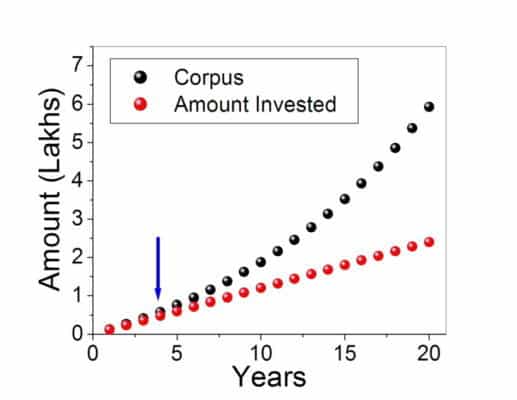
The gaping difference between the invested and maturity amount as the years increase of course reflect the ‘power of compounding’. Nothing new there. Look at the blue arrow around 3.5-4 years. To the left of the arrow the red and back points are close to each other. To the right of the arrow they branch off. What does this tell us?
🔥Secure your future with our Robo-advisory tool trusted by over 3,500 investors and advisors. From effortless retirement planning to funding your children’s biggest dreams, turn your financial goals into reality. 🔥
Subscribe for money management solutions via email! (Link takes you to our email sign-up form) Join 32,000+ readers in our community.
👉 New Tool Alert! NaviPlan: A Privacy-Focused Multi-asset Tracker and Goal Planner 👈
- Define short-term goals as anything below 3-5 years approximately.
- Define long-term goals as anything above 10 or more years.
For short-term goals:
- Effect of compounding is small/negligible.
- Therefore returns do not matter. Inflation is manageable if not negligible!
- Capital protection is crucial. So no risk of capital and no volatility in returns.
- Tax outgo could optionally be minimized. If returns are not important neither is tax
Therefore:
- Don’t waste time selecting the perfect debt fund. Just pick one which matches the above conditions: Liquid funds or Ultra-short term funds. Analyzing if funds like a dynamic bond funds or income funds will do the job is time not spent well. Such funds, in my view, do not meet the above conditions (which ones?)
- If you are uncomfortable about debt funds use a FD for a lump sum and a RD for small periodic investments.
- Key take-away: Don’t waste time and effort worrying about short-term goals. If returns are not important, where you invest also does not matter as long as it is safe.
For long-term goals:
- Effect of compounding is crucial.
- Therefore inflation is also crucial (inflation is negative compounding). So returns must beat inflation.
- Volatility in returns resulting in short-term risk of capital is necessary to get returns that can beat inflation.
- Since risk is inevitable, lowering risk is crucial.
- Lowering risk can achieved by diversification and rebalancing. These enable capital protection.
- Tax outgo must be minimized.
- Returns matter but a not a single return but the average of returns from diversified investments.
- Near impossible to achieve all of the above by investing in a single product. So child-plan, no pension plan, no money-back schemes.
- Where to invest is a wrong question. How much to invest where is the right one. One should diversify across instruments differing in risk (equity, debt, gold etc.) and also diversify among different equity and debt components (large-cap stocks, mid-caps, international equity etc.)
- Periodic monitoring and rebalancing necessary to ensure the average compounding is on track.
- phew! Key take-away: Long-term investing is complicated! It requires a lot of time and effort to learn and monitor. Spend this time after you begin investing and not before. Getting started with some basic knowledge (can be obtained within a week) as early as possible is important.
- Don’t invest to get good returns. Invest to get returns that beat inflation.
- If you are risk-averse you must invest in equities! (the risk referred to is inflation risk)
What determines the % of equity and debt investment, debt etc. ? We need ‘the’ equation to determine that.
The equation:
Future value of a sum = (Present value of a sum) X(1+return)(No of years invested)
The good old compound interest formula. It is well known that if we begin investing early then
- we will end up with a large corpus.
- we need to invest a much smaller sum to reach our goals
What is often not made explicit enough is
- we could afford to take much lower risk than someone who has started late.
Consider two friends A and B. A is going to be a father next month while B has a 7 year old daughter. B realizes that he has not saved anything for his daughters education and begins to do so. To ensure A does not make the same mistake, he urges him to start investing right away. They both decide to use a goal planner. Here are the numbers:
- Present cost of degree: Rs. 10 Lakhs
- Inflation: 10%
- Due to their personal circumstances both can afford to save no more than about Rs. 10,000 each month.
- A has 17 years before his child reaches college
- B has only 10 years before his daughter reaches college.
- Due to inflation B has to save Rs. 25.9 Lakhs and A Rs. 50.5 Lakhs
- Although A has to save about twice of what B has to, because he begins early he could afford to invest in instruments which gives about 9% return each year.
- B must ensure he achieves a return of about 13% each year
Thus A can afford to invest in very little or no equity while B has to have much more equity exposure in order to get close to his goal. The numbers may appear unnatural and fixed but the message is clear:
A persons risk appetite (how much risk he can take) is relevant only if he begins investing early. For the late starter, the goal requirements will dictate how much risk he must take. The risk appetite becomes irrelevant in such cases.
- We can’t take it with us but we better ensure we have enough when we need it.
Can you tell me why I titled this post, ‘the contented investor’?! 🙄
After I received a couple of interesting comments on who is a contented investor, I read this quote by Benjamin Graham in Hemant Beniwal’s latest post
“People don’t need extraordinary insight or intelligence.
What they need most is the character to adopt simple rules and stick with them.”
To me this perfectly sums up the attributes of a contented investor. Do you agree?