There is a scene in the classic Bollywood movie Baghban that haunts an entire generation of Indian parents. Amitabh Bachchan’s character, having retired and spent his entire provident fund on his children’s settlements, sits at home. He asks his son for a small amount of money for glasses. The son sighs, rolls his eyes, and lectures his father on budgeting.
In that moment, the father wasn’t just broke; he was broken.
This is the modern Indian iteration of Shakespeare’s King Lear—the tragedy of a king who gave away his kingdom to his daughters prematurely, expecting love and care in return, only to be cast out into the cold storm, stripped of dignity and power.
In India, this isn’t just a story; it’s a pervasive, silent fear. It is the darkness that lurks behind the sunny urge to settle our children.
About the author: Ajay Pruthi is a fee-only SEBI-registered investment advisor. He can be contacted via his website plnr.in.
🔥Secure your future with our Robo-advisory tool trusted by over 3,500 investors and advisors. From effortless retirement planning to funding your children’s biggest dreams, turn your financial goals into reality. 🔥
Subscribe for money management solutions via email! (Link takes you to our email sign-up form) Join 32,000+ readers in our community.
👉 New Tool Alert! NaviPlan: A Privacy-Focused Multi-asset Tracker and Goal Planner 👈
Giving Away the Firewood
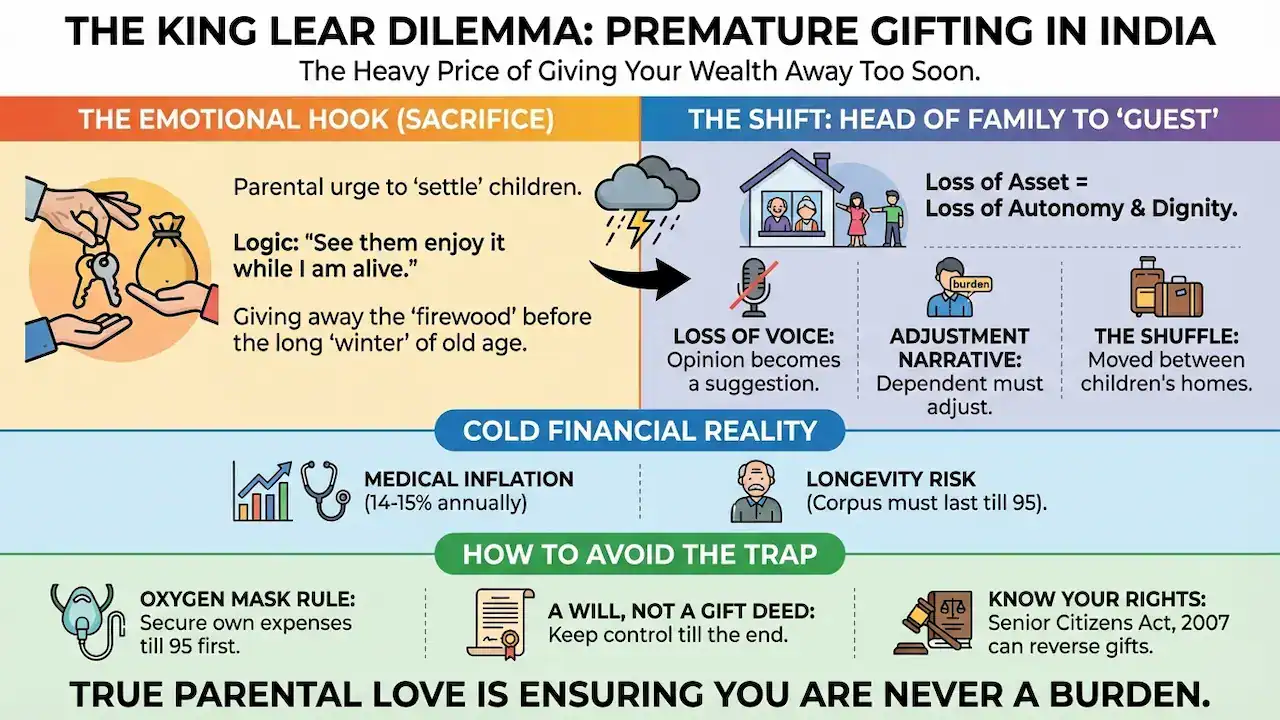
Indian parenting is defined by sacrifice. We wear frayed shirts so our kids can wear branded ones. We take buses so they can take Ubers to tuition. It is natural to feel that the final act of love is to hand over the keys to the house, the jewellery, and the investments while we are still alive.
The logic seems sound: It’s all theirs anyway. Why make them wait for courts and probate? Let me see them enjoy it while I am alive.
But there is a profound, dangerous difference between leaving an inheritance and giving a premature gift.
When you hand over your assets in your 60s or early 70s, you are forgetting one crucial thing: Winter is coming, and it might last 30 years.
By giving away your wealth too soon, you are giving away the firewood you need to keep yourself warm during the long, expensive winter of old age.
The Shift: From Head of the Family to Guest
Retirement money is not just currency for buying groceries; it is the currency of autonomy. It is leverage. It is dignity.
When you own the house, you are the host, even if your adult children live with you. When you transfer the deed to your son or daughter, the dynamic subtly, but brutally, shifts. You become a guest.
The transition is often slow and painful:
- The Loss of Voice: When you no longer control the finances, you lose your vote in household decisions. Whether it’s renovations, vacations, or daily menus, your opinion shifts from a directive to a mere suggestion, easily overruled.
- The Adjustment Narrative: If you live with your children, and friction arises, the expectation is that you—the dependent one—must adjust. You are told, Papa, times have changed, you don’t understand how things work now.
- The Shuffle: The most heartbreaking outcome is being shuffled between children’s homes—three months with the elder son, three months with the daughter. You become living luggage, tolerated rather than cherished.
The fear isn’t just about being treated cruelly. It’s about the loss of respect. It’s the humiliating realisation that without the weight of your wallet, your words carry no weight either.
The Cold Financial Reality
Emotions aside, premature gifting is often financial suicide in modern India.
- Medical Inflation: Healthcare inflation in India hovers around 14-15% annually. A surgery that costs ₹5 Lakhs today will cost over ₹20 Lakhs in 10 years. If you require 24/7 nursing care at age 85, the costs are astronomical. If you have already gifted your corpus, you are entirely dependent on your children’s willingness—and ability—to pay.
- Longevity Risk: We are living longer. Your retirement corpus needs to last until you are 90, not 75. Giving a chunk of it away at 65 to help your son buy a bigger flat is a massive gamble on your own future lifespan.
How to Avoid the King Lear Trap
Loving your children and protecting your dignity are not mutually exclusive.
- The Oxygen Mask Rule First
Airlines tell you to put on your own oxygen mask before helping others. Your retirement is that mask. Do not give away a single Rupee of your core corpus until you have secured your own medical and living expenses up to age 95, factoring in aggressive inflation.
- A Will, Not a Gift Deed
The best way to pass on wealth is through a clear, registered Will. A Will says, This is yours when I am gone. A Gift Deed says, This is yours right now. Keep control of the asset until the very end. It ensures that while you are alive, the roof over your head is yours.
- Know Your Rights (The Nuclear Option)
It is tragic that we need it, but India has the Maintenance and Welfare of Parents and Senior Citizens Act, 2007. If parents have gifted property on the condition that the children will care for them, and the children fail to do so, Senior Citizen Tribunals can actually reverse the gift and return the property to the parents. Knowing this exists is empowerment, even if you hope never to use it.
The Bottom Line
It is a harsh truth to swallow for an emotional Indian parent, but financial dependence on your children is not a retirement plan. It is a vulnerability.
True parental love is ensuring you are never a burden on your children. And the only way to ensure that is to keep a tight grip on your own security. Keep your kingdom. Your Lear-like sacrifice doesn’t guarantee their love; it only guarantees your own powerlessness.