A reader asks, “In your experience, what is the biggest mistake mutual fund investors make? Can you write an article about this?”
This can be answered in three words! Shiny Object syndrome – most mutual fund investors, suffer from this, which is their biggest mistake. The trailing one-year return is often the only factor an investor uses to choose a mutual fund.
Fear of missing out on that “shiny object” and the assumption that they would enjoy such huge returns in the (immediate) future (hot hand fallacy) is often a recipe for immediate or near-term frustration. This is (in my experience) the biggest mutual fund investing mistake.
I have seen this happen so many times, especially in the recent past: Quant Active Fund, Quant Small cap, PGIM Midcap, Technology Funds, Parag Parikh Flexicap, Nifty Next 50 (for which the cycle has turned!), Axis Midcap, Axis Small Cap, Axis Long Term Equity. We could go on and on. Even the recent interest in index funds results from such “analysis”.
The only reason these funds got “popular” is because of their near-term performance. Once the law of averages kicks in, the investor feels frustrated and moves on to the next shiny object. The existing units in the cold fund are left as is in the hope of future recovery, and future investments are shifted to the current hot fund.
🔥Secure your future with our Robo-advisory tool trusted by over 3,500 investors and advisors. From effortless retirement planning to funding your children’s biggest dreams, turn your financial goals into reality. 🔥
Subscribe for money management solutions via email! (Link takes you to our email sign-up form) Join 32,000+ readers in our community.
👉 New Tool Alert! NaviPlan: A Privacy-Focused Multi-asset Tracker and Goal Planner 👈
Thus begins a process of portfolio clutter and di-worsification, resembling an expensive total market index fund over the years! How we wish we could prove this speculated phase lag between mutual fund returns and “interest” in the fund as measured by the AUM growth!
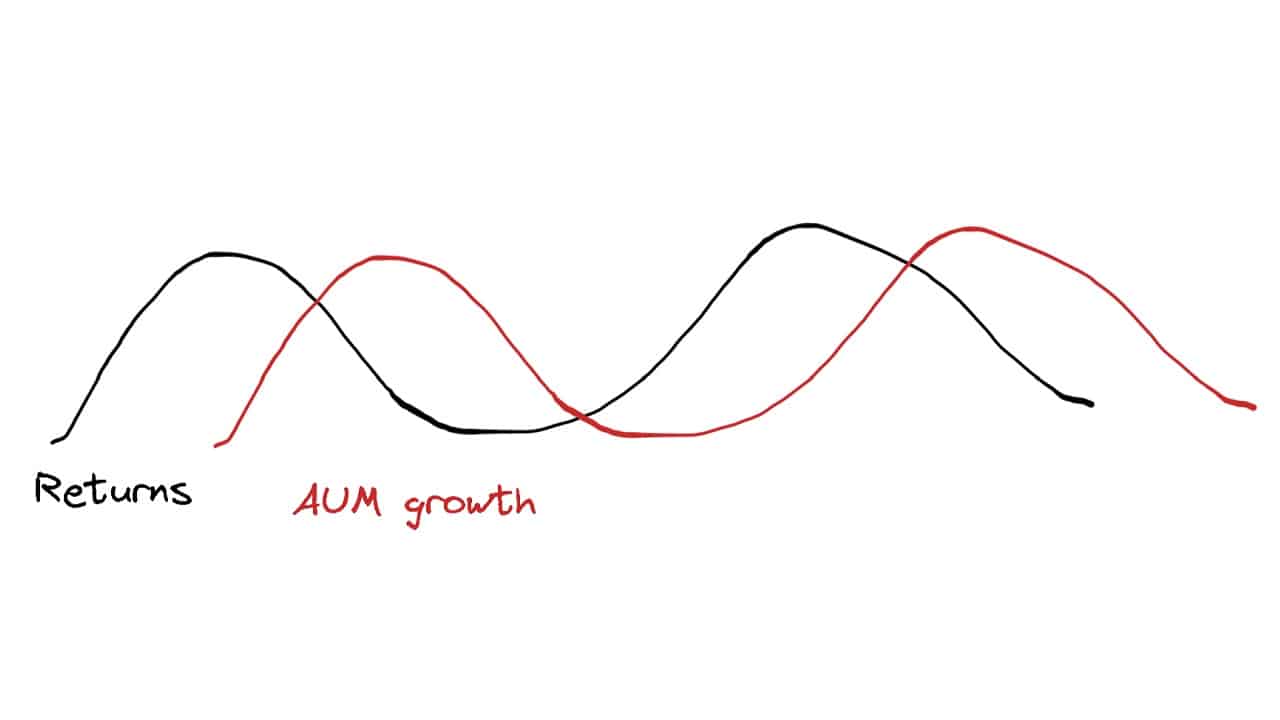
At freefincal, we have always maintained that (1) either opt for index mutual funds (not based on recent outperformance!) and achieve investing nirvana or (2) opt for active funds that have a reasonable performance consistency (neither too high nor too low) without attracting too much attention and be prepared for holding them through some ups and downs.
More often than not, any surge in performance means a downturn is around the corner. If we are enticed by the surge, we will be first to suffer from the downturn. As they say, it will be a case of bolting the barn door after the horse has left.