Last Updated on September 4, 2018 at 10:09 am
Perhaps, “what should be the role of a fund manager?” is a more appropriate question. In an interview to Cafemutual, Mirae assets fund manager, Neelesh Surana said,
“The challenging part (of being a fund manager) is the pressure of generating superior performance vis-à-vis markets and peers. The pressure of getting it right consistently is always there”. Cafemutual promptly headlined this as, “Fund managers have to generate superior performance vis-à-vis markets and peers”
Cafemutual promptly headlined this as, “Fund managers have to generate superior performance vis-à-vis markets and peers”!
I have no inside information about how an AMCs fund management team operates. Its targets and terms of references. Thank god, I don’t. Perhaps if I did, I will be a direct equity investor!
🔥Secure your future with our Robo-advisory tool trusted by over 3,500 investors and advisors. From effortless retirement planning to funding your children’s biggest dreams, turn your financial goals into reality. 🔥
Subscribe for money management solutions via email! (Link takes you to our email sign-up form) Join 32,000+ readers in our community.
👉 New Tool Alert! NaviPlan: A Privacy-Focused Multi-asset Tracker and Goal Planner 👈
The reason I write this is because I am disturbed by the fund managers indication that the management worries about peer performance.
If true, I think it is quite undesirable.
What is the role of an active mutual fund manager?
I think it is to beat the benchmark over a reasonable time frame on a risk-adjusted basis. That is it. In my opinion, peer comparison should be irrelevant to a fund management. Naturally, the top management is answerable to shareholders and will worry about what drives the business or what brings in the AUM (assets under management). Ideally they (or the sales department) should not pressurize the fund manager to change his/her strategy because of a drop in star rating. These are events that are hidden from public gaze.
Let us try and understand the role of a fund manager with an example: PPFAS Long Term Value Fund
The fund is classified by Value research as a Mid and Small Cap fund. It is however not a typical mid and small cap fund. It has decent exposure in international stocks, hedges currency risk. Can pretty much invest all investments classified as equity by the tax man!
See the full list and more detailed explanation of risk-adjusted return here
It is still too young to be rated by VR. When it is eligible I will surprised if it is rate high. Since the fund has a highly diversified portfolio, volatility is lower. So will the short-term returns be.
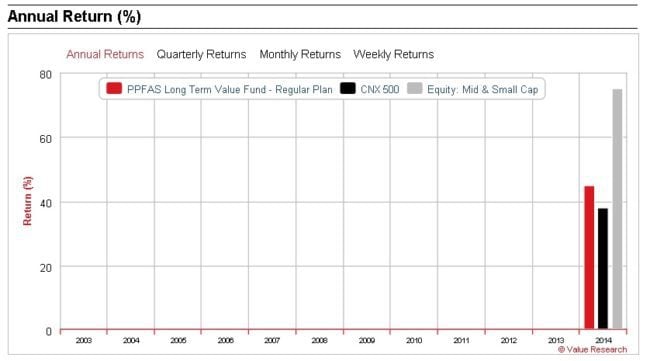
Notice that the fund beat its benchmark but lags behind the category average by a mile. Do you expect the fund to stick to its guns or change its strategy because it is not doing well among peers?
Who is VR to tell the AMC or the investor that PPFAS LTVF should be gauged among mid and small cap funds?
The other problem is that the peer group is not constant. Consider a 20+ year old fund like Franklin blue chip.
In 2003, it had 26 peers according to VR. In 2014, there were 76 peers. Should the fund manager worry about such an ever-increasing peer group? If they do, I wish I knew about it for I would rather be investing in stocks and managing my portfolio myself.
For the same reasons, peer comparison is as irrelevant for the investor as it is for fund managers.
What is the role of an active mutual fund investor?
I invest in a mutual fund because I expect the fund management to have a solid investment strategy based on fundamental principles. I expect them to stick to it rain or shine. I as an investor must cut them some slack and give them time to perform.
My job as an investor is to have a method, implement it asap and review it periodically. The criteria for portfolio review should be clearly set and adopted. See: How to review your mutual fund portfolio
Peer comparison has no place in this (except for initial short-listing). If I worry about the star ratings of my funds without analyzing my portfolio health, it would be like driving a car by looking at the side windows. There is no race or chase. We are undertaking an independent, individual journey.
While we are on the topic, let me quickly add that many investors have a habit of gauging fund performance looking at the returns listed in fund rating portals. This is a terrible mistake. The only thing that matters is the investors returns. For a volatile asset class, returns will depend on the duration chosen for the calculation.
Here a couple of graphs to illustrate “beat the benchmark over a reasonable time frame on a risk-adjusted basis”
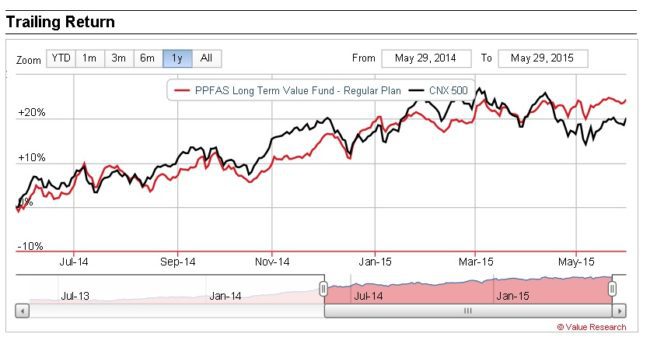
Source: VR online
In the last on year, PFFAS LTVF has not done well with respect to its benchmark CNX 500. That does not mean the fund management has done badly.
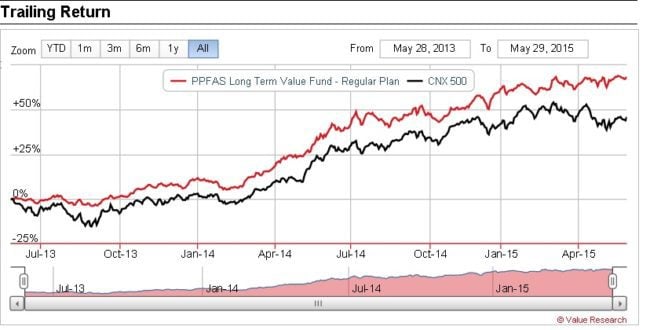
Since inception the fund has beat the benchmark with lower volatility (risk-adjusted basis). Notice that the NAV fluctuations are lower than the index fluctuation in certain time periods. This results in better downside protection, alpha, at much lower risk and investor stress.
Note: PPFAS LTVF has been randomly chosen for illustration. There many other funds which have accomplished this for longer periods of time.
###