A reader asks, ” My age is 37, and I have been investing for retirement for the last six years. Using a retirement calculator, I understand that portfolio real return % is essential in the calculation. I want to be on the safe side. So, what real return to consider for a 50-50 equity debt portfolio? And is 7 % a correct inflation assumption”
Most retirement calculators use a single input for investment returns. And many investors make the mistake of entering what they expect from equity, forgetting that the overall portfolio return after tax should be used.
Even if the calculator uses the real return* as input, we should not make the mistake of entering a nice positive value like 2%- 4% here, as that is unlikely.
* The real return = (1+portfolio return after tax) ÷ (1+InflationRate)-1
Why unlikely?
🔥Secure your future with our Robo-advisory tool trusted by over 3,500 investors and advisors. From effortless retirement planning to funding your children’s biggest dreams, turn your financial goals into reality. 🔥
Subscribe for money management solutions via email! (Link takes you to our email sign-up form) Join 32,000+ readers in our community.
👉 New Tool Alert! NaviPlan: A Privacy-Focused Multi-asset Tracker and Goal Planner 👈
- Equity returns decrease with time as the economy grows. Even today, expecting 12% from equity before tax is a touch high. We recommend expecting 10% before tax and 9% after tax.
- Fixed income returns also decrease with time for the same reason. After two decades, PPF (EPF) returns may hover close to or even less than 6% (7%).
- Yes, inflation is also expected to decrease. But there is a catch. Inflation on essential needs will decrease, but the key reason for an increase in expenses is lifestyle changes. So if we wish to maintain our current lifestyle (this variable must be reviewed each year), then inflation should be assumed to be reasonably high. Yes, 7% inflation is a reasonable estimate for frugal households! Those who spend more will have to assume 8%.
- After retirement, inflation can be lowered by about 1%.
So we have: (50% x 9%) + (50% x 7%) = 8% is the post-tax portfolio return expected for a 50-50 portfolio. Here we have generously assumed that a big chunk of the fixed income comes from EPF and PPF (tax-free fixed income).
So assuming 7% inflation, a real return of about 1% is reasonable today and perhaps over the next few years. Unfortunately, even if we assume these return expectations are unchanged until retirement, most of us cannot afford to hold on to 50% equity risk until retirement.
We have shown that reducing equity either continuously or step-wise before retirement is an effective way to combat sequences of returns risk. This variable asset allocation strategy is key to the functioning of the freefincal robo advisory template.
This is an example of a taper with a 60% equity and 8% inflation assumption (before retirement) and 6% after retirement.
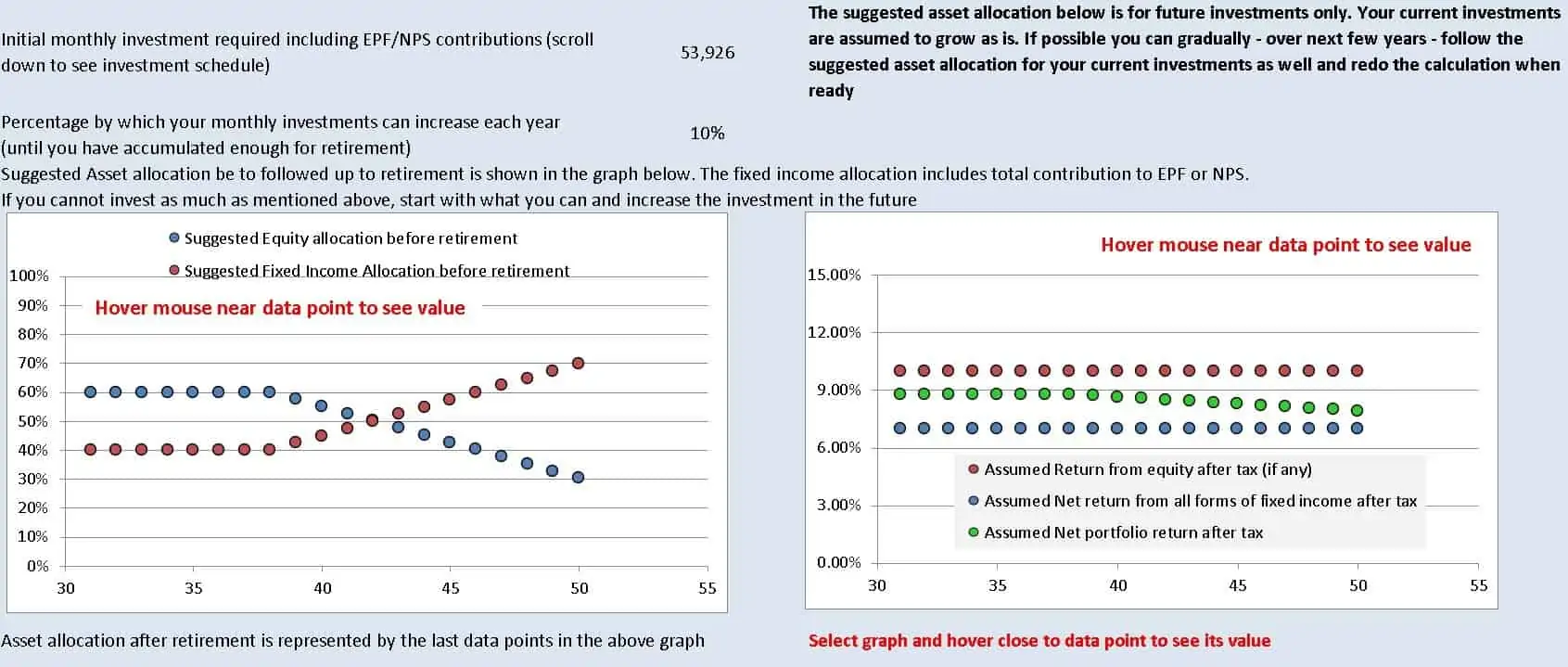
Notice how the portfolio return gradually reduces as the equity allocation is reduced. At the time of retirement, the real return is negative.
In summary, the real return will change with time due to changing asset class returns, inflation and asset allocation. A single value cannot be and should not be assumed. Among these, what we can control is asset allocation.
This is why we need to plan for a variable asset allocation (equity de-risking strategy or, equivalently, a variable real return strategy) as early as possible. In that case, we have a good chance of not falling short on investment. Otherwise, if the single real return assumption goes wrong, we cannot make up for it later. The time lost is lost forever.