In this edition of the fund profile, we take a look at the Kotak Short Term Bond Fund. We evaluate its portfolio history and discuss when it can be used.
According to SEBI, a Short Duration Fund is a fund that invests in debt & money market instruments with Macaulay duration of the portfolio between 1 year – 3 years. This is quite difficult for a retail investor to understand. So let us start the Macaulay duration.
What is a Macaulay Duration?
The Macaulay duration is defined as the amount of time it takes to recoup our investment.
Let us under this via an example. If the following discussion is a bit hard for you to understand, you can read the basics in this article: Why you need to worry about “duration” if your mutual funds invest in bonds (the following example is also from this article). Do not invest in debt mutual funds without understanding the risks! Download our free e-book: A Beginner’s Guide To Investing in Debt Mutual Funds
Suppose an Rs. 1000 bond was issued at a coupon rate (interest rate) of 8%. So Rs. 1000 is the original price of the bond and the interest payment each year is Rs. 80.
We wish to buy this bond and there are two more years for maturity. The current yield is 8% (same as the original rate) and therefore the current price is also Rs. 1000.
🔥Secure your future with our Robo-advisory tool trusted by over 3,500 investors and advisors. From effortless retirement planning to funding your children’s biggest dreams, turn your financial goals into reality. 🔥
Subscribe for money management solutions via email! (Link takes you to our email sign-up form) Join 32,000+ readers in our community.
👉 New Tool Alert! NaviPlan: A Privacy-Focused Multi-asset Tracker and Goal Planner 👈
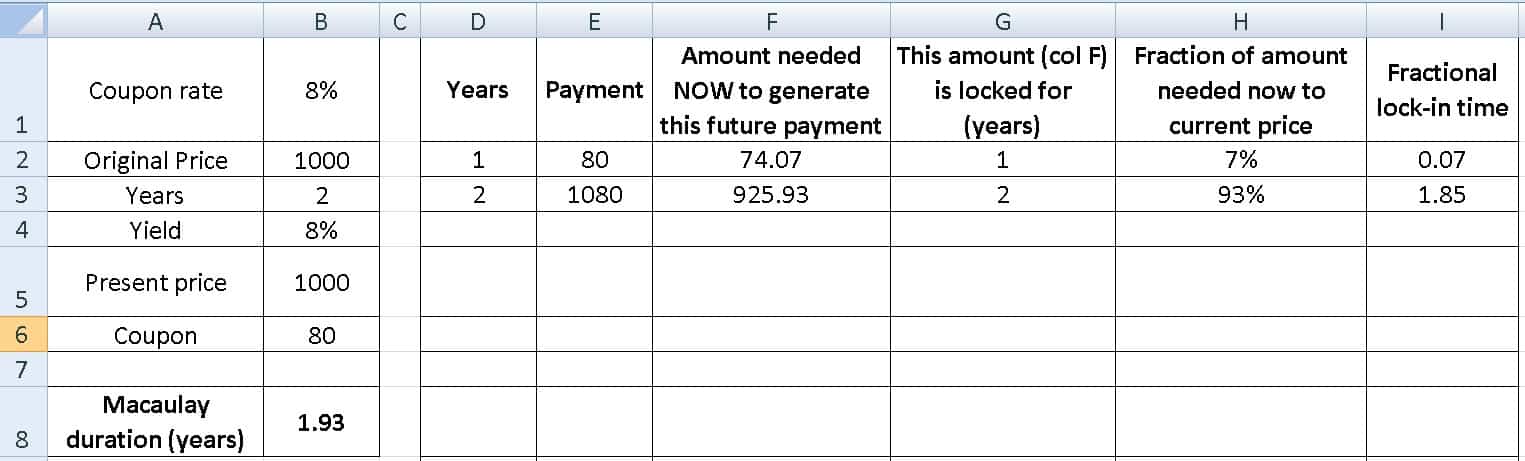
After 1Y, we will receive the interest of Rs. 80. After 2Y: Rs 80 + Rs. 1000 = Rs. 1080.
Now out of the Rs. 1000 we paid, say
Rs. X will become Rs. 80 after 1Y at the current yield of 8%. X = 80/(1+8%) = Rs. 74.07
Rs. y will become Rs. 1080 after 2Y at the current yield of 8%.
Y = 1080/(1+8%)^2 = Rs. 925.93
Rs. X + Rs. Y = Rs. 1000 = amount we paid to buy the bond.
Let us look at this in another way.
X/1000 of the original investment will be locked in for 1Y, or
Rs. (X/1000) x 1 Year = Fractional lock-in period of Rs. X = 0.07 years (see table below)
In other words, if Rs. 1000 is locked in for one year, how long should Rs. X be locked in for the same yield in investment:
This is (X/1000) x 1 Year = 0.07 years
Similarly, Y/1000 for the original investment will be locked in for 2Y, or
Rs. (Y/1000) x 2 years = Fraction lock-in period of Rs. Y. =1.85 years
Or, If Rs. 1000 is locked in for two years, how long should Rs. Y be locked for the same yield in investment:
This is (Y/1000) x 2 Years 1.85 years
Macaulay Duration = 0.07 + 1.85 = sum of fractional lock-in periods = 1.93 years.
That is, after 1.93 years, you would have effectively recouped your investment even though you will get your money back only after 2Y.
So Kotak Short Term Bond Fund should invest in such a way that its Macaulay Duration is between 1 to 3 years. This does not mean it will invest in bonds maturing within three years!!
The average maturity of the fund and its Macaulay duration(approximately computed using yield to maturity and modified duration data) is given below.
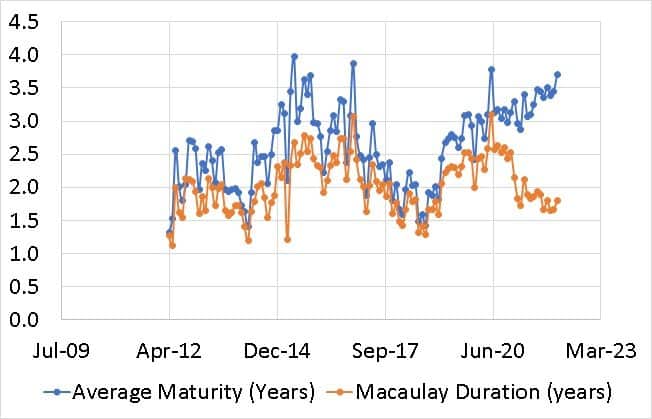
The Macaulay duration is as per SEBI’s definition for a short term bond fund but the average maturity is not (it need not be). The deviation in trend since June 2020 is due to a gradual increase in yields. Higher the yield, the lower the Macaulay duration. The same relationship also holds for the Modified duration but the change is stronger. To understand the importance of the modified duration, see Why you need to worry about “duration” if your mutual funds invest in bonds.
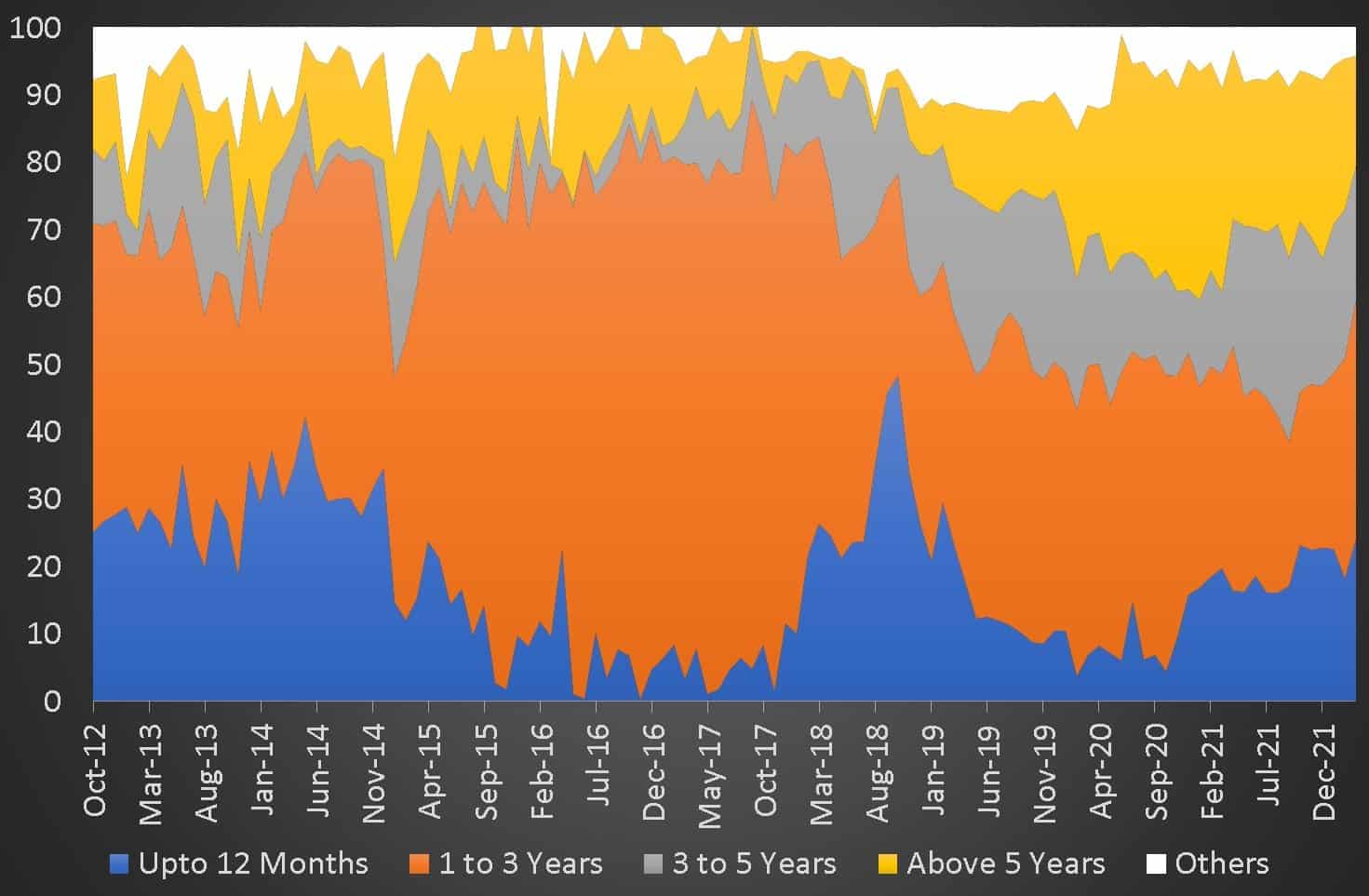
The historical portfolio maturity profile is shown below. There is some duration play. That is the fund has chosen longer-term bonds when interest rates have fallen.
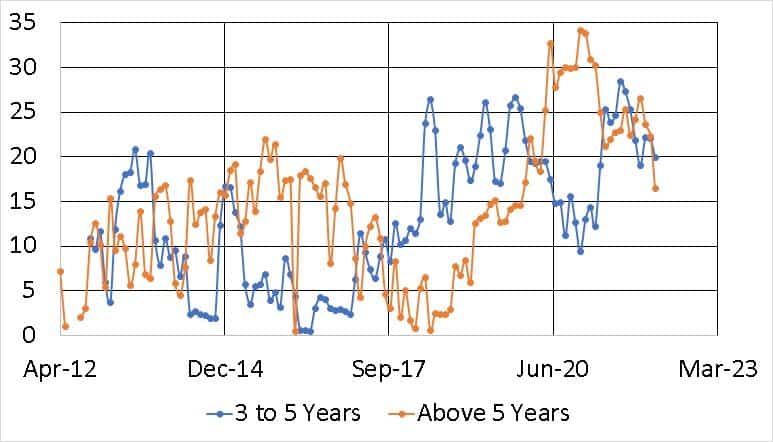
The variation >5Y bond exposure along with 3-5Y bond exposure is shown below better illustrating the duration play. The fund manager has already started to decrease >5Y bond exposure anticipating a rate increase. From 22% exposure in Feb 2022 to 16% in March 2022.
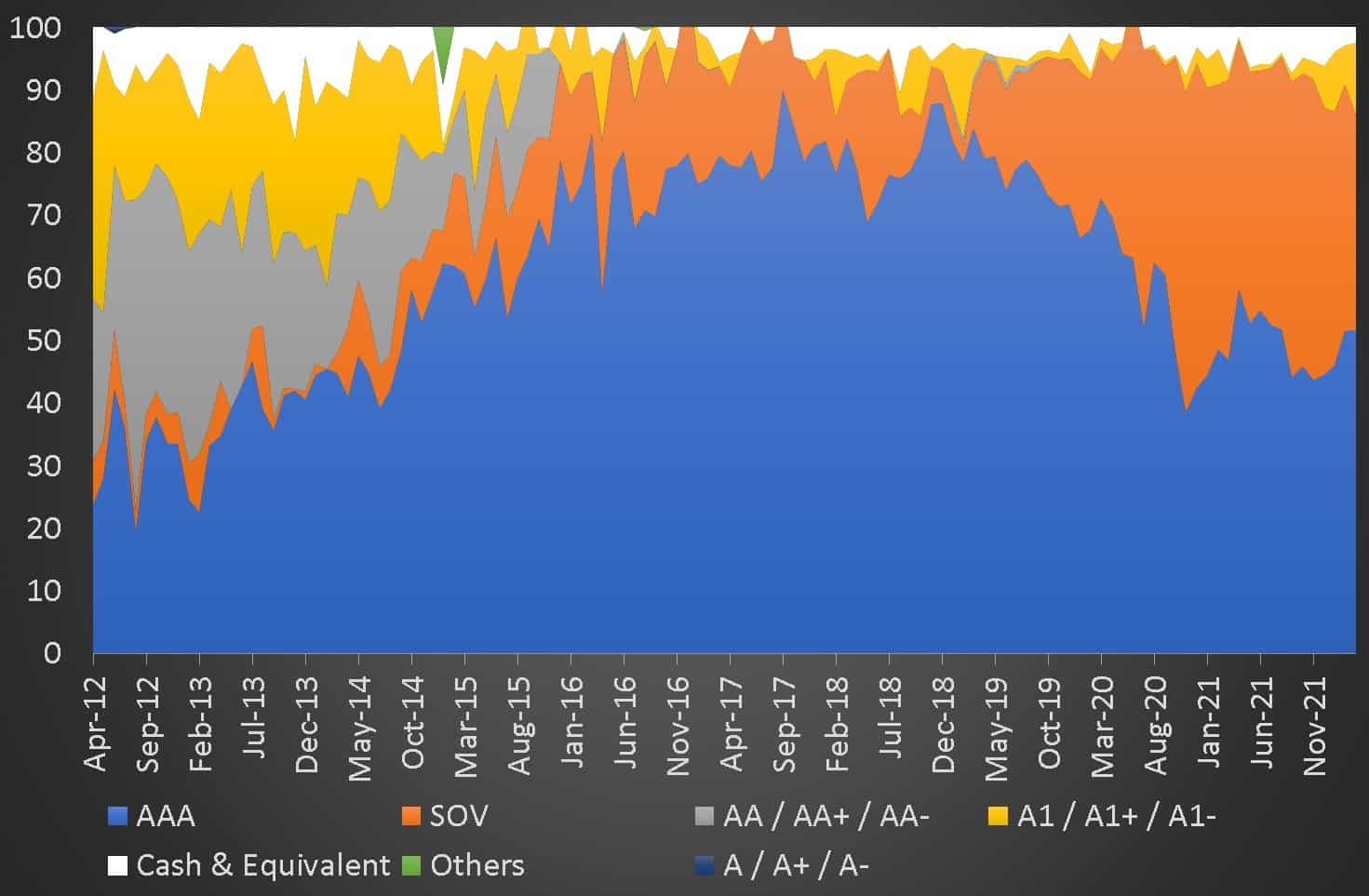
The credit rating history is shown below. The duration play mentioned above has been to increase gilts with falling rates. The fund has largely invested in high-quality debt. Will they chase after lower credit quality in future is unknown.
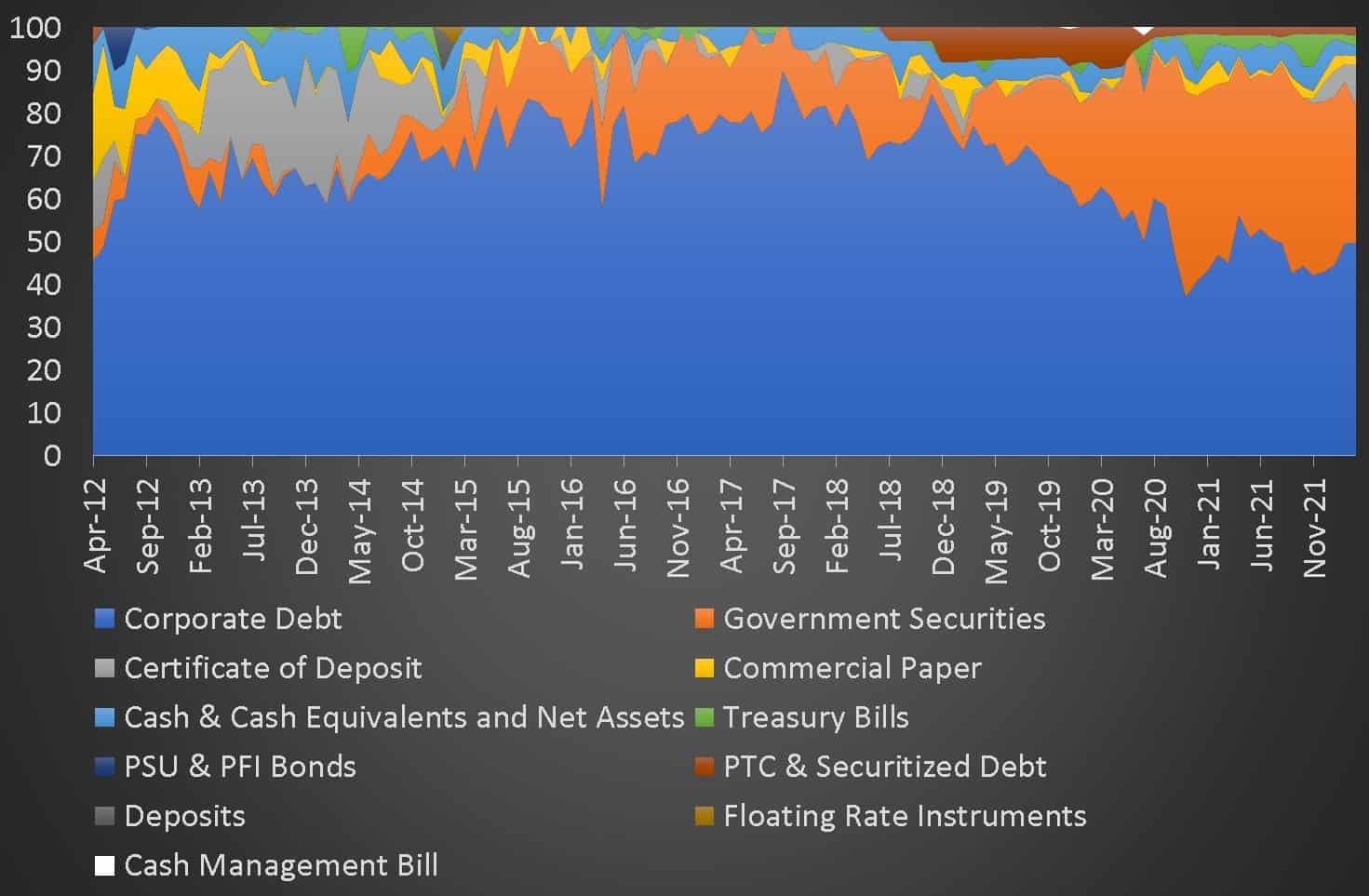
The asset type allocation is shown below.
The five-year rolling returns are shown below. The regular plan is chosen for a longer data set. The direct plan returns can be expected to be a bit better.
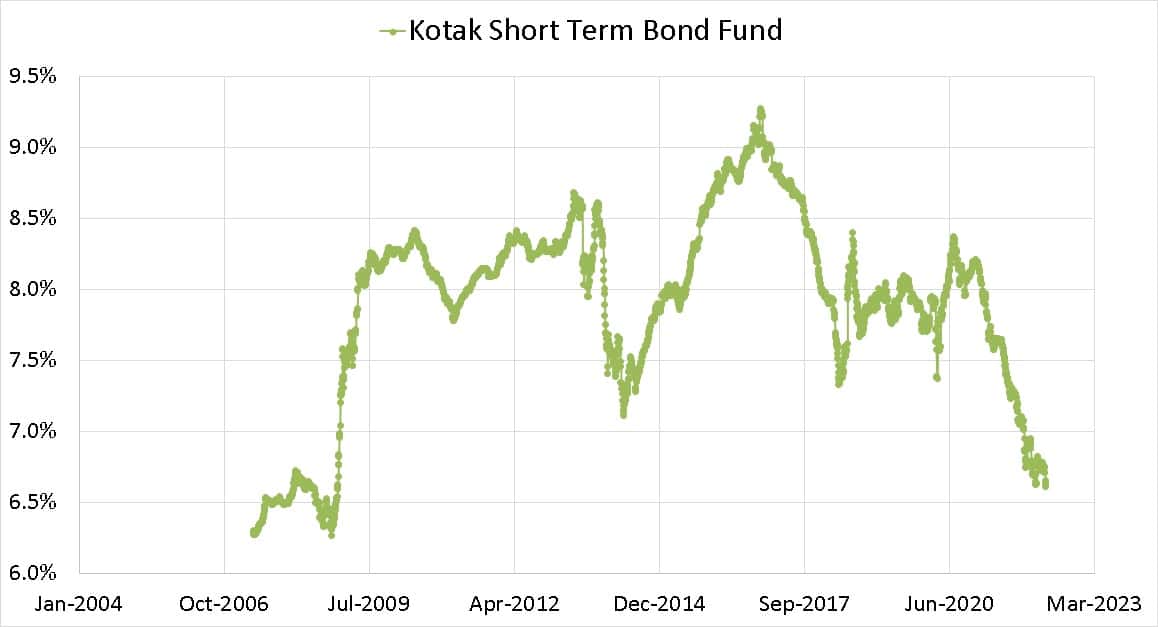
The return spread is quite large. There is no one return value one can expect from the fund. Only experienced investors who can handle debt fund volatility can consider using the fund for three to seven years.
The 10Y rolling returns data is limited and for what it is worth shown below.
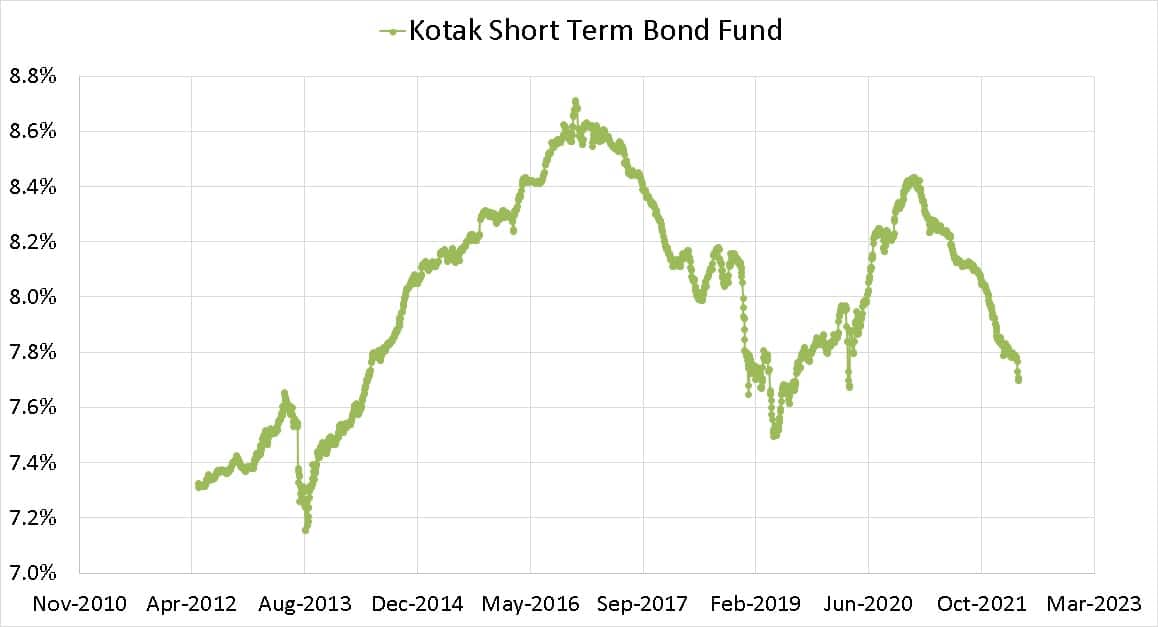
Can we use Kotak Short Term Bond Fund for short term goals? As mentioned above, unless you are an experienced debt fund investor, we do not recommend it for 7Y or less. It can be quite volatile ( in terms of possible returns) over that period.
Can we use Kotak Short Term Bond Fund for long term goals (> 7 Y)? Yes, but with the following caveats
- Do not get fixated on a particular return value. We do not know what the future brings and past performance is not indicative of future performance.
- Do not expect the fund to outperform gilt funds over the long term. The fund will be less volatile compared to a gilt fund but whether this results in higher returns or not depends on which portion of the rate cycle we are in while redeeming or reviewing.