Last Updated on February 3, 2024 at 8:11 am
Many who use our retirement calculators often are shocked to see the results. Some lose sleep, and some think the math is wrong. Eventually, many recover and start investing. See, for instance, this reader story: We lost sleep after using a retirement calculator! This is how we recovered. Here is a detailed explanation of the calculation.
Let us discuss a simple illustration of a retirement calculation to understand why the corpus required is so large.
Note: The assumptions made below, the inputs and the result of seven crores will vary from person to person. The calculation below was done a few years ago. While conservative even for that time, today, I am inclined to be more conservative so that I err on the side of caution. Not everyone will agree with us and would like to use values they like. This is precisely why our robo-advisory financial planning tool has no hidden calculation. The user can change all inputs and assumptions.
Any calculation requires inputs. For retirement, we require at least five inputs. This can be arranged in the following way.
🔥Secure your future with our Robo-advisory tool trusted by over 3,500 investors and advisors. From effortless retirement planning to funding your children’s biggest dreams, turn your financial goals into reality. 🔥
Subscribe for money management solutions via email! (Link takes you to our email sign-up form) Join 32,000+ readers in our community.
👉 New Tool Alert! NaviPlan: A Privacy-Focused Multi-asset Tracker and Goal Planner 👈
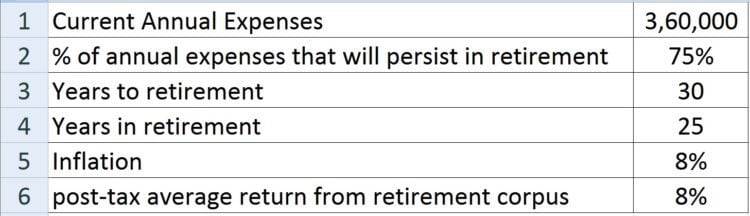
Suppose my current monthly expenses are 30,000. I would need Rs. 3,60,000 a year (excluding loans). Now, I assume I would need 75% of 3,60,000 if I were to retire today.
Sure, I can assume I would need only 50% or 25%, too, but since we do not know how the future will pan out, it is always a good idea to be conservative and not assume your expenses will decrease after retirement! Anyway, for the purpose of illustration, I will use 75%.
Years to retirement is 30. So I will retire 30 years from now. Similarly, years in retirement is 25. After 25 years, I better drop dead because our calculation assumes the retirement corpus will become zero.
Now, I assume 75% of 3,60,000 = 2,70,000 as my current expenses that would be factored into the retirement calculation.
We are assuming that this expenditure increases year upon year at 8%. So if the current year is 2016 and my age is 30 (I wish!), the expense will increase, as shown below, right up to retirement.
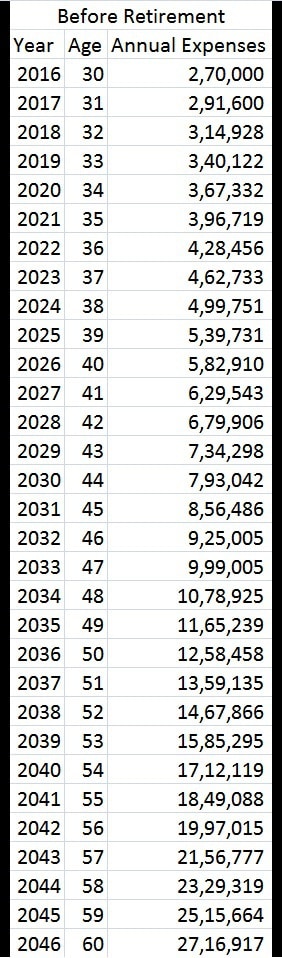
This increase in expenses is expected to continue after retirement. This key assumption is the source of all stress associated with a retirement calculation.
The expenses before retirement and after retirement are mapped side by side.
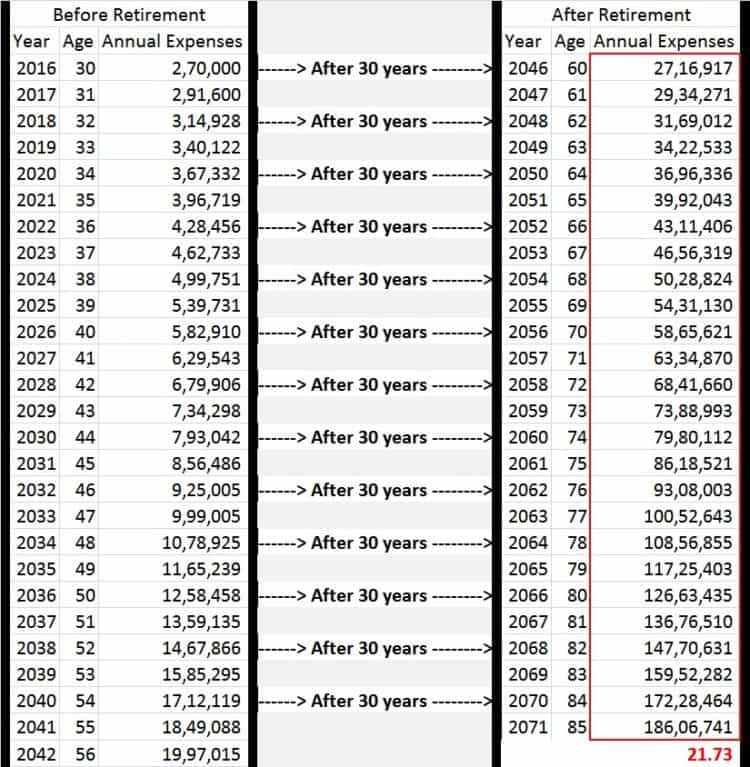
The —> After 30 years —-> applies to every row in the above table.
Suppose I retire in 2016 (when I first made the above table!), I will require 2,70,000 as the annual expense in the first year of retirement. However, I am going to retire 30 years later. Due to inflation, 2,70,000 will increase to 27,16,917 (~ 27 lakhs).
Similarly, the annual expense of 2,91,600 in 2017 will become ~ 29 Lakhs after 30 years in 2047, and so on, as shown above.
Now, notice the red rectangle. This represents the annual expenses in each year of retirement. This is an astounding 21.73 crores (indicated in red above).
If, after retirement, I do not intend to invest anything and keep the entire corpus at home (some under the carpet, some in pickle jars, etc.), then I would need 21.73 Crores to provide annual expenses for 25 years with the sum increasing at the rate of 8% each year.
However, this is silly. Of course, I would like to invest after retirement. Now, there are two ways I can consider this investment.
A: I only use the post-tax return from the entire portfolio. This is 8%, as assumed above. So, I invest the corpus in a portfolio which grows at 8% each year (at an average rate of 8%, to be precise, after tax!). While it grows, I will withdraw the amount I need as annual expenses at the start of each year. After 25 years, the amount will reduce to zero. This is the basic premise of most retirement calculators.
When such an assumption is made, the retirement corpus decreases considerably from 21 to about seven crores.
The key aspect of this discussion is to realise that retirement planning involves accounting for future expenses with inflation factored in. When pre- and post-retirement expenses are mapped side by side, we realise there is not much else to do (except to assume unrealistic inputs for more pleasing outputs).
Each month we invest for retirement, we are trying to provide for at least a month’s expenses (or less) in retirement.
B: Instead of using a single portfolio return, we can use a bucket Strategy. The associated calculator is here: Robo Advisory Software Tool: Build a complete financial plan!
Those interested can also check out these examples using the above tool:
- Retirement plan review: Am I on track to retire by 50?
- I am 30 and wish to retire by 50; how should I plan my investments?
Once the corpus is determined, the next step is to determine the monthly investment required for an average return assumption (post-tax) as in A (above, but before retirement) so that about seven crores is in hand after 30 years (in this example).
At a conservative 9% portfolio return after tax, about 40,000 is required as a monthly investment.
If one can increase the investment by 5% each year, only about 24,000 is required in the first year. And at a 10% increase, only 13,000 in the first year.
End of the day, we all invest what we can, but it is important to understand the impact of inflation. One should use a retirement planner each year to account for changes in one’s personal situation.