Last Updated on December 29, 2021 at 5:38 pm
Readers may recall that the Nifty/Sensex moved up since Feb 2018 (until the crash this year) while the rest of the market moved down. We had reported that this market imbalance/inhomogeneity lead to an all-time high return difference between Nifty 50 vs Nifty 50 Equal-weight indices in Dec 2019 and also pointed out that Market crash destroys two-year imbalance among Index stocks. Has this imbalance returned over the last month? If it continues, is it bad news for both active and passive equity mutual funds!
The imbalance between Nifty 50 and Nifty 50 Equal-weight movements had started to decrease months before the market crash in March but seems to have returned over the last month.
This can be best appreciated by looking at the two-year return difference between the Nifty 50 and the Nifty Next 50. The Nifty 50 is a market capitalization-weighted index. Since the distribution of market cap is not uniform, just a few stocks dominate the Nifty 50 index. Sensex, BSE 100, 200, Nifty Next 50, NIfty 100, 200 500 are all market-cap-weighted indices.
🔥Secure your future with our Robo-advisory tool trusted by over 3,500 investors and advisors. From effortless retirement planning to funding your children’s biggest dreams, turn your financial goals into reality. 🔥
Subscribe for money management solutions via email! (Link takes you to our email sign-up form) Join 32,000+ readers in our community.
👉 New Tool Alert! NaviPlan: A Privacy-Focused Multi-asset Tracker and Goal Planner 👈
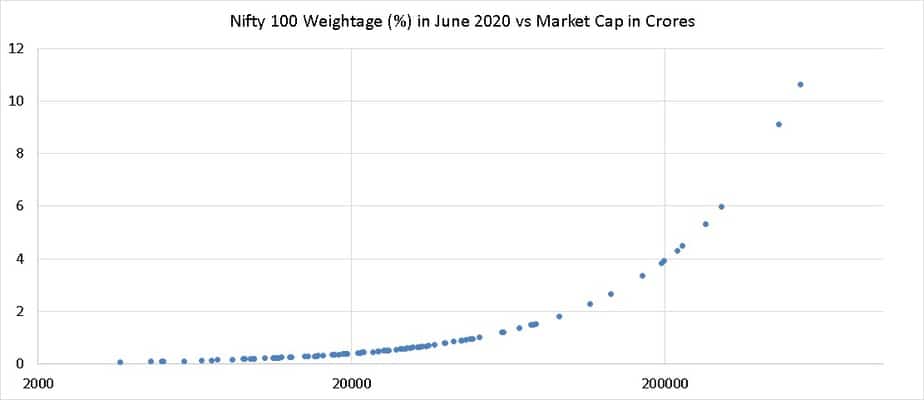
The top three stocks in the NIfty (June 2020) – Reliance Industries, HDFC Bank and HDFC – make up 30% of the 50 stock index! The top 5 stocks, 41.55%. The top ten stocks 62.69%. If these ten stocks move up, the Nifty will move up a bit even if the rest of the 40 stocks fall. This is even more dramatic in the Nifty 100. Just ten stocks account for 53.57% of the weight and only 11 stocks have a weight above 2% as seen below.
The Nifty 50 Equal Weight index has approximately equal weight for all stocks (there is a Nifty 100 Equal Weight index as well). Shown below is the T]two-year rolling return difference Nifty 50 Equal-Weight TRI and Nifty 50 TRI from June 1999.
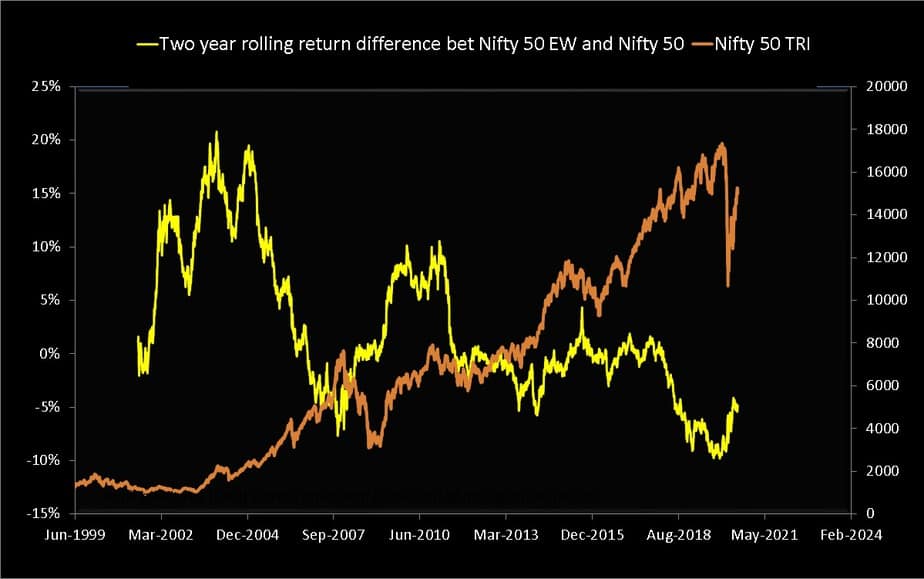
Notice how the Nifty 50 Equal-weight return minus NIfty 50 return fell to an all-time low just before the market crash. The crash corrected this, but if we take a closer look at the same graph, it is slipping back over the last month (white circle in the image below).
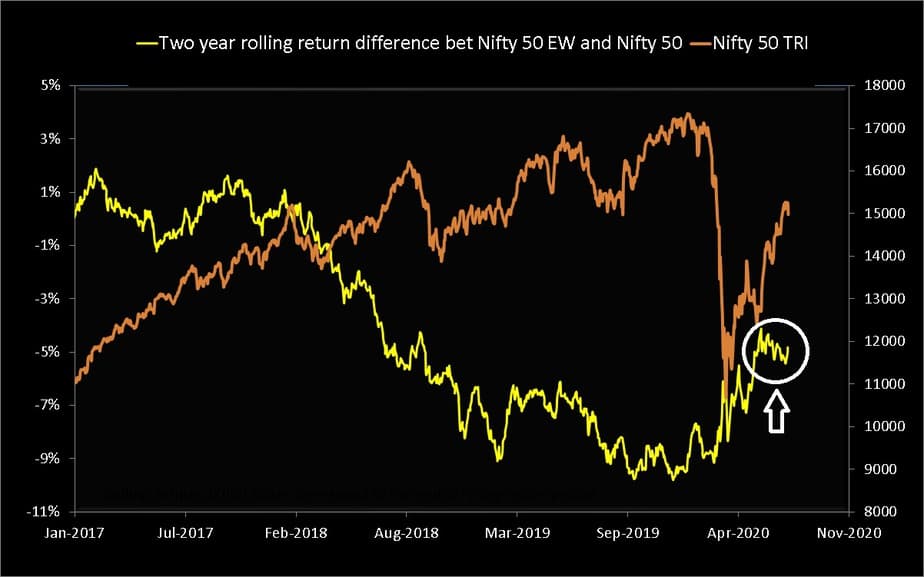
Notice how the return difference dropped below zero (N50 return > N50EW return) from Feb 2018 onwards. If we look at the full return difference graph, N50EW-N50 seems to be a reasonable indicator of market valuation. As the price moves up, this return difference seems to move down. Please note: I make no claim that this is a technically sound indicator, just making an interesting, almost uncanny observation.
I believe the reason this imbalance (N50 return > N50EW return) is the reason for the sudden interest in index funds*; is the reason why active fund managers visibly failed to beat the Nifty. When the imbalance is removed, the visible outperformance returns as seen in mid-May: after the market crash, 80% of active large cap funds outperform Nifty, Nifty 100.
An active fund manager who is not heavy on stocks that drive the NIfty/Sensex is likely to underperform. If they follow the NIfty or Sensex then we would be paying more for passive investing!
The stress on “visibility” is to denote that this is a casual observation. Even before this imbalance not more than 50% of funds in a category beat the index: Poor performance of active mutual funds: Is this a recent development? That said, this imbalance is bad news for index investors as well. Their returns hinge on just a handful of stocks and that cannot be good news. Active MFs have more money invested in these stocks than passive funds so there is need to worry about an “index bubble”
* An index investor choosing an index because it is making better returns than an active fund is doing so for the wrong reasons: Are Indian Investors ready to choose Index mutual funds or ETFs?. Also see: How to select an index fund (do you really need one?)
The last one and three month returns for the top ten Nifty stocks is shown below.
| Company | Weight in Nifty 50 | 1-Month Return | 3-Month Return(%) |
| Reliance Industries Ltd. | 12.45% | 16.06 | 56.54 |
| HDFC Bank Ltd. | 10.65% | 7.16 | 17.62 |
| Housing Development Finance Corpn. Ltd. | 7% | -0.13 | 8.14 |
| Infosys Ltd. | 3.21% | 20.07 | 30.37 |
| ICICI Bank Ltd. | 5% | 0.46 | 4.58 |
| Tata Consultancy Services Ltd. | 5.04% | 9.53 | 26.98 |
| Kotak Mahindra Bank Ltd. | 4.59% | 0.8 | 3.13 |
| Hindustan Unilever Ltd. | 4% | 7.97 | -3.04 |
| ITC Ltd. | 3.92% | 2.48 | 9.42 |
| Bharti Airtel Ltd. | 3.10% | 0.62 | 10.04 |
Reliance Industries Ltd. contributed to 45% of the Nifty’s last one month return and 55% of the last three month’s return. HDFC Bank 17% and 14% respectively over corresponding durations.
This is normal in a market-cap-weighted index but when the rest of the stocks do not move up as much then the imbalance is striking. We are slowly beginning to learn how the lockdown impacted businesses big and small. This will eventually slow down this “rally” if not bring the market crashing down again. Will this homogenise the market or make the imbalance worse? Only time will tell.
What should an investor do? Nothing, as there is not much one, can do. Index investors must be prepared for a phase (however brief) where they see ‘some’ large cap funds beat the index. This imbalance could be one reason why funds like Quantum Long Term Equity and ICICI Value Discovery are struggling over the last couple of years.
Does it make sense for investors to give these fund managers a bit more time or will this imbalance never correct? It becomes a tussle over the heart vs mind. If you recognise that buying the index is better than trying to be invested in the best/good funds then you can switch.