Last Updated on December 29, 2021 at 6:05 pm
ELSS mutual funds are often sold with an incorrect pitch: Since they are eligible for tax-saving under Section 80C, each fund unit is locked for three years from the date of purchase. AMCs and sales guys state ELSS mutual funds can offer better returns or lower risk because of this lock-in. This article explains why this is incorrect, and there is no data to support ELSS funds can provide better returns or lower risk.
If you visit MotialOswal MF’s website, you can see this image (fourth image in the slider). It says, “when your investments are locked, you need not worry about market volatility”.

Legally, it merely means there is no point worrying about volatility when your investment is locked from redemptions – because you cannot exit! What is the nominal meaning of the statement, and how would a typical investor interpret it?
At the very least, it means ELSS funds have a different volatility profile compared to other funds. Is this so? Do ELSS funds offer better returns, as some claim? Before we consider the data, let us think this through. Most ELSS funds are open-ended. That is, investors can freely invest and freely redeem units older than three years.
🔥Secure your future with our Robo-advisory tool trusted by over 3,500 investors and advisors. From effortless retirement planning to funding your children’s biggest dreams, turn your financial goals into reality. 🔥
Subscribe for money management solutions via email! (Link takes you to our email sign-up form) Join 32,000+ readers in our community.
👉 New Tool Alert! NaviPlan: A Privacy-Focused Multi-asset Tracker and Goal Planner 👈
Suppose an AMC introduces a new ELSS fund. There will be a two week NFO period, and the fund (if open-ended) will open for new subscriptions after a couple of weeks. There will be no outflow from the fund for the first three years due to the lock-in and only inflows.
After that, units invested by those in the NFO period or close to it would be free to redeem. As the fund grows older, the no of units eligible for redemption would keep increasing. After a while, there will be no practical difference between an ELSS fund and any other fund.
Below are the return spreads and volatility spread (standard deviation) of ELSS funds (blue) and other funds. Other funds here refer to large cap, large and mid cap, mid cap, small cap, index funds, value funds, contra funds, dividend yield funds and aggressive hybrid funds.
The horizontal axis is simply the fund count and has no significance. Please focus on the spread on the vertical axis. This shows the spread between the minimum return/volatility to the maximum return/volatility. The returns have been sorted in descending order.
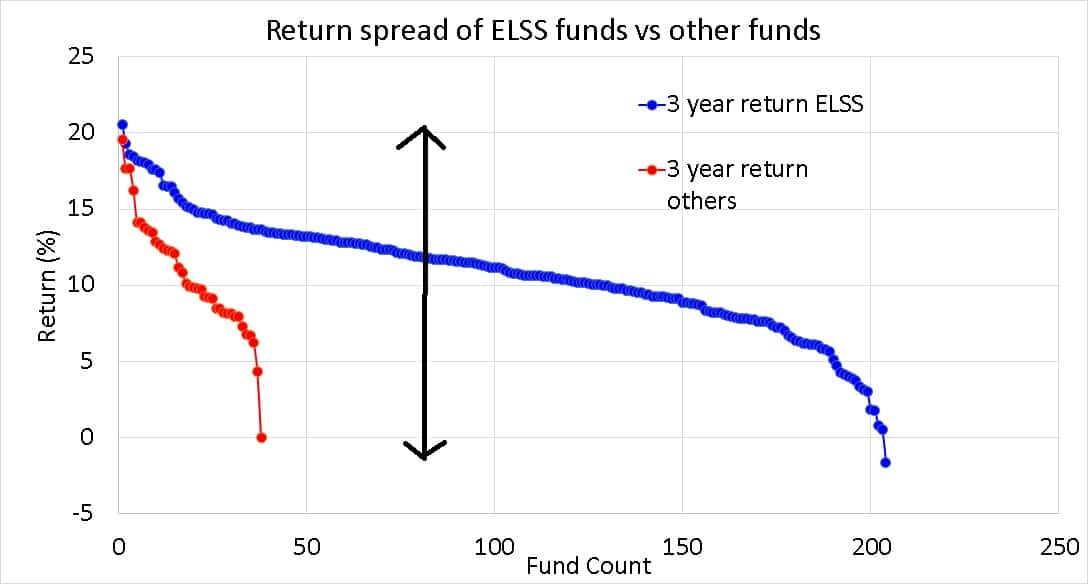

Notice there is practically no difference in the return spread or volatility spread of ELSS funds when compared with other diversified funds. The same information is presented below for three and eight years.
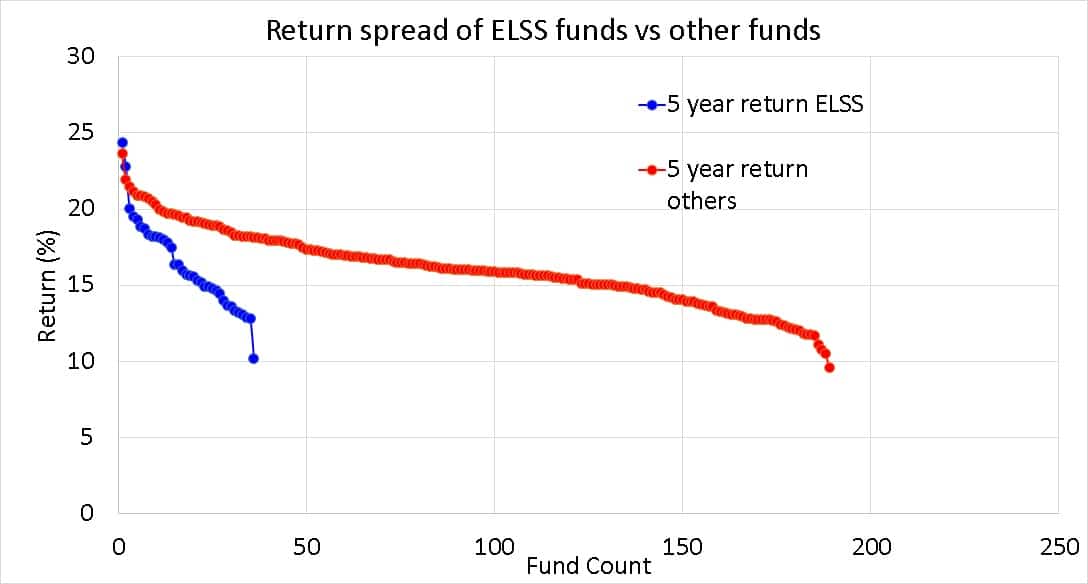
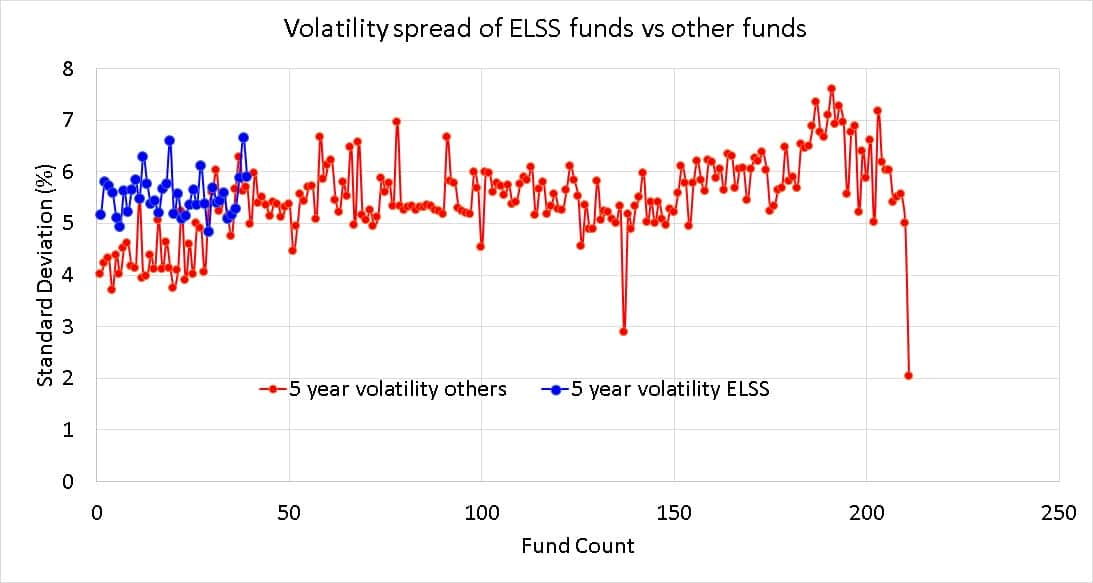
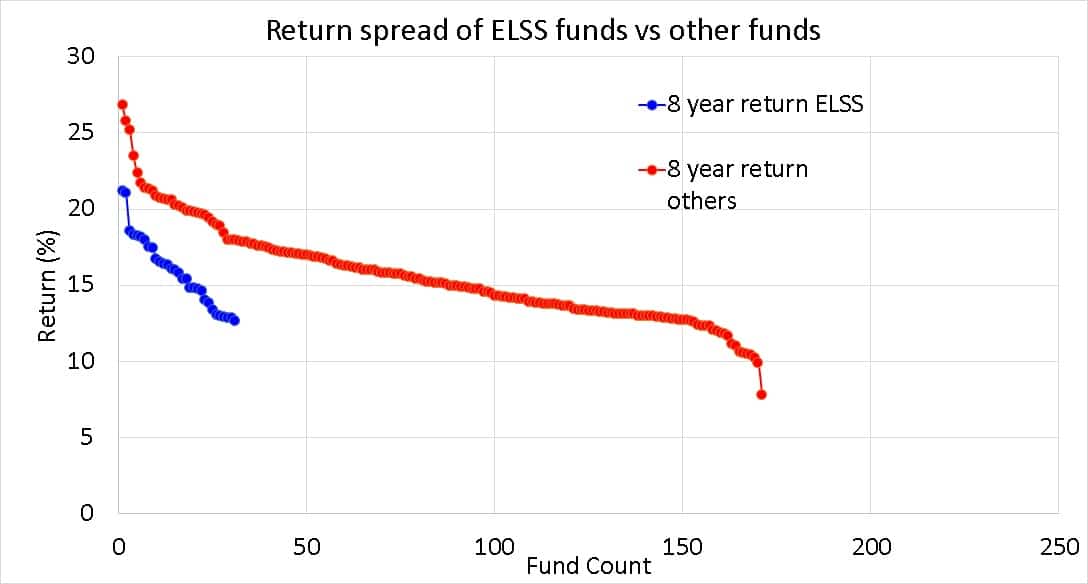

Conclusion: There is nothing special about the lock-in associated with ELSS funds. They offer just as much return or just as much risk as any other diversified funds. Use ELSS funds only if you need them! You can refer to our ELSS selection guides:
- How to choose an ELSS mutual fund for saving tax
- ELSS Mutual Funds: Seven Consistent Performers
- Five Interesting Facts about ELSS Mutual Funds