From time to time we keep pointing out that there is nothing special about a mutual fund SIP. It neither enhances returns nor reduces risk. It is merely an automated way of buying mutual fund units on the same day of each month. In response to our latest article and video on the topic – What return can I expect from a 10-year equity MF SIP? – a viewer asked, “will a step-up SIP fare better than a normal SIP?”
A step-up SIP is one in which the investor keeps increasing the monthly SIP amount each year. In the above-mentioned article, we had pointed out that 10-year returns from a standard or normal SIP (where the monthly investment is fixed for the entire tenure) fluctuate a lot.
If the market moves up, the 10Y SIP return (XIRR) moves up. If the market crashes, the return also crashes. This means, we can expect any return we want, but the market will give us what it likes. This is why our investment strategy should depend on a variable asset allocation.
So the effective question the viewer asked is, if we cannot expect a set return from a normal SIP, will a step-up SIP fare better? In other words will a step-up SIP beat the returns of a normal SIP?
When we see an illustration like this, it is quite tempting to assume a step-up SIP offers higher reward.
🔥Secure your future with our Robo-advisory tool trusted by over 3,500 investors and advisors. From effortless retirement planning to funding your children’s biggest dreams, turn your financial goals into reality. 🔥
Subscribe for money management solutions via email! (Link takes you to our email sign-up form) Join 32,000+ readers in our community.
👉 New Tool Alert! NaviPlan: A Privacy-Focused Multi-asset Tracker and Goal Planner 👈
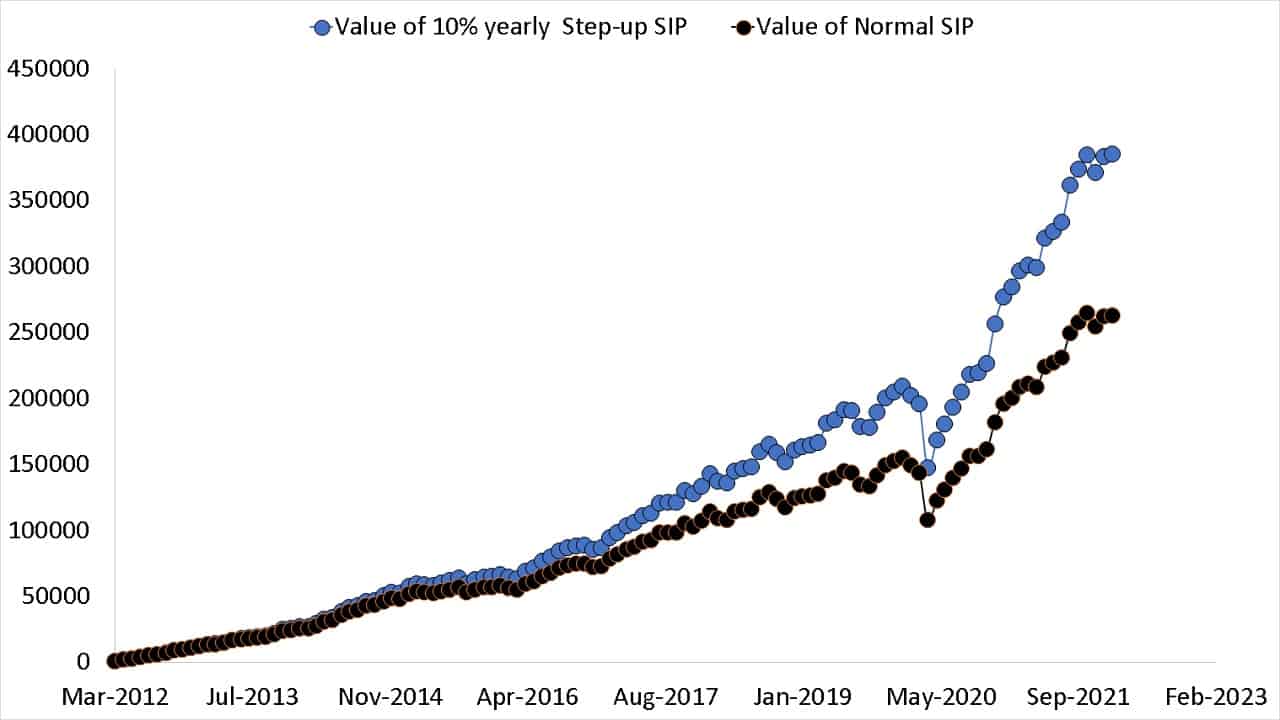
Well, it does offer a higher reward to the salesguys and AMCs who bang the drums, but does it result in a higher return, a more predictable return for the investor?
The simple, intuitive answer to this is, no. There will be no difference in returns (XIRR) between a normal SIP and step up SIP. To appreciate this, consider two friends A and B who buy a mutual fund. A invested Rs. 1000 and B invested Rs. 2000.
After a year, the mutual fund NAV increased by 10%. So the market value of A’s investment is Rs. 1100 and B’s is Rs. 2200. Did B get a higher return than A? Of course not. They both got the same return of 10%.
(2200-2000)/2000 = (1100-1000)/1000 = 10%.
Just because we put in more money, does not mean the return is higher. Of course, the corpus is higher but not the gain. The same logic applies to a step-up sip vs a normal sip.
Yes, it is an excellent idea to increase the monthly investment amount each year. In fact, it is essential to invest as much as possible to beat inflation. See: What is your investing growth rate? The corpus will be higher than a normal SIP with a fixed investment. However, the return will be the same!
Let us consider 153 10-year rolling SIP return (XIRR) values for the Nifty 50 TRI.
For example:
- From 01-07-1999 To 01-07-2009: 19.23% (19.38%). That is the Normal SIP return was 19.23% and the 10% a year step-up SIP return was 19.38%
- From 02-08-1999 To 03-08-2009 20.59% (20.87%)
- From 01-09-1999 To 01-09-2009 20.11% (20.29%)
- …..
- From 01-03-2012 To 23-02-2022 14.50% (14.79%)
This is the full comparison.
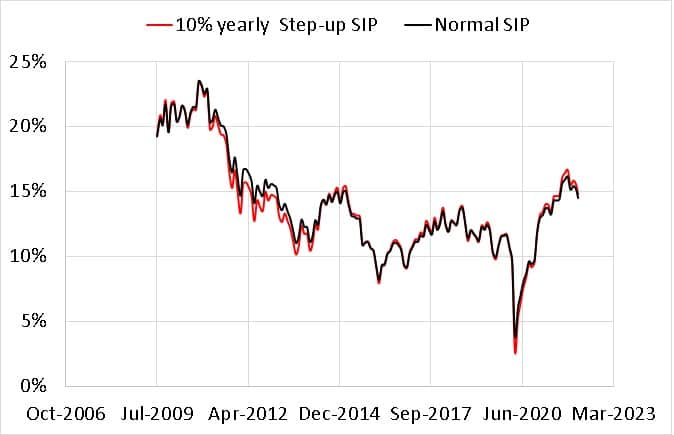
There is practical no difference in returns! The step-up return is just as unprecitable as the normal SIP return. It must be understood that XIRR is an estimation process (using Newton-Raphson method) and not a precise calculation. The small differences are likely due to this.
In summary, it is vital that investors increase their inevstment as much possible from one year to the next. However, a step-up SIP does not provide a higher investment return than a normal SIP. It only results in a higher corpus.