A reader wants to know, “I have just started a SIP in an equity mutual fund. I plan to continue this for 10 years. What return can I expect?”. The reader later clarified that he has no other investment planned for this goal.
The honest answer to “What return can I expect from a 10-year equity MF SIP?”, is “no idea”. We have discussed this at length before: Do not expect returns from mutual fund SIPs! Do this instead! Here is an updated graph relevant to the reader’s question.
Each dot in the graph below is a return from a 10-year SIP. Notice that it can just about be anything. If the markets crash, so do SIP returns. If the markets recover, so do SIP returns.
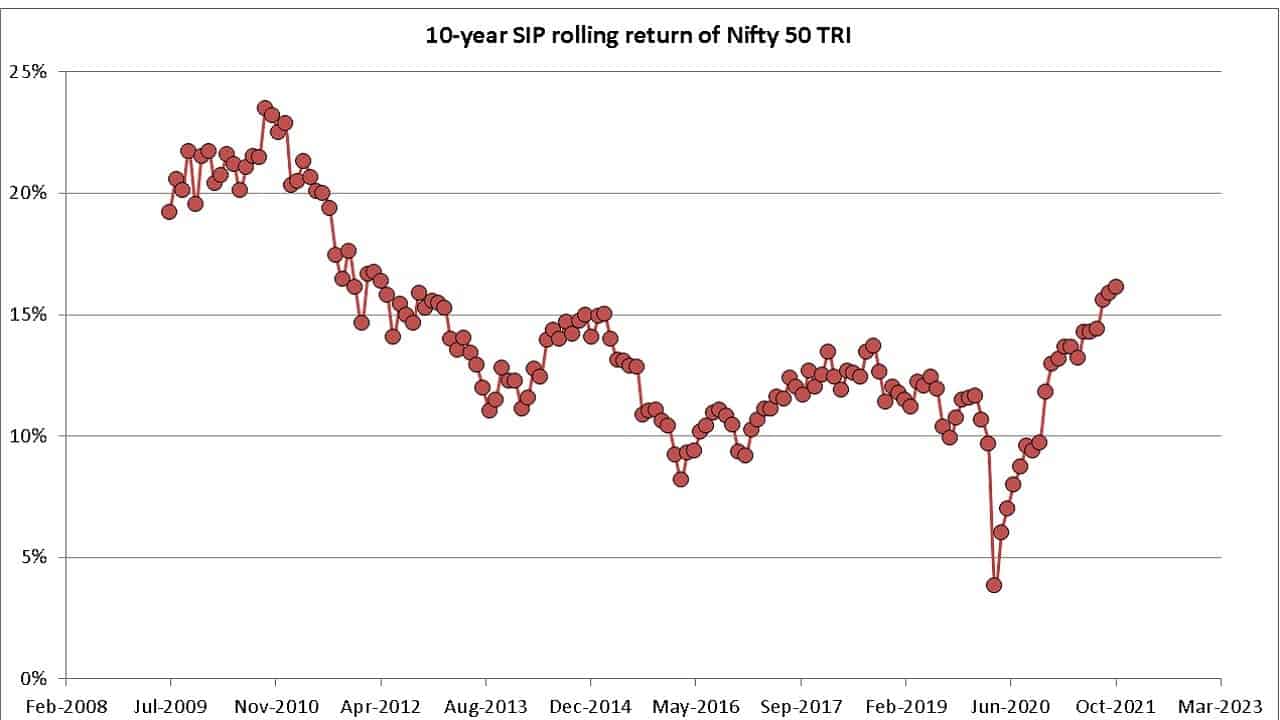
You can expect 10% or 12% or 15% but the market will give you what it wants.
So what is the solution?
So one cannot expect any return, but then what is the solution? First, let us clarify that a bit. One should not expect any return if the idea is to simply buy units and live in hope. As shown before – How to reduce risk in an investment portfolio, no matter what the sequence of returns is (which is the reason for the return variations), one can, with a clear asset allocation plan and stepwise reduction of equity can help us reach a target corpus.
🔥Secure your future with our Robo-advisory tool trusted by over 3,500 investors and advisors. From effortless retirement planning to funding your children’s biggest dreams, turn your financial goals into reality. 🔥
Subscribe for money management solutions via email! (Link takes you to our email sign-up form) Join 32,000+ readers in our community.
👉 New Tool Alert! NaviPlan: A Privacy-Focused Multi-asset Tracker and Goal Planner 👈
So the solution is to replace target return (= expectation) with a target corpus. This is possible only when we are clear about the purpose of the investment. You can use the Freefincal Robo Advisory Tool and create a concise plan for each goal.
Take the case of the 10-year goal. We can use 10% before tax or 9% after-tax returns from equity. However, we should not expect our portfolios to grow at that rate. First of all, 100% equity investment is a mistake. The risk is too high because the swing in the possible returns is too high.
The robo tool recommends an initial asset allocation of 30% equity and 70%. This might seem “too conservative” to many. However, by adding more equity we are only adding more risk, not more reward.
Also, a 10Y goal will not always remain a 10Y goal. Before you know it, there will only be 5-6Y left and in any case, the equity allocation has to be reduced. If at this time, the returns are poor, the overall portfolio return will be lower than expected and the time lost is lost forever (we cannot go back in time and invest more). See: Equity may beat inflation but that doesn’t mean you will!
So moderate equity exposure to begin with plus gradually tapering will greatly increase the chances of getting close to our target corpus with lower portfolio volatility. This is the asset allocation plan auto-generated by the robo tool.
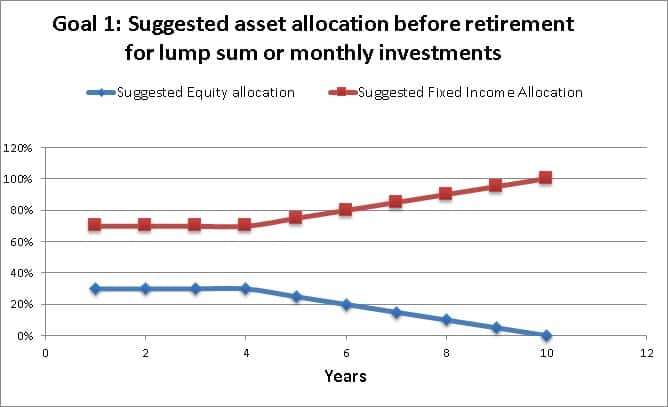
The main advantage with variable asset allocation is our focus shifts from some set return target to the target corpus. We don’t need to worry about news and events that affect market returns.
In summary, we recommend the reader first appreciate the importance of asset allocation and include a substantial amount of debt (fixed income) in the portfolio and then consider an equity de-risking plan as indicated above. To get started from scratch see: Basics of portfolio construction: A guide for beginners.