SEBI registered fee-only advisor Abhishek Kumar explains why we must check our KYC status and when it must be re-validated.
About the author: Abhishek is part of a freefincal’s curated list of fee-only financial advisors and a fee-only India member. His journey has been published earlier: Fee-only Advisor Abhishek Kumar’s tap dancing to financial freedom.
Most people who have been college students in their lives would have experienced a phenomenon where people delay things until right before the deadline. There is a word for that – Student Syndrome. In my college days, many students, including yours truly used even to miss the deadline. This phenomenon has also carried on in other aspects of life. We don’t even meet the deadline and then face the consequence of missing it.
The deadline for mutual fund (MF) investors to re-do their KYC if their KYC was not based on an officially valid document (OVD), which includes an Aadhaar card, passport, or voter ID card, among others, is over, and many MF investors are facing the brunt of missing the deadline. So, if you had completed your KYC using non-OVD, such as bank statements and utility bills, your KYC would no longer be valid after this deadline.
Why was SEBI asking to redo the KYC, and how does it affect your MF investments?
🔥Secure your future with our Robo-advisory tool trusted by over 3,500 investors and advisors. From effortless retirement planning to funding your children’s biggest dreams, turn your financial goals into reality. 🔥
Subscribe for money management solutions via email! (Link takes you to our email sign-up form) Join 32,000+ readers in our community.
👉 New Tool Alert! NaviPlan: A Privacy-Focused Multi-asset Tracker and Goal Planner 👈
SEBI issued a master circular on KYC norms for the security market (dated October 12, 2023). As part of the Prevention of Money-Laundering (Maintenance of Records) Rules, 2005, MF investors were asked to redo the KYC by March 31, 2024, if it was previously done using non-OVD. So, after the deadline, although one could continue with existing MF investments, one could not invest in new MF units through a new AMC or other intermediary. For a list of OVDs, refer to pages 9 to 11 of SEBI’s master circular on KYC.
The easiest way to do this is to go to www.cvlkra.com and click “KYC Inquiry” on the homepage. Afterwards, input your PAN number and complete the captcha. If you see the status under the column “KYC Status” as “KYC Validated,” then you are good. If you don’t see that specific status, you can also check which document was previously used to complete KYC under the “Address Proof” column, as shown below.
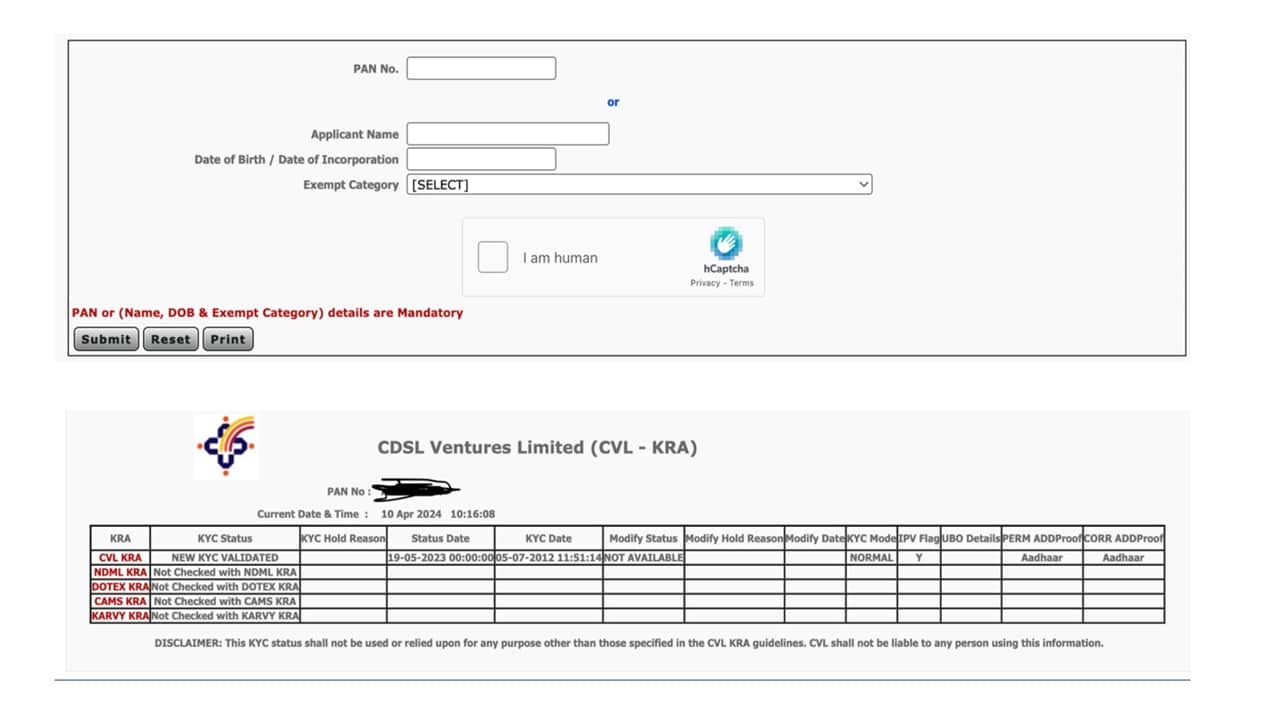
If the status says “KYC registered”, you can continue investing in your existing funds, but if you wish to buy a fund from a new AMC, you must do a fresh KYC with Aaadhar or any other approved OVD. If the status says, “KYC on hold” or “KYC rejected”, then a fresh KYC is needed for any transaction.
The difficult way to ascertain KYC status would be to call the respective asset management company (AMC) or registrar and transfer agents (RTA) helpline numbers. So, I suggest the former route unless you are the kind of person who would like the churn experience in reaching out to AMC or RTA representatives through their helpline.
How can you redo your KYC? One can do so by both offline and online processes. In the offline process, one must submit a physical KYC form (along with the OVD) either to one of the mutual fund houses or the RTAs such as CAMS or Kfintech. Afterwards, this information is passed on to the KYC registration agencies (KRAs) such as NDML, CVL, etc., and then the updated KYC is reflected across all MF investments made under that PAN across all AMCs.
Depending on the KYC status of the investor, re-KYC can be done online on the website of a few fund houses, such as UTI. Like in re-KYC done offline mode, the updated KYC will reflect in your MF investments across all AMCs. In both processes, ensure that your PAN and Aadhar are linked; otherwise, you will face a problem completing the process. Also, we have learned that some RTAs do not consider the driving license to be OVD, although SEBI’s master circular on KYC lists it as OVD. So, we advise you to complete it through Aadhar-based validation to avoid such issues.
So, if you missed the bus, now would be the time to come out of your inertia and complete the re-KYC process so that you don’t have an issue making new MF investments going forward due to the KYC issue.