In this article, we discuss simple tips to review your investment portfolio. Every portfolio requires a personalized benchmark for comparison. Our long-term goals, particularly the money required for these goals, form natural benchmarks for a portfolio review.
First, the basics should be in place before we start investing or immediately after:
- Emergency fund
- Life Insurance
- Health Insurance
- Determine the investment necessary for short-term and long-term goals. While short-term goals (< 5 years; < 10 years for newbies!) can be in 100% fixed income. Long-term goals (> 10 years away) would require an asset allocation of 50-60% equity and the rest in fixed income.
- Allocate money from your income for both short and long term goals. Typically, the target investment amount would be too high. Just start with whatever you can and see how it goes.
- Based on what you can invest, set up an investment schedule each month and then each year. Aim to increase the investment amount by at least 5%, preferably 10% each year.
Once these are in place, you can move on to an advanced step (before or during the first-year portfolio review).
You need to figure out how to reduce equity exposure for long-term goals. For goals other than retirement, this typically means reducing equity to zero. For retirement, if the corpus is adequate, about 20-30% equity is recommended (much lower if the corpus is lower).
So, from 50-60% equity, one must reduce it to zero or 20-30%. Contrary to what people “recommend, ” this reduction must be gradual -either linear or step-wise – well before the goal deadline. We have established this after hours of backtesting, as explained in our goal-based portfolio management course and implemented it as an automatic output in our robo-advisory tool. Here is an example output from the robo tool.
🔥Secure your future with our Robo-advisory tool trusted by over 3,500 investors and advisors. From effortless retirement planning to funding your children’s biggest dreams, turn your financial goals into reality. 🔥
Subscribe for money management solutions via email! (Link takes you to our email sign-up form) Join 32,000+ readers in our community.
👉 New Tool Alert! NaviPlan: A Privacy-Focused Multi-asset Tracker and Goal Planner 👈
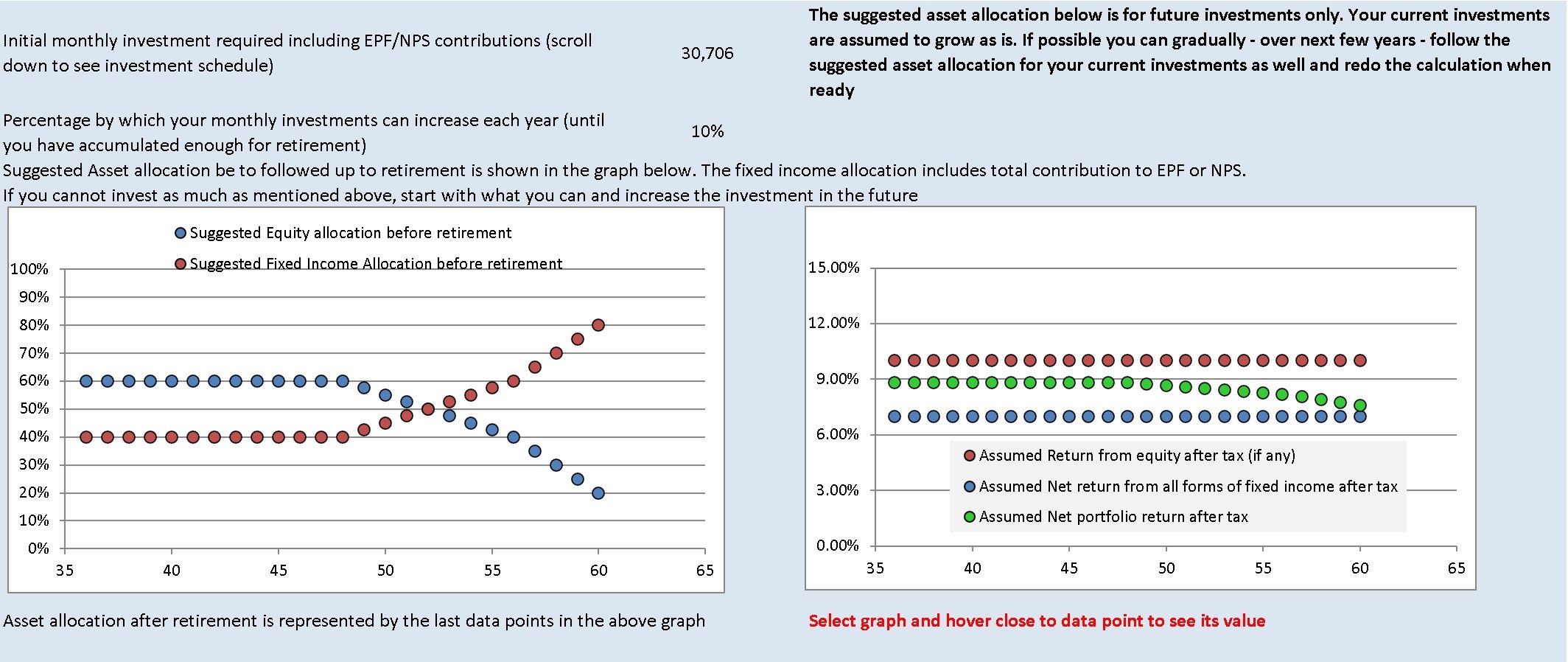
So, this equity reduction schedule must be in place as soon as possible. Why? As you reduce equity exposure, the portfolio return will also gradually decrease. So you have to compensate for this by investing the right amount as early as possible. You can also DIY this asset allocation schedule with our portfolio review spreadsheet.
Now, we are ready for the portfolio review. The following questions must be answered once a year, and necessary action must be taken where applicable.
- Did you invest as per your investment schedule over the last 12 months? If not, keep track of how many months you fell behind and aim to make up for it later.
- How much will you increase your investments in the forthcoming 12 months? You can check if you did in the next review.
- Is it time to change your asset allocation as per the above-mentioned de-risking strategy? If yes, plan for it ASAP.
- If not, is it time for a portfolio reset? That is, a portfolio rebalance? You can do this if your equity or fixed-income asset allocation has deviated above or below the target asset allocation by 5%. To understand the basics, see Portfolio Rebalancing: We answer frequent questions investors worry about (part 1)
- Then, find out how much is your current portfolio worth today. If you retire today, how long would the corpus last? If you were to spend for your goal today, how far behind are you?
- Then (and only then), look at the individual instruments and check if they are doing okay. If you choose index funds, then there is nothing to do. If you have stocks or active funds, you will have to take a call (after allowing a reasonable time and considering market conditions) on whether you need to buy more, sell or hold on to them without further investments. Yes, this is tricky, as it can be arbitrary, but if you get all the other steps right, this last one is not as important.