A 35-year-old reader asks: “I would like to get Rs. one lakh a month pension when I retire. How should I invest to achieve this?” A pension after retirement is a necessary component of a post-retirement investment portfolio. However, it is not sufficient.
Nothing beats the comfort and security of a guaranteed pension payout each month. However, as discussed earlier – Why have we not seen a retirement crisis in India? – retirees from our parent’s generation manage their lives by reducing their needs and depending on their children. This happens so gradually within the fungibility of common family income that it is hard to spot.
A 35-year-old has about twenty years of gainful employment left. Rs. one lakh a month pension may seem huge to many, but it is an emotional measure based on current income. Just as one assumes, one crore term insurance is ‘large enough’ without detailed calculation.
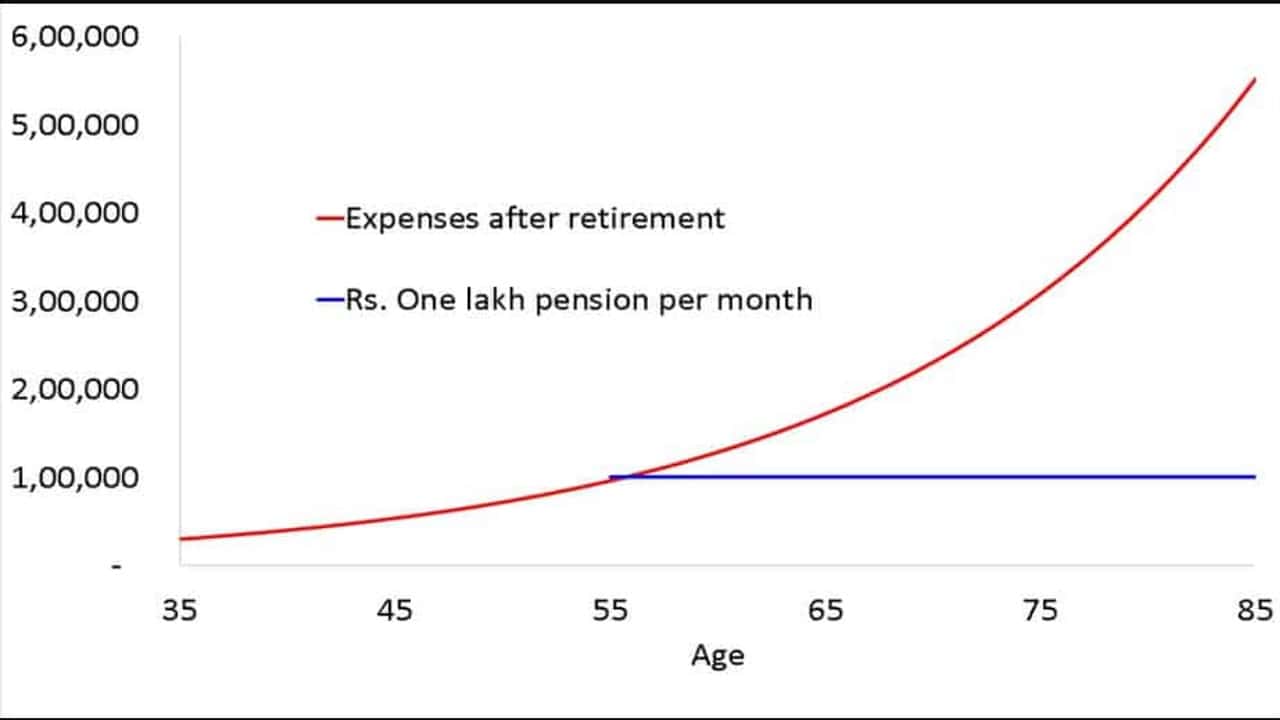
Suppose Praksh’s essential expenses today are about Rs. 30,000. At 6% a year inflation, at age 55, those expenses would have grown to Rs. 96,000. ‘Those’ is highlighted because this calculation must be repeated yearly with current essential expenses. Essential here refers to expenses likely to last the person’s lifetime.
Now let us assume the reader has enough corpus to generate Rs. one lakh a month pension. She buys a pension annuity from a life insurer and some govt bonds that pay out interest every six months.
🔥Secure your future with our Robo-advisory tool trusted by over 3,500 investors and advisors. From effortless retirement planning to funding your children’s biggest dreams, turn your financial goals into reality. 🔥
Subscribe for money management solutions via email! (Link takes you to our email sign-up form) Join 32,000+ readers in our community.
👉 New Tool Alert! NaviPlan: A Privacy-Focused Multi-asset Tracker and Goal Planner 👈
Suppose her total annual income is such that she gets Rs. 12 lakhs a year or one lakh a month after tax. This is how the pension would fare against a projection of her expenses from age 55 to 85 (approximate life expectancy).
The problem of settling for a constant seemingly “high pension” of Rs. one lakh a month should be immediately clear from the above illustration, which excludes additional expenses from age 35 to age 85.
However, as shown before, a constant pension source in retirement is always welcome as it aids the emotional well-being of the retiree. See: Creating the “ideal” retirement plan with income flooring!
Before it becomes too late, the reader should appreciate that this constant pension should only be one component of her retirement basket (a term used by PV Subramanyam). After twenty years, annuity and bond rates are likely to be significantly lower. So, assuming a rate of 5.5%, a pre-tax income of Rs. 14 lakhs a year requires Rs. 2.5 crores (approximately). So even to get a pension, which is grossly inadequate, a person needs to be a “multi-crorepati”.
To compensate for the gap between expenses and pension, the readers need approximately Rs. 2 crores (approximately), assuming this money grows at a post-tax income of 7% after retirement.
Notice the number of assumptions being made in every sentence. The only way to keep these as close to reality as possible is to re-do this calculation with new inputs like current expenses, current rates, etc, every year.
If the reader achieves a portfolio return of 9-10% after-tax over the next 20 years, she would need to invest Rs. 35,000 to Rs. 40,000 a month, increasing 6% a year to get close to the 4 to 4.5 Crore mark!! Recognise current expenses that will persist for life are Rs. 30,000 a month!
Even with a portfolio of 50-60% equity (to achieve the 9-10% return), a sum more than expenses has to be allocated for financial independence after retirement.
Key Takeaways:
- One lakh is just a number. It means nothing if we do not factor in inflation.
- Pension is just one component of a retirement plan, but an important one.
- Inflation after retirement is a crucial factor.
- We need to take on investment risk when we are young and not look for the safety of fixed income to combat inflation.
- Even if we take on investment risk, we must invest at least as much as we spend for retirement.
- Think thrice before adding any new expense because it will lower your investment.
- Avoid debt as much as possible or postpone essential debt like a home loan until basic financial goal planning is in place and at least 30% of your salary is allocated to investing even while servicing the loan.
- Plan for these additional income sources today! See: Passive income is a crucial part of your retirement plan: How to get started.