The 4% withdrawal rule for retirement planning assumes excessive equity allocation (50-75%), which makes it impractical. To make this worse, the 4% rule is often misunderstood and misapplied, so it is not a useful tool for retirement planning for most people. Here is an alternative idea.
What is a safe withdrawal rate? The safe withdrawal rate is the annual withdrawal amount divided by the available retirement corpus in the first year of retirement. How is this connected to the 4% rule? What is “safe” about this withdrawal rate?
Assuming you retire with a corpus of INR 1 crore and invest it in yielding an overall annual after-tax return of 7%, this may seem like a straightforward retirement plan. However, it is important to note that this approach is simplistic and potentially risky. Additionally, factoring in an annual inflation rate of 7%, your expenses are expected to increase by the same percentage each year without accounting for any sudden increases.
So, one crore is invested, and you withdraw an amount equal to current annual expenses each year. Let us assume your expenses in the first year of retirement are Rs. 4 lakhs.
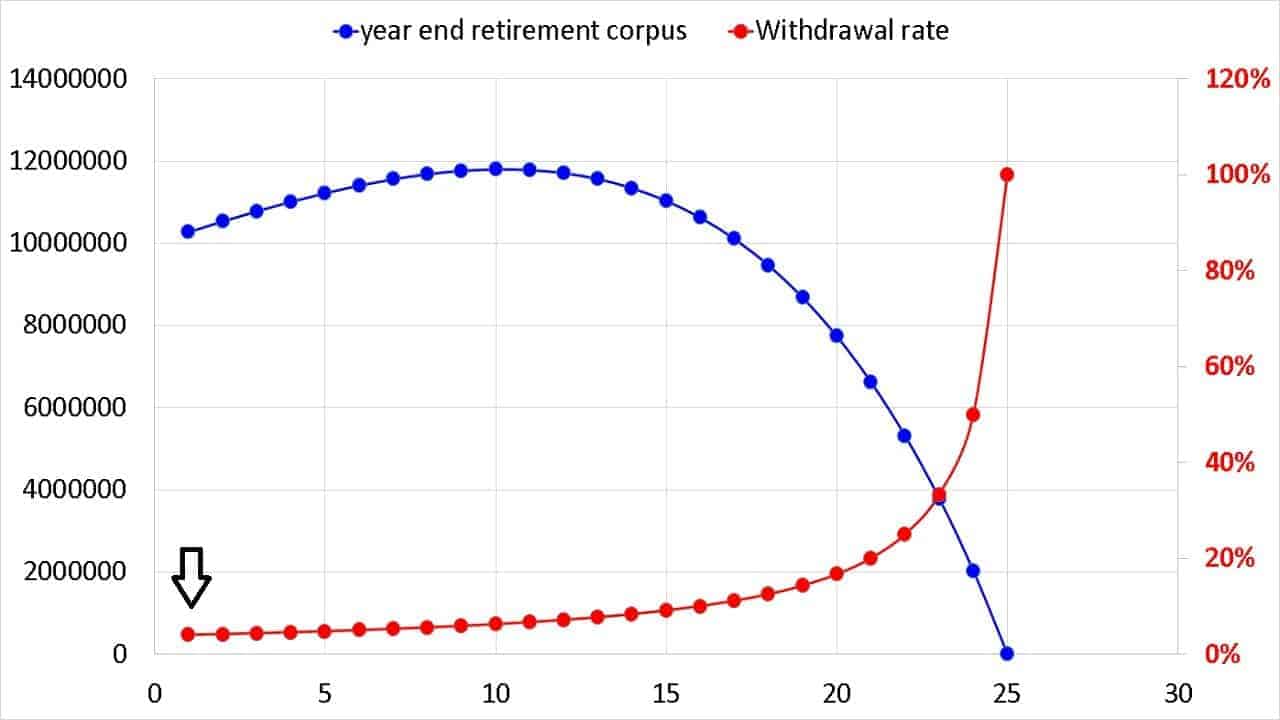
The initial withdrawal rate is 4 lakh divided by one crore = 4%. This is the same 4% association with the 4% rule. The withdrawal rate in the first year of retirement is 4%. In the second year, the expenses are Rs. 4.28 lakh (7% inflation), the corpus has grown by 7% to Rs. 1.0272 Crores (Rs. 102.72 lakhs).
🔥Secure your future with our Robo-advisory tool trusted by over 3,500 investors and advisors. From effortless retirement planning to funding your children’s biggest dreams, turn your financial goals into reality. 🔥
Subscribe for money management solutions via email! (Link takes you to our email sign-up form) Join 32,000+ readers in our community.
👉 New Tool Alert! NaviPlan: A Privacy-Focused Multi-asset Tracker and Goal Planner 👈
The withdrawal rate in the second year of retirement is 4.28/102.72 = 4.17%. The withdrawal rate keeps increasing as we draw more and more from the corpus. The corpus drops to zero after 25 years of retirement, and the withdrawal rate increases to 100%, as shown below.
What is the 4% rule? The 4% rule is a rule of thumb for determining safe retirement withdrawal rates, as William Bengen proposed. In a Reddit AMA (ask me anything), Bengen explains the rule most eloquently as follows.
The “4% rule” is actually the “4.5% rule”- I modified it some years ago on the basis of new research. The 4.5% is the percentage you could “safely” withdraw from a tax-advantaged portfolio (like an IRA, Roth IRA, or 401(k)) the first year of retirement, with the expectation you would live for 30 years in retirement. After the first year, you “throw away” the 4.5% rule and just increase the dollar amount of your withdrawals each year by the prior year’s inflation rate. Example: $100,000 in an IRA at retirement. First year withdrawal $4,500. Inflation first year is 10%, so second-year withdrawal would be $4,950
You throw away the 4% or 4.5% rule after one year of retirement because it will keep increasing, as shown above. Unfortunately, the 4% rule has been misinterpreted as “the safe amount you can withdraw in any year of retirement.”
To be more precise, assume you are a financial planner. A client just about to retire comes to you and says, X is my retirement corpus, and Y is my annual expenses. How should I manage my money in retirement?
You compute the withdrawal rate in the first year as Y/X. Suppose this is less than or equal to 4.5%. Then, there is a reasonable chance that the corpus will not reach zero before your lifetime. If the withdrawal rate is higher than this, then taking on capital market risk would be dangerous. However, how high is too high is arbitrary.
It is practical to define a safe withdrawal rate (SWR) as the following: If the initial withdrawal rate is less, or in other words, the corpus will last the lifetime of a retiree with a reasonable return and inflation expectations (or a reasonable asset allocation). We can refer to it as a “safe” withdrawal rate. If the expenses are too high or the corpus is too low, the withdrawal rate will be high, and the corpus will get depleted soon if we keep withdrawing from it. Such a withdrawal rate is, therefore, unsafe, and the retiree will have to settle for a pension (annuity),
For example, in the above example, with a one crore corpus, if the initial annual expenses are five lakhs, the initial withdrawal rate becomes 5%, and the corpus will only last 20 years and not 25 years. What would you do then? Say this is too risky, and buy a pension plan for as much corpus as possible. When do you say the retiree cannot take any risk? At 5% WR or 5.5% WR? No one knows. It becomes an opinion.
There is some leeway available in the assumptions. One could try a little bit more equity (never more than 30%, though), a little higher equity return expectation (not more than 11,12% post-tax), and a little lower inflation (5%, 4% or 3%). We are working on a new tool that would allow such adjustments. If the corpus is still insufficient after these accommodations, then an annuity is the only choice.
Most financial advisors in India do not have experience handling such cases, and to make things worse, because of conflict of interest, they would propose bizarre solutions such as monthly dividends or SWP from a “balanced advantage” fund.
The 4% rule is based on US historical data, but newer studies argue this even is flawed: The 4% retirement rule is wrong! Based on that, do not retire early in India (or the US)!
The main catch is the assumption of at least 50% equity. This implies that the overall post-retirement return expectation is high. This is neither practical nor reasonable. That much equity in the portfolio makes it extremely susceptible to the sequence of returns risk.
Any poor run of returns would mean the corpus would erode faster than it should, and the retiree would run out of money sooner than expected. Such an over-dependence on the stock market after retirement is dangerous.
This is why the freefincal robo advisor tool does not recommend more than 30-35% equity for most retirees and rarely about 40% for early retirees.
The withdrawal rate can be misleading and easily misinterpreted. Many in the FIRE community assert they will maintain a withdrawal rate of less than 4% per year during retirement. However, this is only feasible if additional income sources are utilized alongside corpus withdrawals.
Alternative to the safe withdrawal rate
There are two problems here. (1) How much risk should a retiree take? (2) How should I manage my corpus after I retire in 10, 15, 20, or 25 years? Most retirees in India today have no capital market experience and not much of a corpus to play with.
Those who have ample time to plan for retirement have some choices to work with.
- Income buffer: Ensure 15 years of inflation-protected income with an income bucket. One chunk of the corpus goes here. During this time, the rest of the corpus is divided among low-risk, medium-risk, and high-risk buckets and is managed actively. This is the logic used in the freefincal robo advisor tool.
- This gives ample cushion to combat the sequence of returns risk.
- As discussed in the Online Course on Goal-based portfolio management, an alternative innovative variation of gradually increasing equity allocation (0 to 30/40%) in retirement is also possible.
Our research shows that lowering equity allocation and ensuring an ample income buffer will help retirees effectively manage money. These steps are an effective alternative to using the withdrawal rate.
Here are some sample illustrations using the robo-advisor tool.
- I am 30 and wish to retire by 50; how should I plan my investments?
- Retirement plan review: Am I on track to retire by 50?
- How to create retirement buckets for inflation-protected income

Join 32,000+ readers and get free money management solutions delivered to your inbox! Subscribe to get posts via email! (Link takes you to our email sign-up form)

Use our Robo-advisory Tool to create a complete financial plan! More than 3,000 investors and advisors use this! Use the discount code robo25 for 20% off. Plan your retirement (early, normal, before, and after), plus non-recurring financial goals (such as child education) and recurring financial goals (such as holidays and appliance purchases). The tool helps anyone aged 18 to 80 plan for retirement, plus six non-recurring and four recurring financial goals, with a detailed cash flow summary.
🔥Join our community of 9000+ users! 🔥Avail massive discounts on our courses + freefincal investor circle!
Track your mutual funds and stock investments with our Google Sheet!
We also publish monthly equity mutual funds, debt and hybrid mutual funds, index funds, ETF screeners, as well as momentum and low-volatility stock screeners.
You can follow our articles on Google News

We have over 1,000 videos on YouTube!

Podcast: Let's Get RICH With PATTU! Every single Indian CAN grow their wealth!

You can watch podcast episodes on the OfSpin Media Friends YouTube Channel

- Do you have a comment about the above article? Reach out to us on Twitter: @freefincal or @pattufreefincal
- Have a question? Subscribe to our newsletter using the form below.
- Hit 'reply' to any email from us! We do not offer personalised investment advice. We can write a detailed article without mentioning your name if you have a generic question.
About The Author
Dr M. Pattabiraman (PhD) is the founder, managing editor and primary author of freefincal. He is an associate professor at the Indian Institute of Technology, Madras. He has over 14 years of experience publishing news analysis, research and financial product development.
Connect with him via Twitter(X) LinkedIn YouTube
Our flagship course! Learn to manage your portfolio like a pro to achieve your goals regardless of market conditions! More than 3,500 investors and advisors are part of our exclusive community! Get clarity on how to plan for your goals and achieve the necessary corpus no matter the market conditions! Watch the first lecture for free! One-time payment! No recurring fees! Lifelong access to videos! Reduce fear, uncertainty and doubt while investing! Learn how to plan for your goals before and after retirement with confidence.
Increase your income by getting people to pay for your skills! More than 900 salaried employees, entrepreneurs and financial advisors are part of our exclusive community! Learn how to get people to pay for your skills! Whether you are a professional or small business owner seeking more clients through online visibility, or a salaried individual looking for side or passive income, we will show you how to do it by showcasing your skills and building a community that trusts and pays you. (Watch the 1st lecture for free). One-time payment! No recurring fees! Lifelong access to videos!
Our book for kids: “Chinchu Gets a Superpower!” is now available!


Must-read book even for adults! This is something that every parent should teach their kids right from their young age. The importance of money management and decision making based on their wants and needs. Very nicely written in simple terms. - Arun.
Buy the book: Chinchu gets a superpower for your child!
How to profit from content writing: Our new ebook is for those interested in getting a side income via content writing. It is available at a 50% discount for Rs. 500 only!
We publish monthly mutual fund screeners and momentum, low-volatility stock screeners.
About freefincal & its content policy
Freefincal is a News Media organisation dedicated to providing original analysis, reports, reviews and insights on mutual funds, stocks, investing, retirement and personal finance developments. We do so without conflict of interest and bias. Follow us on Google News. Freefincal serves more than three million readers a year (5 million page views) with articles based only on factual information and detailed analysis by its authors. All statements made will be verified with credible and knowledgeable sources before publication. Freefincal does not publish paid articles, promotions, PR, satire or opinions without data. All opinions will be inferences backed by verifiable, reproducible evidence/data. Contact Information: To get in touch, please use our contact form. (Sponsored posts or paid collaborations will not be entertained.)Connect with us on social media
Our publications
You Can Be Rich Too with Goal-Based Investing

Gamechanger: Forget Startups, Join Corporate & Still Live the Rich Life You Want

Your Ultimate Guide to Travel