Last Updated on August 18, 2025 at 4:50 pm
This is a performance review of Tata Mid Cap Growth Fund, an open-ended equity scheme predominantly investing in growth-oriented mid cap stocks. We study the history and features of the fund and its performance against benchmarks and category peers to find out if it can be considered for investment.
The performance of this fund is yet another example of why past performance should not be blindly considered without accounting for changes in investment style. The fund has impressively beat indices like BSE Mid Cap TRI and Nifty Midcap 100 TRI.
According to Value Research, as on Nov 22, 2019, Tata Mid Cap Growth Fund is among the top ten among category peers over the last 1,3,5 and 10 years. Over the last year, it has beat BSE MIdcap by more than 10%(!) without diluting its midcap allocation.
According to the fund factsheet (Oct 2019), a 3Y SIP in Tata Mid Cap Growth Fund would have returned 5.51%. This is impressive considering the corresponding return of Nifty Midcap 100 TRI is -2.13%. One year SIP in the fund would have clocked 11.77% while the Nifty Midcap 100 TRI would have managed only -1.38%.
🔥Secure your future with our Robo-advisory tool trusted by over 3,500 investors and advisors. From effortless retirement planning to funding your children’s biggest dreams, turn your financial goals into reality. 🔥
Subscribe for money management solutions via email! (Link takes you to our email sign-up form) Join 32,000+ readers in our community.
👉 New Tool Alert! NaviPlan: A Privacy-Focused Multi-asset Tracker and Goal Planner 👈
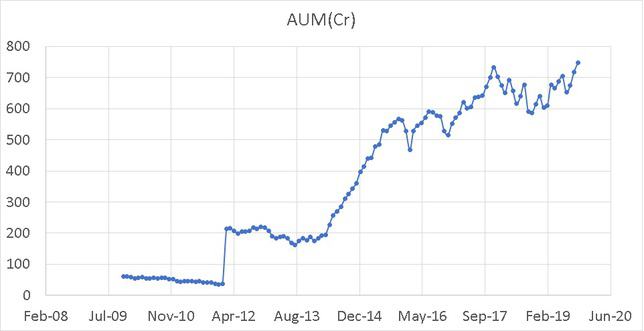
These are impressive numbers. However, in spite of being launched in June 1994, the fund only has an AUM of about 747 Crores – a good seven times lower than the AMCs most popular equity fund, Tata Equity PE Fund (click for review). This warrants a study of its history.
Tata Mid Cap Growth Fund: History
According to the fund’s scheme document (page 35), The scheme was launched by Indian Bank Mutual Fund as a closed-ended equity scheme named Ind
Navratna. The fund was taken over by Tata AMC in November 2001 and became Tata Ind Navratna Fund. The fund opened for subscription since 31st March 2004 with a new name Tata Growth Fund.
From Nov 2012, Tata Growth Fund was called Tata Midcap Growth Fund. Prior to that Tata Midcap Fund and Tata Capital Builder Fund was merged with the Tata Growth Fund in Feb 2012 (see merger event in AUM trend section)
Surprisingly Tata AMC does not seem to host an archive of fund factsheets on its website. This makes it hard to study the portfolio history and past nature of the fund. We will, therefore, have to make inferences from a comparison of the NAV history versus benchmarks.
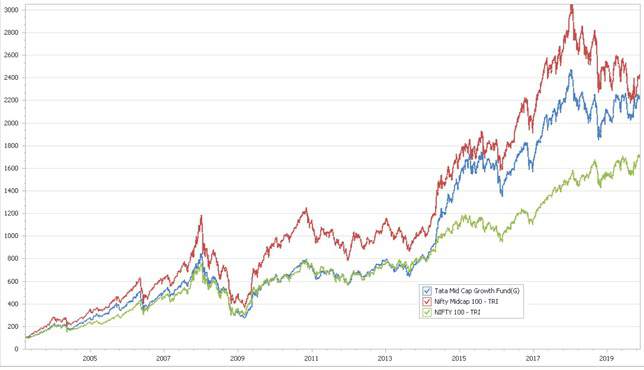
Notice that the fund behaved pretty much like a Nifty 100 index fund until late-2013/early-2014 and after that seems to have gone heavy on midcap and smallcap stocks. When there is such a dramatic change in the nature of the portfolio, the study of past returns becomes practically useless.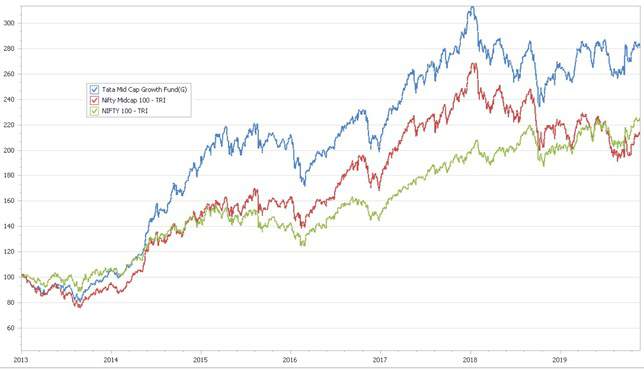
Tata Mid Cap Growth Fund NAV comparison with Nifty 100 TRI and Nifty Midcap 100 TRI since 1st Jan 2013Since 2013 has comfortably beat Nifty 100 and Nifty Midcap 100.
Market Cap History
Notice how the fund has changed after May 2018. A year before that it had more of small cap and this has progressively reduced.
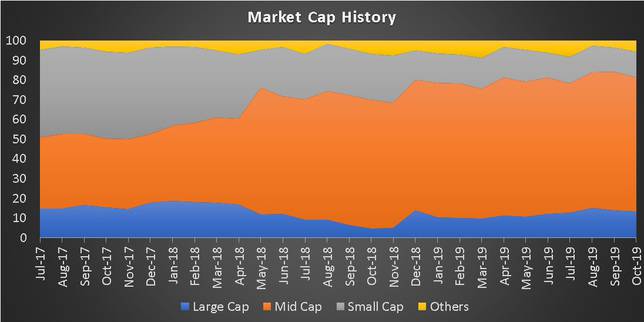
Investors should first look at the portfolio and management style history before taking past performance seriously. Unfortunately, this is not easy as fund history is not easily available and in this case, even past factsheets were not accessible.
AUM Trend
Summary
Tata Mid Cap Growth Fund has had a colourful history, to say the least! It operated as a small cap and mid cap fund from 2013 until May 2018. It has however managed to do well in the last couple of years amidst the fall in mid/small cap segments. Investors looking for a midcap fund and are particular about low AUM can consider this fund provided they understand that they are taking a chance as the fund has no style-pure past performance to speak of. A sudden uptick in the market could make the AUM grow rapidly and affect performance. Existing investors can continue until the performance is satisfactory.