Last Updated on September 4, 2018 at 10:19 am
In this post, let us compare two large cap funds from the same fund house. One a consistent performer with a terrific track record and the other a young superstar. The results will hopefully show how herd instincts among investors (and perhaps amcs and therefore(?) intermediaries too?) can obscure good funds from the same fund house.
The results shown below are derived with:
- Mutual Fund Risk and Return Analyzer: Fund A vs. Fund B
- Mutual Fund Risk and Return Analyse: Fund vs. Benchmark
Let us now list the salient features of both funds (Sources: VR online, thefundoo, fund SIDs, monthly reports)
ICICI Pru Focused Blue Chip Equity
Category: Large Cap
🔥Secure your future with our Robo-advisory tool trusted by over 3,500 investors and advisors. From effortless retirement planning to funding your children’s biggest dreams, turn your financial goals into reality. 🔥
Subscribe for money management solutions via email! (Link takes you to our email sign-up form) Join 32,000+ readers in our community.
👉 New Tool Alert! NaviPlan: A Privacy-Focused Multi-asset Tracker and Goal Planner 👈
Benchmark: CNX Nifty
Inception Date: 23rd May 2008
AUM: 5879.7 Crores (30th June 2014)
Investment Objective: To generate long-term capital appreciation and income distribution to unit holders from a portfolio that is invested in equity and equity related securities of about 20 companies belonging to the large cap domain and the balance in debt securities and money market instruments. The Fund Manager will always select stocks for investment from among top 200 stocks in terms of market capitalization on the National Stock Exchange of India Ltd.
If the total assets under management under this scheme goes above Rs. 1,000 crores the Fund Manager reserves the right to increase the number of companies to more than 20.
Indicative asset allocation:
Equity: 70% or more. Rest in debt or money market instruments
Portfolio:
Large cap: 88.5%
Mid-cap: 8.9%
Small-cap: 0.6%
Cash: 2%
Dominant Sectors:
Finance: 33.47%
Energy: 12.99%
IT: 13.79%
FMCG: 14.9%
ICICI Pru Top 100
Category: Large Cap
Benchmark: CNX Nifty
Inception Date: 9th July 1998
AUM: 666.56 Crores (30th June 2014)
Investment Objective: To generate long-term capital appreciation from a portfolio that is invested predominantly in equity and equity related securities
(broader the mandate, the less verbose the objective!)
Indicative asset allocation:
Equity: 95% or more. Rest in debt or money market instruments
Portfolio:
Large cap: 79%
Mid-cap: 12.3%
Small-cap: 3.3%
Cash: 5.4%
Dominant Sectors:
Finance: 27.6%
Energy: 25.6%
IT: 15%
Portfolio overlap: Out of the 80% folio listed at VR online, there is an overlap of 52%. Which is significant.
Obtained with: Mutual Fund Portfolio Comparison Tool
Impression: There is reasonable similarity between the two funds (at the moment!). ICICI Top 100 is a bit more diversified than Focused Blue Chip equity.
ICICI Pru Focused Blue Chip Equity vs. Nifty
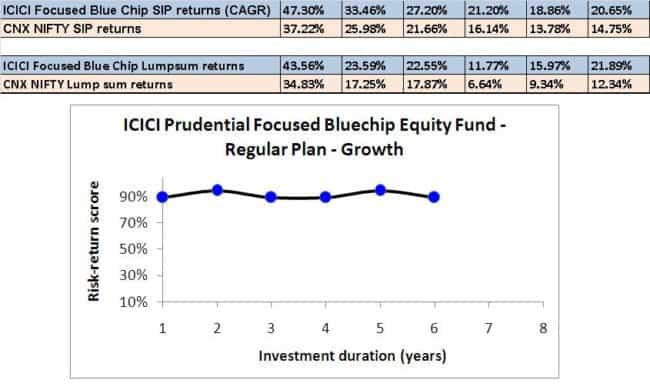
The data and graph speak for themselves. Needless to say that the fund has done excellently well when compared with the Nifty
Ulcer index is a measure of downside protection and investor stress.
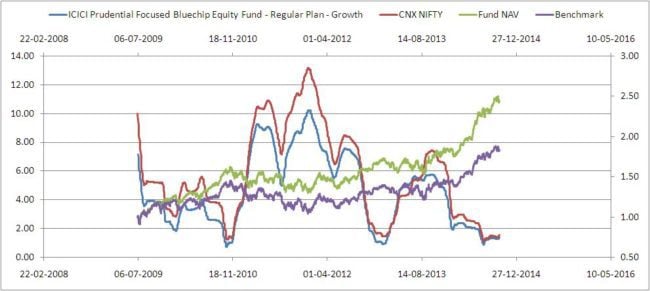
Since Focused Blue Chips ulcer index is lower than that of Nifty, investors would have been sitting pretty with this fund.
Created with Mutal Fund Risk and Return Analyzer
Read more: Mutual Fund analysis with the Ulcer index
ICICI Pru Top 100 vs. Nifty
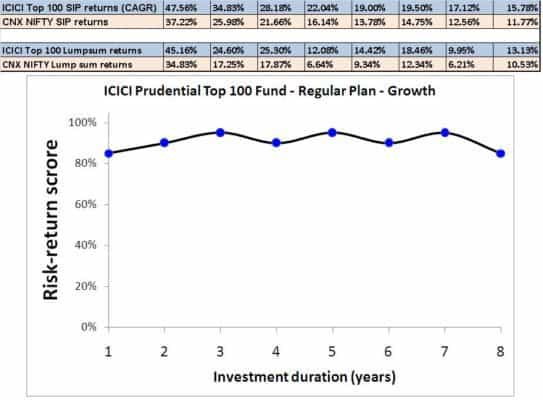
Top 100 has a longer history of consistent outperformance.

Again pretty decent when compared with the Nifty. However, not as much as Focused Blue Chip.
Created with Mutal Fund Risk and Return Analyzer
ICICI Pru Focused Blue Chip Equity vs. ICICI Pru Top 100
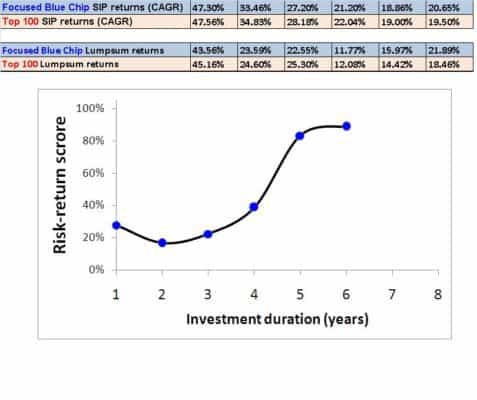
This Ulcer index comparison confirms that Focused Bluechip has better downside risk than Top 100. However,
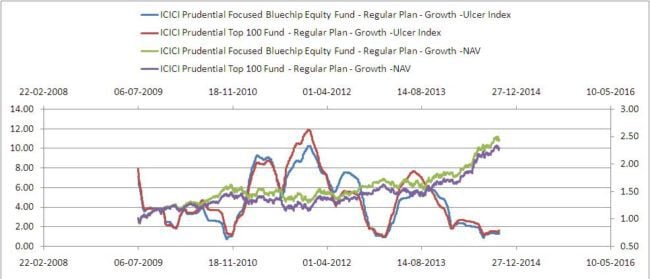
A score of more than 50% means focused blue chip has done better than top 100. Created with Fund A vs. Fund B Risk and Return Analyzer
While there is not much difference in terms of returns, Top 100 has had better overall risk-adjusted performance than focussed blue chip for the last four years.
Is this because of its large AUM?
In Aug. 2009, Focused Blue Chip had 20 stocks in its folio (as per its original mandate) with an AUM of ~ 740 Crores and an annual churn ratio of 1.18 times.
In Aug. 2014, it has 50 stocks. It has to, because its AUM is now ~ 5879 Crores. Its churn ratio has dropped to 0.57 times. Read more about the impact of size on churn ratio here: Mutual Fund Size vs. Performance: a case study
My answer would be, yes.
ICICI Top 100 has a current AUM of ~ 666 Crores. Lower than what focused blue chip had 5 years ago?
The reason I wrote up this analysis is to pose the question why is this so?
In terms of performance, that is bare returns, there is not much difference between the two funds. In fact, Top 100 has a longer track record of consistency.
So why has this been pushed to the background? Who is responsible for this?
The AMC? The distributors? The investors? My guess is everyone.
The only difference between the two funds:
Focused blue chip began operations at the start of the 2008 financial crisis. Therefore, I think it appeared as a saviour to many since the established funds (incl. top 100) were struggling to cope with the crash.
While existing mutual fund investors flocked to focused blue chip equity, new investors saw it as a safe bet. One person said, ‘the fund would never fail’.
It is heartening that MorningStar analysts have given a ‘silver’ rating to Top 100 and a ‘neutral’ rating to focused blue chip, while VR online rates them both as 5* funds.
Silver: Fund with advantages that outweigh the disadvantages across the five pillars and with sufficient level of analyst conviction to warrant a positive rating.
Neutral: Fund that isn’t likely to deliver standout returns but also isn’t likely to significantly underperform, according to the analysts.
Now a few definitions for your perusal. Hopefully, they would clarify the first word in the title of the post.
Herd Behaviour
A group of animals fleeing from a predator shows the nature of herd behavior. In 1971, in the oft cited article “Geometry For The Selfish Herd,” evolutionary biologist W. D. Hamilton asserted that each individual group member reduces the danger to itself by moving as close as possible to the center of the fleeing group. Thus the herd appears as a unit in moving together, but its function emerges from the uncoordinated behavior of self-serving individuals. (wikipedia)
Herd Instinct
A mentality characterized by a lack of individual decision-making or thoughtfulness, causing people to think and act in the same way as the majority of those around them. In finance, a herd instinct would relate to instances in which individuals gravitate to the same or similar investments, based almost solely on the fact that many others are investing in those stocks. The fear of regret of missing out on a good investment is often a driving force behind herd instinct. (investopedia)
Information cascade
This occurs when a person observes the actions of others and then—despite possible contradictions in his/her own private information signals—engages in the same acts. A cascade develops, then, when people “abandon their own information in favor of inferences based on earlier people’s actions” (wikipedia).
Moral of the story: Never buy a fund because it is popular or even if a professional recommends it. Focus on your own portfolio. Do your own research. Ignore star ratings.
Note: Do not sell or stop investing in focused blue chip because of this post. Evaluate your needs and make informed choices. You know where to find the necessary tools 😉
~~~~~~~~~~~~~~~~~~~
Many years ago, my wife and I took an evening stroll around a temple tank. The moon was full and beautiful. We stopped to stare at it for a few minutes and took some pictures. Before we stopped to look at the moon, no one around us cared about it in the busy street. When they saw two people looking at something, they became curious and joined in. Soon there was a chain reaction! I am pretty sure behavioral scientists have a word for this phenomenon. Do share, if you know what it is.