Last Updated on February 12, 2022 at 6:13 pm
Each time I publish an updated retirement asset allocation, I get asked this question: “At age 46, are you not holding too much equity?” In this article, I discuss a common misconception about asset allocation and how much equity is suitable for a middle-aged person.
As we begin investing for retirement, say in our mid-thirties, we are clueless about at least two factors: (1) how much volatility we can tolerate in real-time and (2) and how our risk appetite and goal priorities change. As we keep investing the lessons we learn are innumerable and incredible.
As mentioned in yesterday’s article – There is more to retirement planning than building a large corpus! – my approach to retirement planning in the last decade has undergone a sea change. While this article covers the technical aspects of my learning, here is how my personal goals changed.
Like most people, the first time I used a retirement planning calculator, I got the, “you do not have enough money to invest”. This may be disheartening but we do not know how our future cash flow will change. In the 20s and 30s, our main goal should be to try and increase our main income as much as possible. In the 40s and 50s, while regular investing continues, the focus can shift to creating passive income streams that last a lifetime.
🔥Secure your future with our Robo-advisory tool trusted by over 3,500 investors and advisors. From effortless retirement planning to funding your children’s biggest dreams, turn your financial goals into reality. 🔥
Subscribe for money management solutions via email! (Link takes you to our email sign-up form) Join 32,000+ readers in our community.
👉 New Tool Alert! NaviPlan: A Privacy-Focused Multi-asset Tracker and Goal Planner 👈
I was amazed by the power of continuously increasing our investments and what a sudden market rally after years of no return can do to your portfolio and to your station in life! When we begin, we cannot appreciate the power of these forces. Those who put their head down and invest without immediate expectations stand a better chance of success.
As the networth builds from 1X to 5X to 15X to 30X (X = annual expenses that will persist in retirement), your approach to risk changes, your goals change. Of course one cannot make arbitrary changes to a plan. The core plan is clear. As of now, my retirement age is 65 and if I punch my nos in the robo advisory template, I can afford to hold on to 60% for at least the next few years. Max retirement age in the template is 60 as everyone should be ready to retire by then!
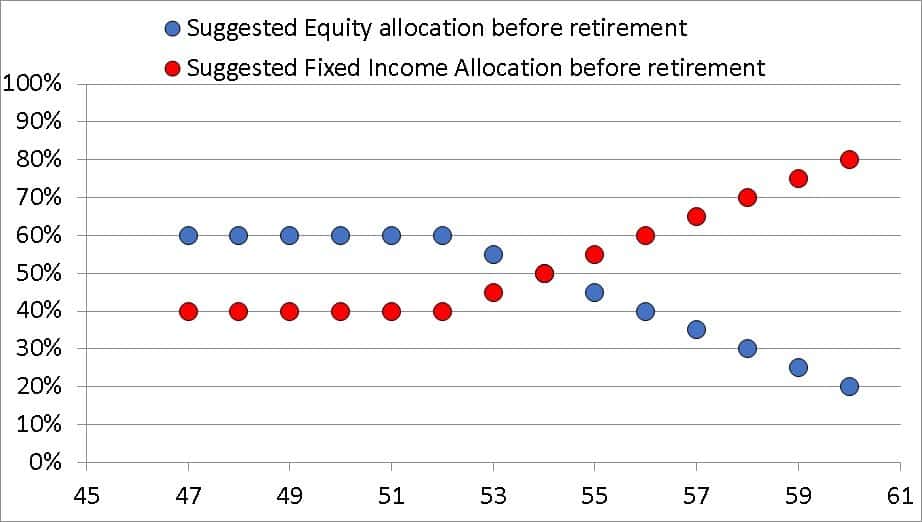
Now there are two different ways of viewing this result.
- If I am already holding 60% equity – I am, see: Rebalanced my retirement portfolio after 13Y, a crash & recovery! – then not only am I comfortable with this suggestion, but I also think of tweaking it as below.
- If I am middle-aged and hold little or no equity, there are only two choices: Either DIY a custom asset allocation schedule (the results will be tough to stomach!) or consult a SEBI registered fee-only advisor.
So 60% equity holding may seem right or wrong depending on how much equity we are currently holding. Also, percentages mean little. A person may only hold 40% debt, but what is it currently worth?
I had often talked about 30X as the threshold of financial freedom. That is a networth of 30 times current annual expenses that would persist in retirement. This means for zero real return (inflation = post-tax overall portfolio return after retirement) the corpus would last for 30 years.
Before I cross this 30X mark, it seemed like a big deal, but today, my targets have changed. “Can my debt portfolio hit the 30X mark?”, “Can I afford to hold on to 60% equity all my life?” I do not have answers for these, but my point is, after years of investing out outlook changes.
Our goal targets change, the way we look at asset allocation and risk management change. This is something we ourselves cannot anticipate, so naturally, others cannot as well. Certainly not from percentages.
So in general how much equity is “right” for a middle-aged person? This largely depends on their capital market experience. Those with experience will never ask this question! Assuming middle age is 40-50 (in this context) and retirement is 55 (for those in corporate, 50 may be a better estimate than 55!), there are not more than 15-10 years of investing years left.
This is a difficult problem to solve: no experience with equity and only 10-15 earning years left. What would you do? I would recommend getting the equity asset allocation at least up to 40% as quickly as possible, say within three years. Get ready to hold at least 20% equity after retirement.
This brings us to another question: how much equity should we hold after retirement. In the goal-based portfolio management lectures, interesting and counter-intuitive evidence on this subject is presented.
One of the most important lessons on investing I have learnt over the years is this: portfolio management has two components: (1) a well laid out plan that takes into account as many of the knowns as possible; (2) the ability to look at a developing situation (crash, recovery or sideways market) and make course corrections. There is not well-defined set path here. We have to create our own as we go along. And when we do, we tend to redefine the goals as well.