Social media seems to be an excellent psychological indicator of market sentiment. When the doomsday and recession forwards increase, investors with financial needs decades away should probably buy more equity! Among those who see this as an opportunity, some wish to know “is this a good time to buy mid cap and small cap mutual funds?” The answer is not a simple yes or no. We need to ask the question in a different way.
Before webegin, If you are working with a SEBI registered fee-only financial advisor (from my list or elsewhere), please help by providing feedback via this survey. We have had a phenomenal response so far, thank all for your time!!
Midcap Index market trend
Using the Nifty Valuation Tool (you can use this to find if the market is expensive or cheap in multiple ways) we can quickly check market trends in the mid cap and small cap space (I shall present results for mid cap alone here).
🔥Secure your future with our Robo-advisory tool trusted by over 3,500 investors and advisors. From effortless retirement planning to funding your children’s biggest dreams, turn your financial goals into reality. 🔥
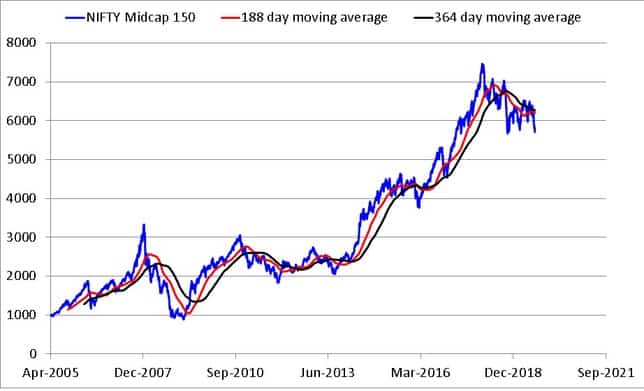
The double moving average shows midcap index price to be below both the 1Y and 6month average with the 188-day line below the 364-day line. If we go by past history, this is a buy signal.
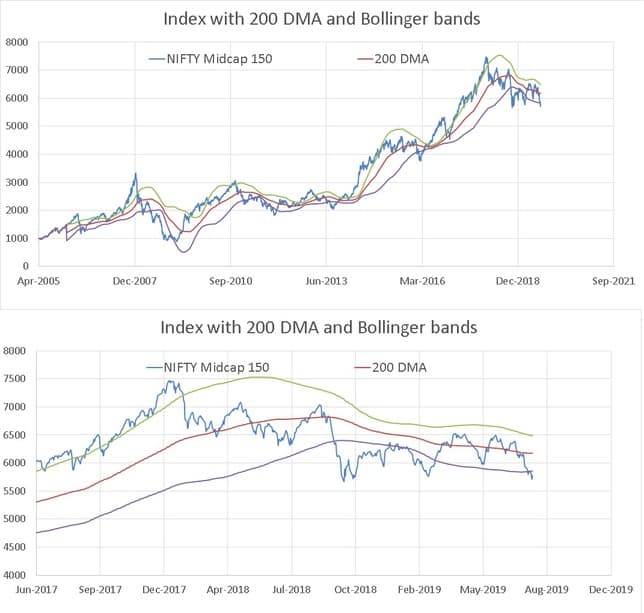
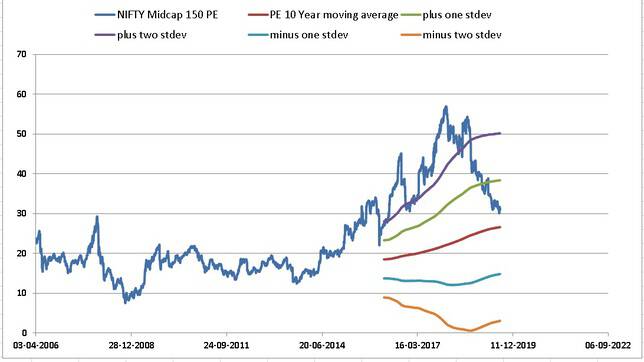
The trend and volatility indicator, Bollinger bands show good separation with the price hitting the lower band. This is generally considered as buy signal again. Read more: Spotting market trends with Bollinger BandsThe mid cap index PE is also reasonably favourable (although the history is quite short). It could go down further, but that does not mean one needs to wait.
So we now buy mid cap and small cap funds?
I am not irresponsible to offer a simple yes or no answer to this. I will provide a qualified “no, do not buy” response. Why? Most investors who ask questions like these have no strategy (they will not be asking if they had one!). So please first get yourself an investment strategy first.
If you hold multicap funds plus or minus aggressive hybrid funds, then I suggest you continue investing in them. Let the fund manager worry about increasing allocation to mid caps or small caps. This is the most straightforward, safest approach suitable for everyone.
If you insist on having individual large cap (LC), mid cap (MC) and small cap (SC) funds, then take a moment to understand asset allocation. Suppose you decide to have an equity portfolio with 50% LC, 25% MC and 25% SC and started investing two years ago via SIP.
Today the asset allocation would be 52% LC, 26% MC, 21% SC (for the funds selected, think of this as only a trend). That should automatically tell you what to do! Rest the equity allocation back to 50% LC, 25% MC and 25% SC and you will automatically buy more of small caps. There is no need to look at market trends!
For the example, considered here, 4% of the LC fund holding should be sold, 5% of MC holding sold and added to the SC folio. It would be a 16% increase in the SC folio. Do you have the guts to do this? Or will you still think about adding new investments in your MC and SC funds?
If you manage the additional risk from mid cap and small cap holdings, the returns will automatically fall in place. For this, you will need to have a target asset allocation and rebalance as mentioned from time to time. Buying on market dips is a waste of time
The problem is that many investors believe that they manage portfolio risk by changing the amounts that they invest, where they invest and when. This is plain silly. We need to tell ourselves that we are going to get rich. The amount we invest each month will soon be 1% of our invested amount. After that, it will become 0.1%.
Once we adopt that attitude, we recognise that we need to worry about the money already invested and not the money that we are about to invest (at least not as much).
So if you want gains from midcaps and small caps (funds or stocks), have an asset allocation and control it from time to time. The rest will fall in place.
Do share this article with your friends using the buttons below.
Create a complete financial plan with our Robo-advisor!
Trusted by 3500+ investors and advisors! Use code robo25 for a 20% discount!