Last Updated on December 29, 2021 at 5:34 pm
The titular question was posed by a reader a few days ago. Naturally, the AMC would allow a SIP from any MF, but does it make sense to start one in a gilt mutual fund that invests in long-term govt bonds? We look the SIP returns of I-BEX a composite sov bond index to understand what we must expect from a sip in gilt funds.
Suppose you had started a SIP in the I-BEX gilt index (assuming it was possible) in Aug 1994, almost 26 years before, what would be the annualised return as on 1st June 2020? Let us find out, but first some basics about gilt funds.
When you buy a gilt bond and hold it until maturity receiving interest income twice a year, there is virtually no risk (unless the govt becomes bankrupt). Interest change will not affect you. Sov bonds cannot be assigned a credit rating!
🔥Secure your future with our Robo-advisory tool trusted by over 3,500 investors and advisors. From effortless retirement planning to funding your children’s biggest dreams, turn your financial goals into reality. 🔥
Subscribe for money management solutions via email! (Link takes you to our email sign-up form) Join 32,000+ readers in our community.
👉 New Tool Alert! NaviPlan: A Privacy-Focused Multi-asset Tracker and Goal Planner 👈
If you wish to sell that gilt bond before maturity, then the market price will vary as per demand and supply. You can gain a lot of money if demand is higher or lose a lot if there is no demand. Longer the maturity of the bond, higher the daily price fluctuations.
A mutual fund NAV is marked to market. This means, irrespective of whether the fund manager buys and holds gilts bonds or sells them mid-way, the NAV will fluctuate daily as per market supply and demand.
For example, even if the market anticipates a rate cut, the price of existing gilt bonds will move up and so will the NAV. The opposite is also possible. So the argument price and interest rates move in the opposite direction is generally true but need not happen together.
So it is important for the reader to recognise that gilt mutual funds are incredibly volatile and it is possible to get negative returns over the short-term (few years) and low return over the long-term. The annualised return will also fluctuate wildly on a day to day basis.
With these caveats in mind, let us look at examples. First a real-life one. My NPS is dominated by gilts and over the last 10 years given an XIRR of 9.62% (as on June 5th 2020) considerably better than my retirement equity MF portfolio return of 2.75% after 12 years!
MY NPS is a virtually a step-up SIP in gilts. That is the contribution increases each year with increments, DA, promotion and pay commission. See: Ten years of investing in the NPS: Performance report
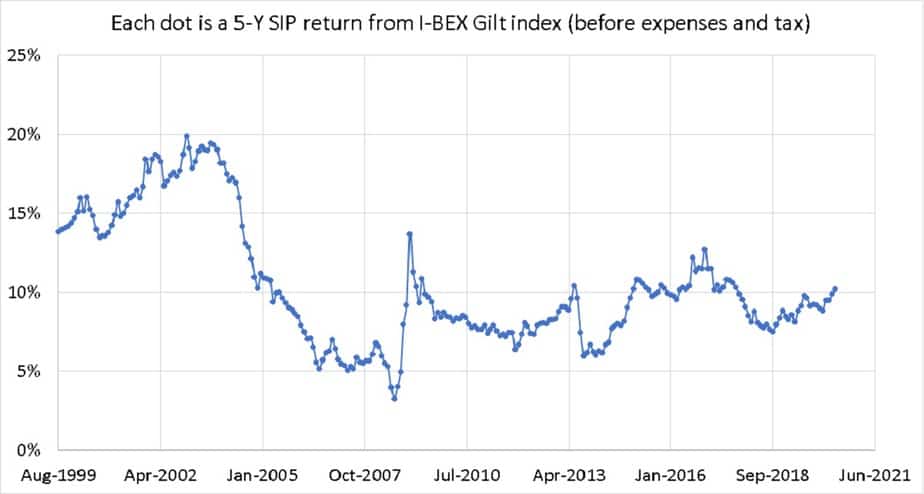
Five-year SIP in gilts
Min 5Y XIRR: 3.31%
Max 5Y XIRR: 19.92%
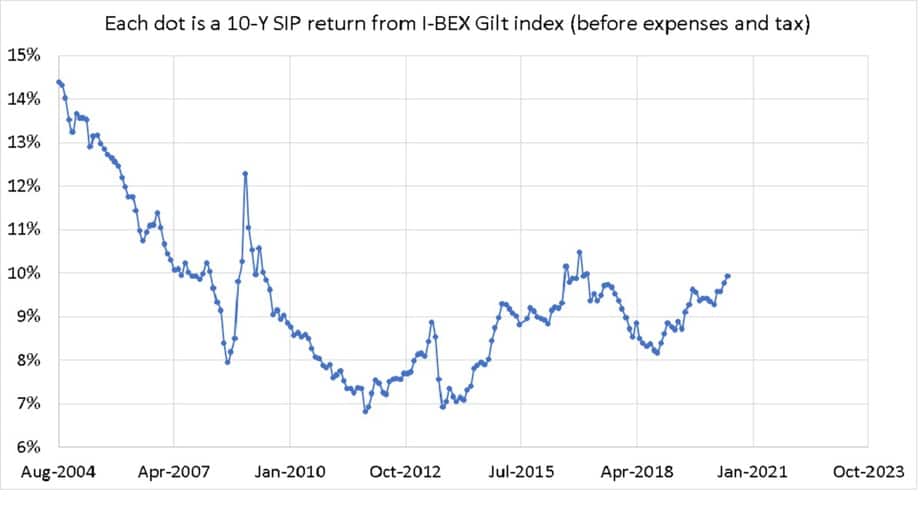
Ten-year SIP in gilts
Min 10Y XIRR: 6.81%
Max 10Y XIRR: 14.40%
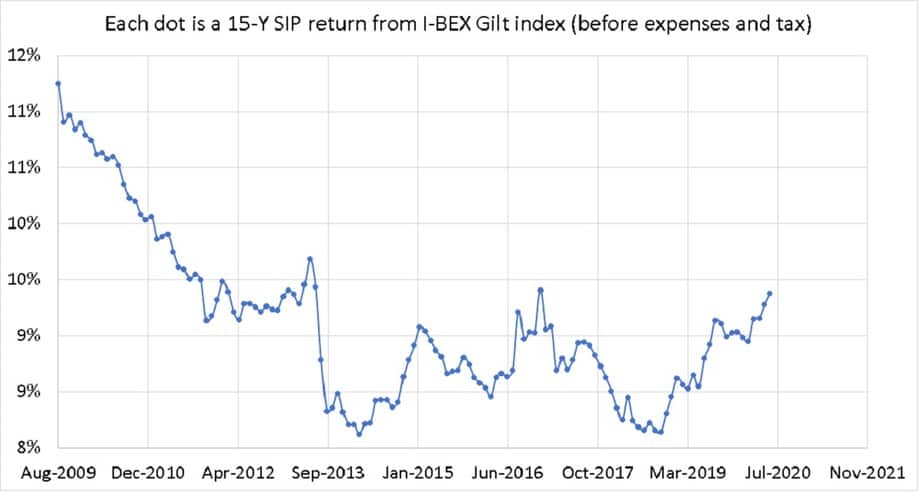
Fifteen-year SIP in gilts
Min 15Y XIRR: 8.12%
Max 15Y XIRR: 11.25%
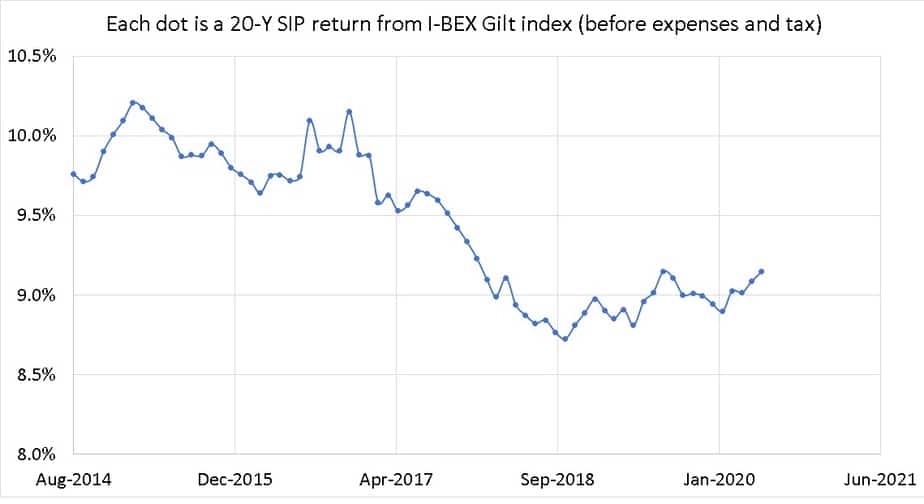
Twenty-year SIP in gilts
Min 20Y XIRR: 8.72%
Max 20Y XIRR: 10.21%
Does it make sense to long-term SIP in gilt MFs?
Clearly the answer is yes. Provided we have the maturity to face huge ups and downs in the journey, stick to the SIP and rebalance either systematically or tactically (shall be discussed later) with a clear goal in mind. Provided our expectations after tax and loads is not too high.
The reader should appreciate the decreasing number of data points in the above graphs as we went from 5–> 10 –> 15 –> 20 years. Also going forward gilt yield would go down over the long term and past performance should not be used as an indication of the future.
Trivia: The 26-year SIP started in the I-BEX gilt index in Aug 1994, would have resulted in an XIRR of 9.98% as on 1st June 2020.