Last Updated on September 15, 2025 at 11:44 am
Direct mutual fund plans were introduced from Jan 1st 2013. In this article, we list the return difference between an 8-year SIP in a direct plan and a regular plan mutual fund. Scared that it would disrupt sales, SEBI has still not renamed “regular plans” for what they really are: “commission plans” – nothing “regular” about them.
However, thanks to advances in technology, direct plan AUM has slowly but steadily increased – close to 40% of total industry AUM if we look at the Average Assets under Management (AAUM) for the quarter of October – December 2020 reported at AMFI (excluding ETFs which no regular/direct plans and domestic fund of funds). Hence the “direct AUM is not sticky” cries. About 30% of the total direct AUM is being held in liquid and overnight funds (typically institutional money).
For those who do not know how regular plans operate: every day before the NAV is declared, mutual funds deduct their expenses and sales guy commissions from the regular plan AUM. In the direct plan, there is no commission involved only expenses.
The next time a sales guy proudly declares that “they paid by AMCs for the service they provide to investors”, please remind them the AMCs are merely removing the commissions from the current market value of the investments.
🔥Secure your future with our Robo-advisory tool trusted by over 3,500 investors and advisors. From effortless retirement planning to funding your children’s biggest dreams, turn your financial goals into reality. 🔥
Subscribe for money management solutions via email! (Link takes you to our email sign-up form) Join 32,000+ readers in our community.
👉 New Tool Alert! NaviPlan: A Privacy-Focused Multi-asset Tracker and Goal Planner 👈
While it is obvious that regular plans would cost most and return less, the real reason for shunning regular plans is the associated conflict of interest. If a person employed by you is being paid by someone else – from your money and you have no control over the terms of the payment, the arrangement is, to put it lightly, far from ideal.
The choice before the investor is quite simple:
- DIY. Mutual fund investing is not rocket science although many investors aspire to be rocket scientists.
- Get unbiased advice from a SEBI registered fee-only advisor
Direct vs Regular Plan Mutual Funds: 8-year SIP return difference
We considered 266 schemes for this study. The full dataset can be obtained on request. We present some results here.
The highest difference in returns and investment value was found for HDFC Hybrid Equity Fund. However, the NAV currently available is only the adjusted NAV which accounts for the scheme merger in 2018. The numbers (see below) are significantly higher than the rest of the pack and therefore not considered. The numbers for its twin HDFC Balanced Advantage look better though.
The table below shows data the “top” 15 funds. If an Rs. 1000 per month SIP was started on the 1st of Jan 2013, the XIRR of the direct plan investment would be 1.93% higher than that of the regular plan investment (see image below for return differences).
This may not sound like much but the value of the direct plan investment would be (16.37 x 1000) times higher than the regular plan investment for Invesco Midcap fund (1st entry below). That is 16.37 months of investment is lost in commissions.
| Scheme Name | Amount in terms of SIP instalments lost to commissions |
| Invesco India Midcap Fund | 16.37 |
| Invesco India Financial Services Fund | 13.70 |
| Invesco India Contra Fund | 13.54 |
| Invesco India Multicap Fund | 13.39 |
| Invesco India Infrastructure Fund | 13.19 |
| Axis Midcap Fund | 13.04 |
| BNP Paribas Mid Cap Fund | 12.93 |
| Canara Rob Emerg Equities Fund | 12.92 |
| Invesco India Growth Opp Fund | 12.62 |
| Invesco India Largecap Fund | 12.19 |
| Edelweiss Mid Cap Fund | 12.01 |
| BNP Paribas Multi Cap Fund | 11.89 |
| BOI AXA Tax Advantage Fund | 11.72 |
| Axis Focused 25 Fund | 11.71 |
| Indiabulls Blue Chip Fund | 11.62 |
The image below includes the XIRR return differences and the actual value as well.
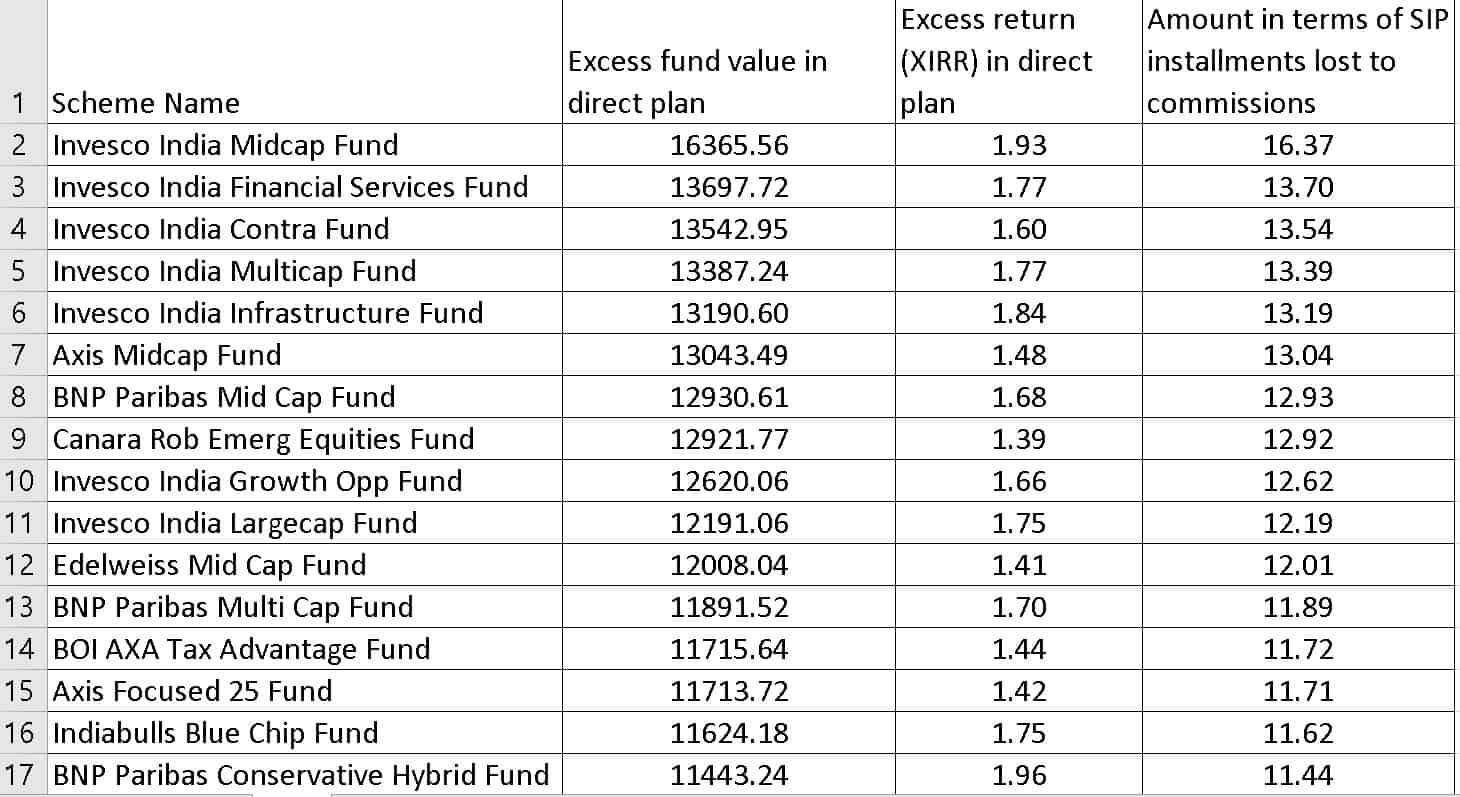
The data is self-explanatory and the choice obvious.