Last Updated on December 28, 2021 at 6:43 pm
We are living in a time where half a data point is enough to announce trends, patterns prophecies. Every week one guy says the markets are going to tank and another says it will do well. The latest such development is the so-called inversion of the US bond yield curve and its association with the onset of recessions. While it is not as simple as that, it was enough to cause worry and fear. Since those will not help, why not use this as a wake-up call to ensure you are prepared for what follows in a recession?
First, let us discuss what is this fuss all about. The yield of a bond is defined as its annual interest payment divided by the current price. When the demand for a bond increases, its yield decreases. So suppose I compare the yields of a 1Y bond and a 10Y bond.
If the yield of the 10Y bond is higher, it means its demand is lower. Suppose the yield of the 10Y bond is less than the 1Y bond. This means that investors prefer short-term bond or fixed-income investments and prefer to invest their money because they believe it will provide higher returns.
What if the investors are no longer confident about the medium-term or long-term prospects in the stock market? They would prefer long-term bonds even if their interest rate is low. Then the yield of the 10Y bonds (in this example, long term in general) would start falling (as prices increase) and at some point fall below the 1Y yield.
🔥Secure your future with our Robo-advisory tool trusted by over 3,500 investors and advisors. From effortless retirement planning to funding your children’s biggest dreams, turn your financial goals into reality. 🔥
Subscribe for money management solutions via email! (Link takes you to our email sign-up form) Join 32,000+ readers in our community.
👉 New Tool Alert! NaviPlan: A Privacy-Focused Multi-asset Tracker and Goal Planner 👈
A yield curve is a plot of the yield of all the bonds in the market (vertical axis) and their duration. As explained in this article, The Bond Yield Curve as an indicator of what’s going on with the economy, these are three simple (simplistic?) possibilities
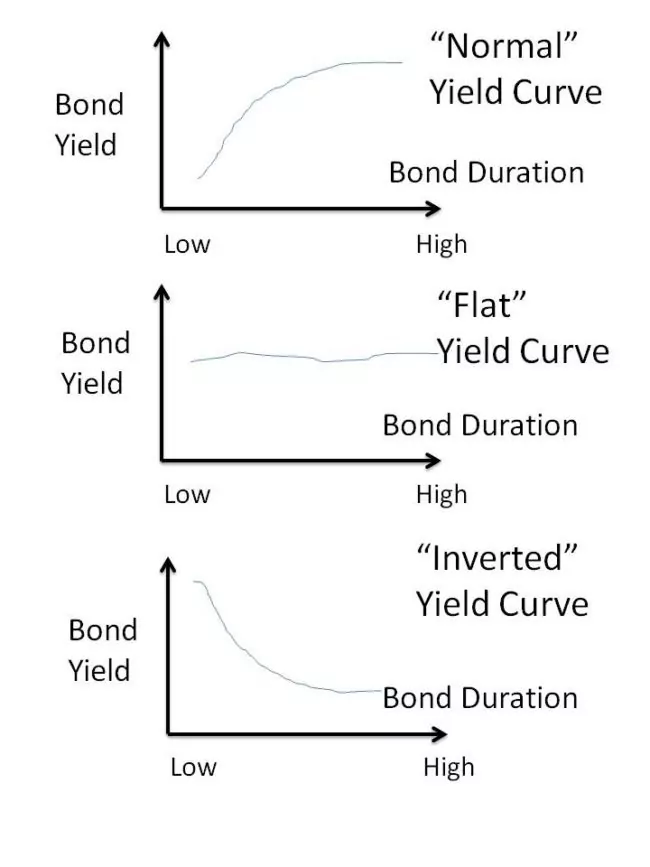
For the last few months, US long-term bond yields have been falling lower than short-term yield resulting in an inverted yield curve. This means turbulent stock markets, difficulty in running businesses, layoffs etc. In other words, a recession.
Not immediately though. It has taken months to years for the US recession to set in after the yield curve inversion. See this article for example. As investors, it is hard to act on such events and assume it is time to pull out money. There is no need to as long as we have invested with the right asset allocation. As money managers, however, this is a wake-up call to check how strong our financial situation.
Are you ready to handle a Recession?
A recession can be a double-whammy: Job loss (and difficultly in getting re-employed), plus a stock market crash fall. The situation in India is a bit different as we have a big array of small saving instruments reasonably insulated from bond yield movements because of politics and an entitled population. Nonetheless, considering the spending habits of the current generation, it does not hurt to check.
Here are some questions to ask
- If I lose my job, how long can I live off my investments without factoring in the severance package? The answer should be at least one year. A cash holding of 6-12 months expenses (including EMIs) is mandatory. So start building it. Do not ask where to invest. Grow up and hold it in SB or FD of a “safe” bank (meaning one that the government will bail out)
- Do I have the skill set to be re-employed within six months? (if you had that, would you have been laid off in the first place, I don’t know, just asking). The longer it will take to get re-employed, the larger your emergency fund should be.
- Can I freelance or do something on my own? If not, work on it now! Do not wait! This video series and this article How to Make More Money In India: Forty real examples may be of some help.
- If the market crashes or if there is a recession, will my short term goals (five to at least seven years) suffer? If the answer is yes, then pull out all associated money from the market and put in safe instruments. Debt instruments are not “safe”!
- Do I have a separate health cover? If I am suddenly laid off, will I be able to transfer my group cover to an individual cover during such a time? Answer no and buy a separate cover.
- Do I have life insurance? Why is this important in a recession? Guess!
It is never too late to start. Download Re-assemble: Step by step money management basics for beginners