Last Updated on January 1, 2016 at 8:38 am
How high can my home loan EMI be? What percentage of my gross monthly income can I afford to set aside for servicing my home loan EMI? These are questions that I have often seen in personal finance forums. When I recently saw it at Facebook group Asan Ideas for Wealth, I thought of discussing the issues with deciding a “comfortable EMI” amount.
The house/apartment decides the EMI!
Simple is it not! We can think long and hard, search for thumb rules for a comfortable EMI. All that would get thrown out of the window when we actually decide on the property that we wish to buy. The property decides the EMI. The “comfortable EMI” rarely decides the property!
That comfortable EMI figure = 4o% of monthly income can easily get stretched to 45% or even 50% of monthly income if the ‘right’ property comes along.
🔥Secure your future with our Robo-advisory tool trusted by over 3,500 investors and advisors. From effortless retirement planning to funding your children’s biggest dreams, turn your financial goals into reality. 🔥
Subscribe for money management solutions via email! (Link takes you to our email sign-up form) Join 32,000+ readers in our community.
👉 New Tool Alert! NaviPlan: A Privacy-Focused Multi-asset Tracker and Goal Planner 👈
Property purchase almost always affects investments
This is what I tell myself: If I ever want to buy a property to live in, the EMI would be 30% of my post-tax monthly income. God willing, only 30% would be my monthly expenses, 30% would be my investments with a 10% buffer.
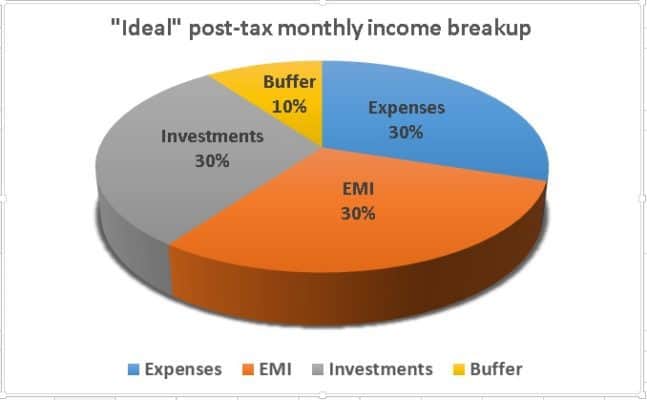
Unless I buy property in the middle of nowhere, I cannot get my EMI to be 30% of my post-tax income. The typical EMI is anywhere between 40-55% of post-tax income. With expenses amounting to 40-45% for most people, there is little to invest. For many, at least initially, the only invest they make is the mandatory EPF contribution!
Renting is better than choosing a small house just to keep the EMI down. So the only way in which the EMI will not affect investments for long-term goal is to postpone buying the house until one ‘settles’ down in a career and until the family is complete. This way, the income would have hopefully increased.
However, the EMI would increase pretty much at the same pace too! In today’s corporate world, no one ‘settles’ down! There is no job security.
Buying early vs. buying late
Many advice to buy asap, clear the loan asap and then focus on investments! Both strategies – buying early or late – have disadvantages.
Buying early – pros
- Chance to get a good property ‘cheap’
- Can live debt free sooner
- Comfort of owning roof
- Sense of accomplishment
- Done duty as provider
- Better to service liability when young and employable
Buying early – cons
- EMI would be too high for comfort
- Not be able to invest enough: retirement planning is the first casualty
- House would be too old at retirement for reverse mortgage
- Complications if we need to relocate
- Early retirement not possible if income does not increase substantially
- Clarity on where we would retire
- EMI likely to be manageable and hence loan can be serviced longer
- Reasonable net worth if invested right and clarity on financial goal planning.
- The property will not be too old at retirement. Reverse mortgage an option, even if not necessary.
Buying late-cons
- Not being able to buy the ‘right’ property
- Taking on liability in middle age
- Early retirement not possible if investments are affected.