Last Updated on February 12, 2022 at 6:13 pm
In a Q and A session held on our Youtube channel yesterday (linked below), we encountered two similar questions: Kohila asks, “we have two goals, retirement, our son’s education which is 8 years and 12 years away. Should we use the same mutual funds for both or separate funds?”
Bala Gurunathan asks, ” I have an X goal in 5 years and a Y goal in 8 years. And next to that usual goal like everyone have child studies, marriage and retirement. I am 35 now. I should maintain asset allocation for each goal or one asset allocation overall?”
So the essential question is, if I have multiple goals, how should I use mutual funds? Should I use the same funds for all goals? Or should I have separate funds for each goal?
The asset allocation for an 8Y goal is different from that of a 12Y goal. That is, the amount of risk we can take for each is different. Suppose you choose to hold 50% equity for the 12Y goal. You cannot hold more than 20-30% equity for the 8Y goal.
🔥Secure your future with our Robo-advisory tool trusted by over 3,500 investors and advisors. From effortless retirement planning to funding your children’s biggest dreams, turn your financial goals into reality. 🔥
Subscribe for money management solutions via email! (Link takes you to our email sign-up form) Join 32,000+ readers in our community.
👉 New Tool Alert! NaviPlan: A Privacy-Focused Multi-asset Tracker and Goal Planner 👈
More importantly, consider the situation 5Y after we start investing. The 8Y goal will now reduce to a 3Y goal and the 12Y goal to a 7Y goal. The 3Y goal should have no equity in the portfolio, and the 7Y goal, not more than 20-25%. Does it make sense to combine the two goals in the same portfolio and same asset allocation? I would never do it. Also, one of these goals is retirement which can (under certain circumstances) be planned with enough equity in the withdrawal phase.
The same argument applies to combining 5Y, 8Y goals with much longer-term goals. So as a thumbrule, one should not combine short-term or medium-term goals with long-term goals.
How about two long-term goals? LIke retirement after 20Y and child’s education after 17Y? Yes, both goals could have the same initial asset allocation. Say 50% equity and 50% debt. After 10-12Y, we will have to start gradual withdrawals for the child’s education.
These withdrawals should ideally not affect the other goal, and they should be factored in from day one else we might end up investing less for both goals. This is a screenshot from the freefincal robo advisory template that offers both independent and unified portfolio planning options with scheduled withdrawals (curved arrows).
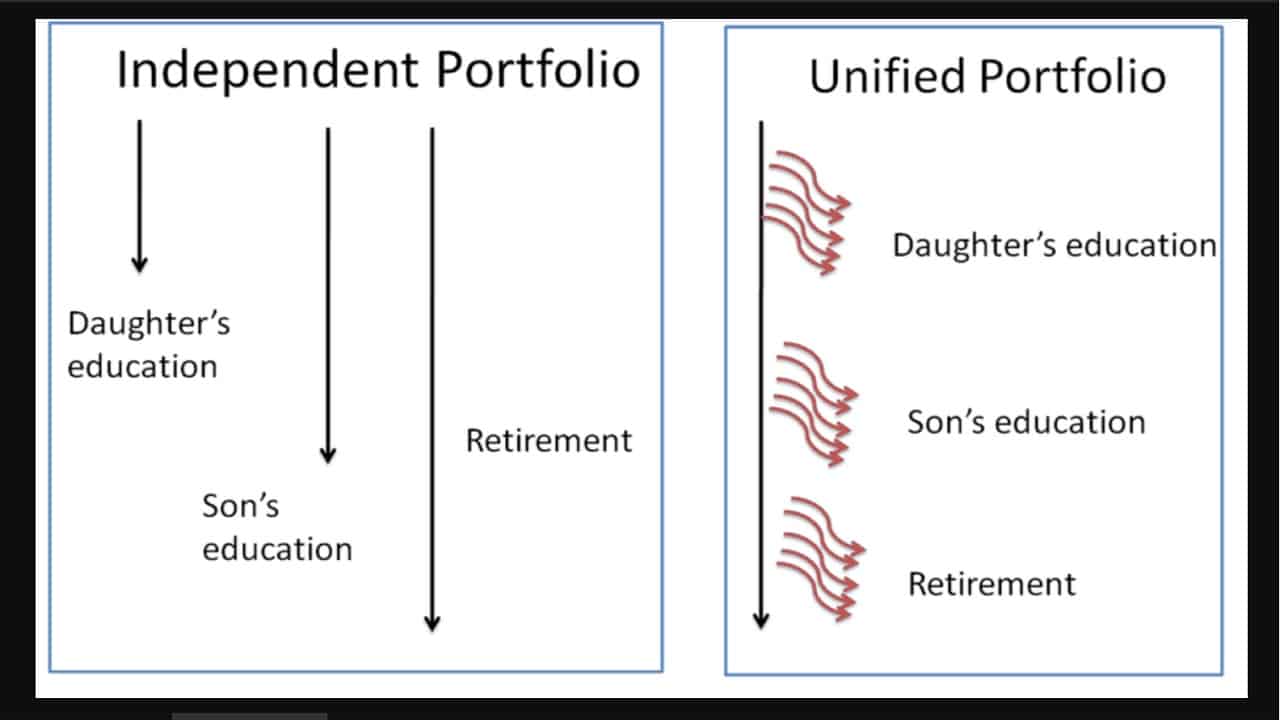
There are additional considerations as well. One of the most enticing aspects of a unified portfolio is not its superficial simplicity but the investment required. The unified portfolio approach assumes that once one goal is completed, more money would be available for investment. This is why the initial investment is lower than the independent portfolio approach.
This is okay if we cannot invest the total amount necessary if all goals are treated independently. It gives us some hope. However, if we can invest a higher amount but do not because of the unified portfolio calculation, it can be risky as we depend on future cash flows.
Index funds can be used for both approaches. In particular, active funds used in the unified portfolio can be messy. If they underperform and you want to switch, the tax outgo can be high. Some people stick to poor funds or clutter their portfolios with additional funds fearing tax.
In summary, while using the same portfolio for all financial goal is in principle ‘ok’, they must all be long-term goals. Either approach will work, but a portfolio de-risking plan is essential for both. In our opinion, it is easier for the typical DIY investor to do this with the independent portfolio approach.
There is no great benefit in having fewer funds if we do not plan the systematic withdrawals ahead. We recommend DIY investors use the independent portfolio approach. This makes tracking and management easier. It also forces them to invest more – if not immediately, at least in the future.
Simplicity in portfolio management should be measured by how well we have planned ahead and not by the number of funds held or what kinds of funds they are.
The Q &A is available in the comments section of this video.