Last Updated on December 29, 2021 at 6:15 pm
In this article, let us consider an example of calculating the annualized return from a stock investment after accounting for corporate actions like dividends and stock splits. We shall consider Colgate-Palmolive the oldest stock in my portfolio.
The calculator used in this illustration can also handle bonuses, buybacks and rights issues. It was first released as a beta version in Oct 2017 and is now being reworked for a fresh release to handle a full portfolio. The beta version is no longer available. We may recall that the CAGR (compounded annualized growth rate) is the measure of annualized return for single investments, the IRR (intern rate of return) for periodic investments and the XIRR (extended IRR) for investments on random dates.
The XIRR for Colgate-Palmolive in my portfolio is 19.7% between Oct 2014 to May 2021. The same purchase dates shall be used in this example, but only one stock is assumed to be purchased each time, resulting in an XIRR of 18%.
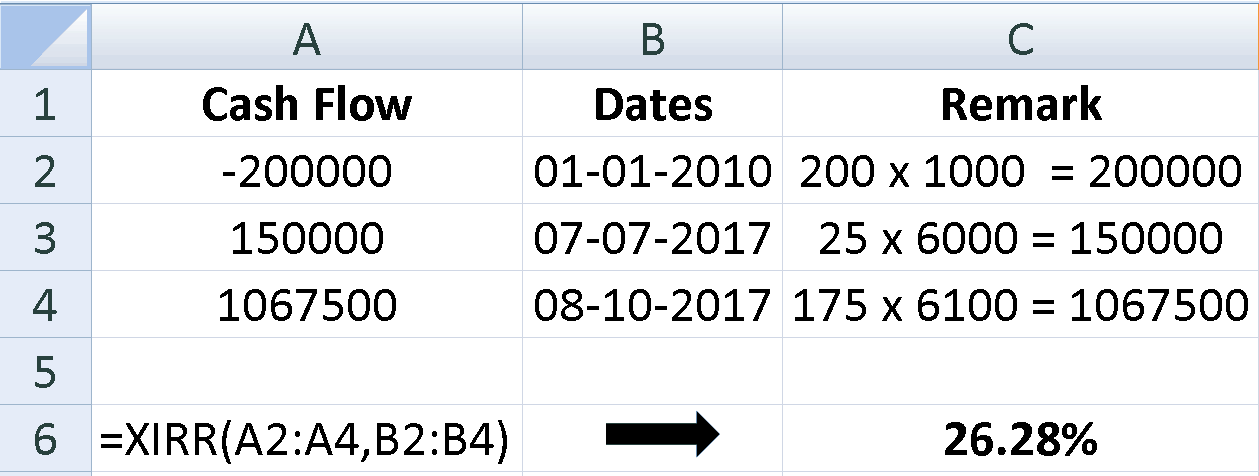
XIRR calculation for investments in growth mutual funds or a stock that does not offer dividends or announce any other corporate action is quite simple. Suppose
🔥Secure your future with our Robo-advisory tool trusted by over 3,500 investors and advisors. From effortless retirement planning to funding your children’s biggest dreams, turn your financial goals into reality. 🔥
Subscribe for money management solutions via email! (Link takes you to our email sign-up form) Join 32,000+ readers in our community.
👉 New Tool Alert! NaviPlan: A Privacy-Focused Multi-asset Tracker and Goal Planner 👈
- you buy 200 stocks of a company at Rs. 1000 a share on 1st Jan 2010
- You sell 25 of those stocks at Rs. 6000 a share on 7th July 2017 and
- calculate the XIRR as of 8th October 2017 (current market price is Rs. 6100). What is the annualized return?
To do this in Excel
Things become complicated with corporate actions. When a stock split or dividend is announced, it is an action by the instrument and not an action by the investor. For example, a dividend announced is money in our hands, but we did not initiate this money transfer the company did.
So while computing XIRR, we shall assume all dividends are reinvested on ex-date (date on which stock price has been adjusted to account for the latest dividend). This is this standard and universally accepted procedure to find out instrument returns. Also see: How to calculate returns from Dividend Mutual Funds and How to calculate returns from Stocks including dividends.
Many people make the mistake of assuming the dividend as a payout. This is certainly easier to do but is not universally accepted and can result in confusion. In this illustration, we have not accounted for dividend taxation, but this is quite simple to include.
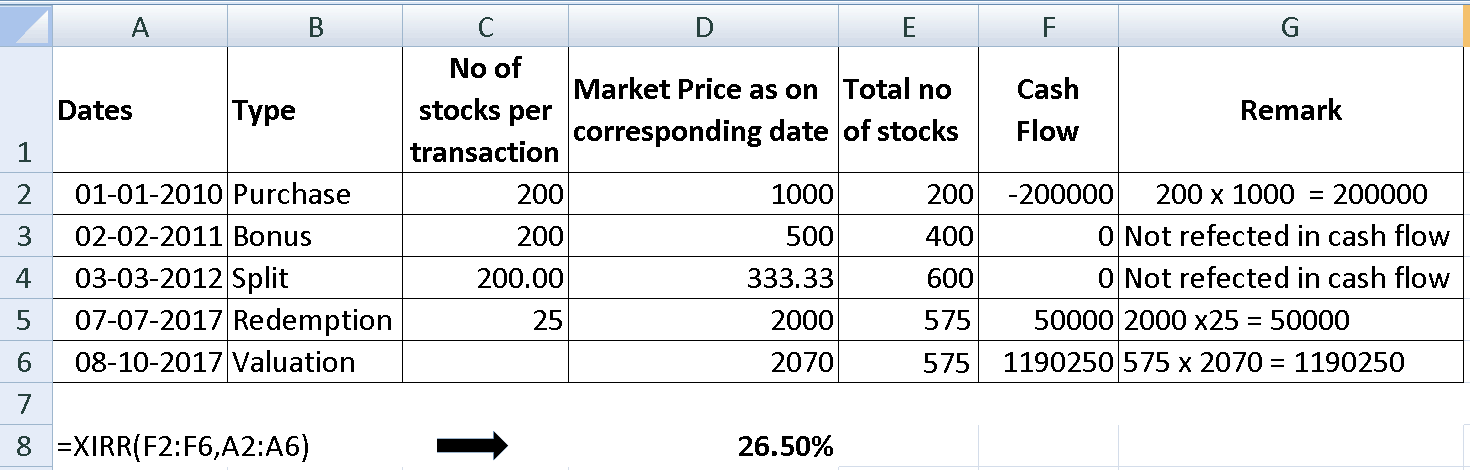
Let us now continue with the above example. Now on 3rd March, a 3:2 split is announced. That is, since you hold 400 shares, half that number or 200 shares will be given to you. This is because
400 x (3/2) = 400 x (1.5) = 400 + 400 * 0.5 = 400 + 200.
So now, you will hold 600 shares. The price will drop by a factor of 1/.5. For example, if the price before the split is Rs. 500, it will drop to 500/1.5 = 333.33.
This will again not be reflected in the cash flow. Entires for a 1:1 bonus on 2nd Feb 2011 is also included with the same reasoning.
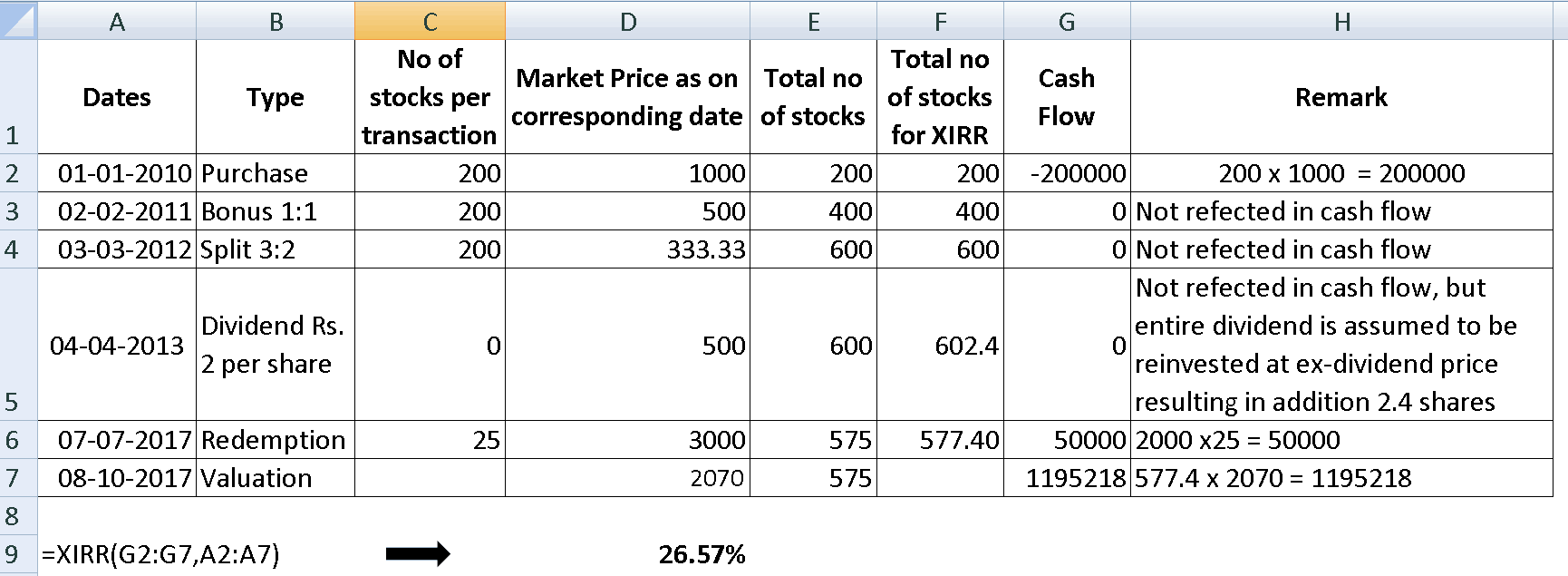
Now a dividend of Rs. 2 per share is announced on 4th April 2013. Regardless of what you do with the dividend, to find the XIRR of the instrument, it will be assumed to be reinvested at the ex-dividend market price. Ex-dividend price is the price before dividend declaration minus the dividend rate.
So the dividend amount of 2 x 600 = 1200 is used to buy imaginary stocks for the XIRR calculation at the ex-div market price of Rs. 200.
So 1200/500 gives 2.4 stocks. Making the total stocks held as 602.4.
Many investors are confused by this and say that this wrong. It is, however, important to recognise that a dividend is an action by the instrument and not by us. Reinvesting stock or mutual fund dividends at ex-price is the standard procedure adopted to calculate instrument XIRR. This is also the procedure recommended by SEBI for mutual funds with dividend option.
Colgate-Palmolive Stock Transactions
The transactions made are shown in the image below. This is a screenshot from the calculator. Several dividends and one stock split are included. For purchases and redemptions, the real-time market price can be included. For corporate actions, one can either use the opening price or closing price on the ex-date. The opening price is probably more accurate but will not make much difference to the XIRR over the long term.
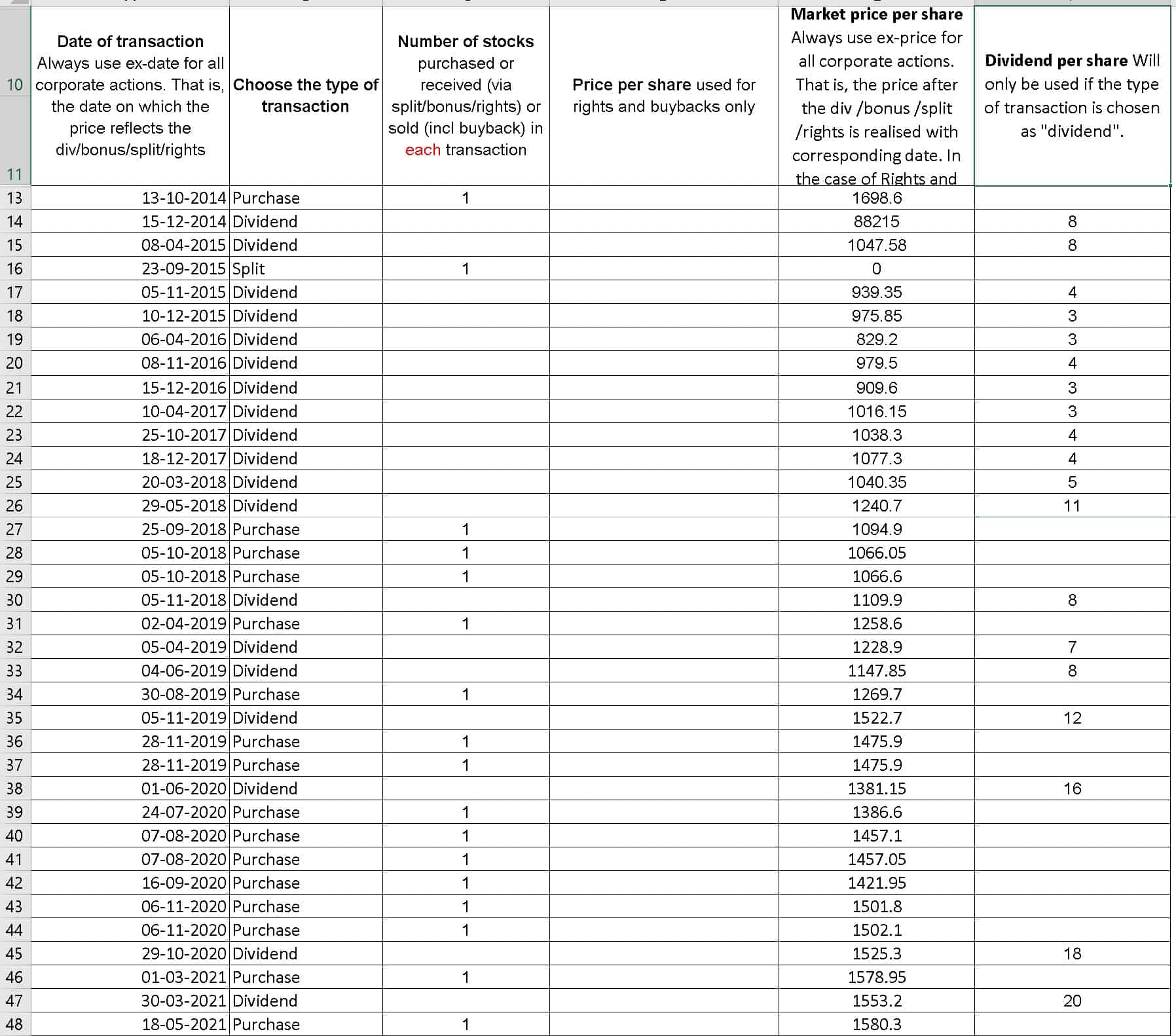
The XIRR calculation is shown below. The reinvested dividends result in a small increase in shares (relevant only for the XIRR calculation). Also, notice that the splits and dividends are not shown as cashflow entires for XIRR.
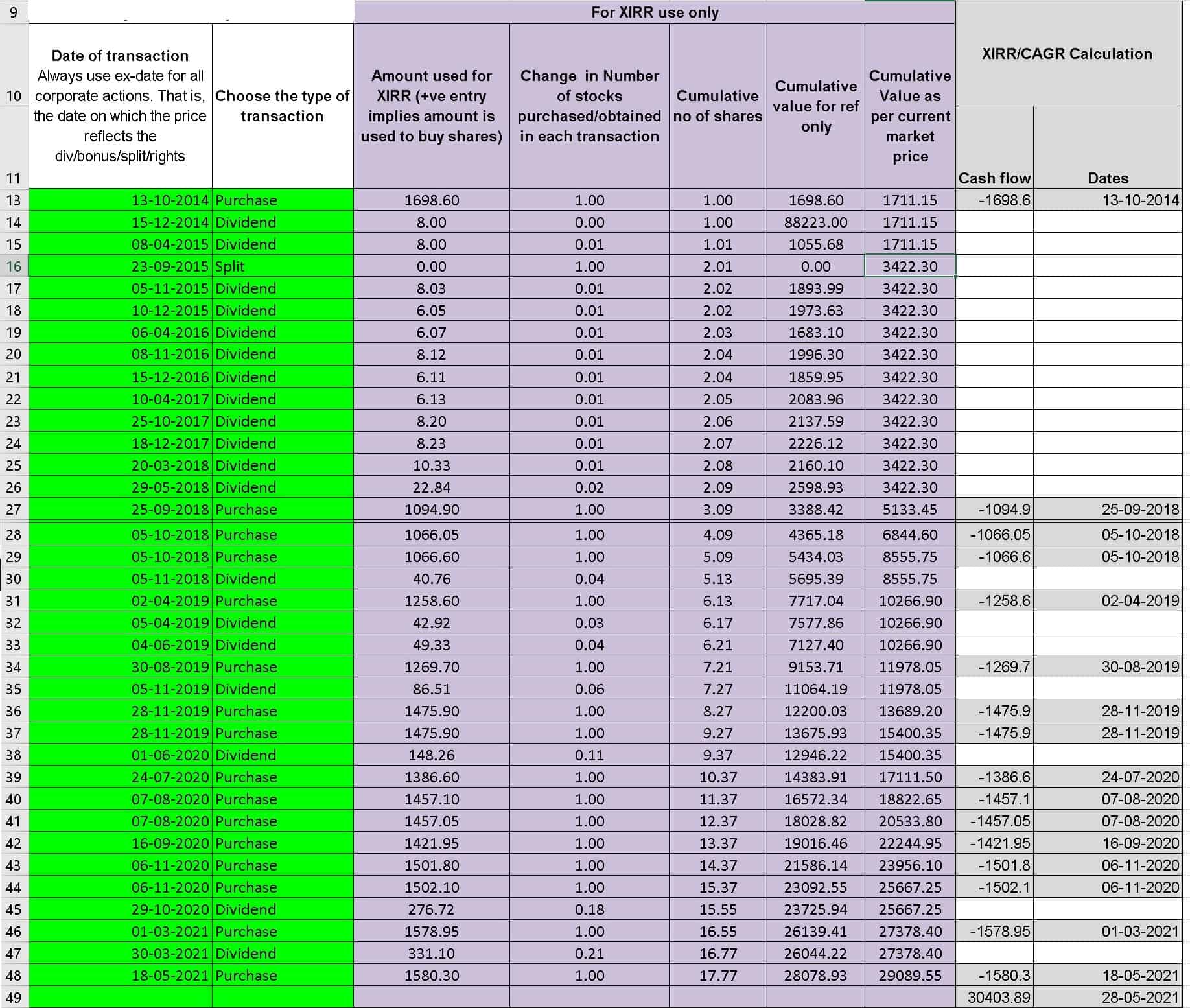
With the current market price and date, the XIRR is computed to be 18%.
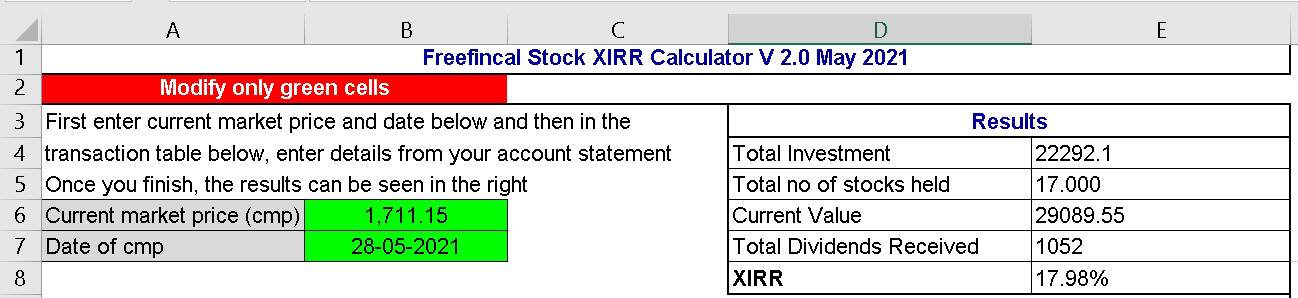
This calculation can also be extended to an entire portfolio of stocks. The user will have to accomplish two tasks to get XIRR for a particular stock or portfolio. Get all transactions from the demat account trade book and then automatically extract the price on ex-dates. The final version of the XIRR calculator will hopefully feature this.