The IDFC US Treasury Bond 0 to 1-year Fund of Fund is an open-ended fund of fund scheme investing in units/shares of overseas Index Funds and/or ETFs which track an index with US treasury securities in the 0-1 year maturity range as its constituents. In this review, we analyse the performance of the underlying index to appreciate the risks and the NFO’s investment suitability.
The first step in analyzing a fund of fund is to look at the fund of funds. According to the scheme information document of IDFC US Treasury Bond Fund of Fund, it will invest in
- JPMorgan ETFs (Ireland) ICAV – BetaBuilders US Treasury Bond 0-1 yr UCITS ETF (inception date: July 2019)
- iShares $ Treasury Bond 0-1yr UCITS ETF (inception date: Feb 2019)
Since these are quite new funds, we must look at the underlying benchmark data. The JP Morgan fund’s benchmark is ICE 0-1 Year US Treasury Securities Index. The iShares ETF’s benchmark is IDC US Treasury Short Term Index (USD).
Since we could get hold of historical data of these benchmarks, we need to look for alternatives. Thankfully there are two:
- Goldman Sachs Access Treasury 0-1 Year ETF (GBIL) (Data from Sep 2016)
- S&P U.S. Treasury Bond 0-1 Year Index (Data available for the last ten years trailing)
So the S&P Index is a natural choice as it has the longest history. Please keep in mind that the analysis below does not consider expenses and tracking errors. These will significantly lower returns in a fund of fund.
🔥Secure your future with our Robo-advisory tool trusted by over 3,500 investors and advisors. From effortless retirement planning to funding your children’s biggest dreams, turn your financial goals into reality. 🔥
Subscribe for money management solutions via email! (Link takes you to our email sign-up form) Join 32,000+ readers in our community.
👉 New Tool Alert! NaviPlan: A Privacy-Focused Multi-asset Tracker and Goal Planner 👈
Now, what is the AMC’s main selling point here? Why do they want to launch this now and want us to invest? This is the 1-year rolling returns of S&P U.S. Treasury Bond 0-1 Year Index in USD. The number inside the graph (3834) represents the number of 1Y return data points.
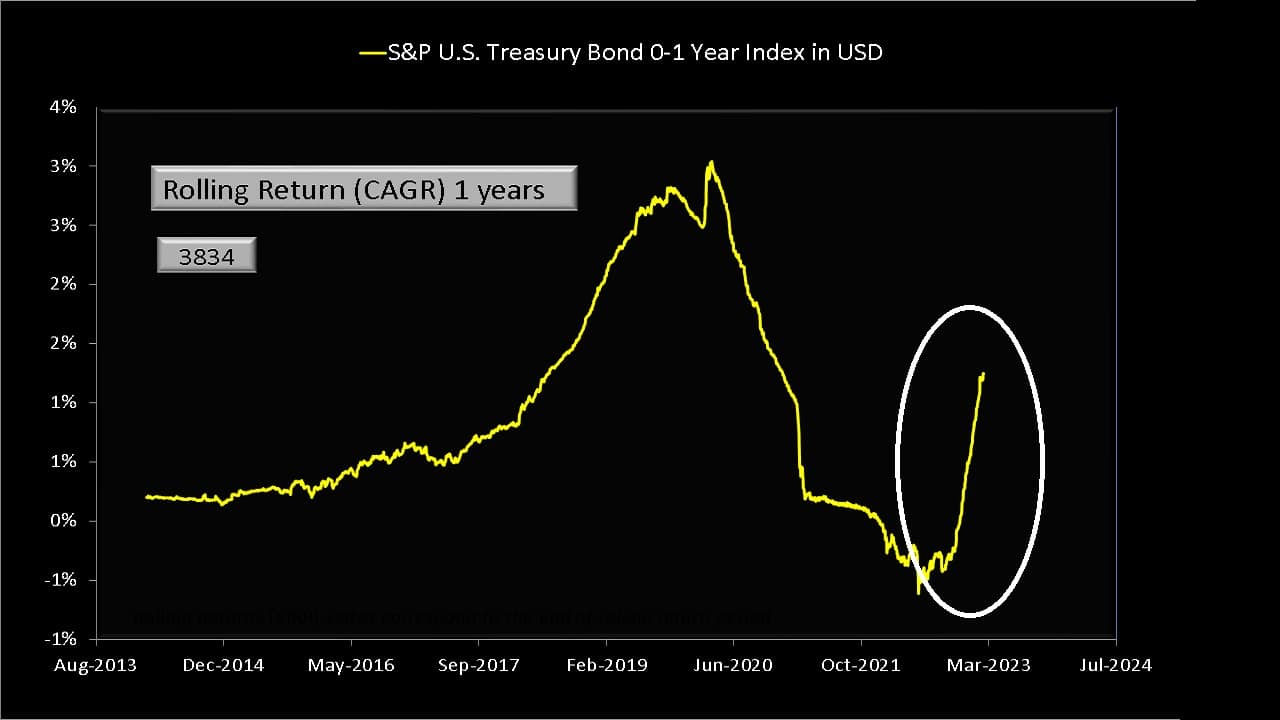
So the index has profited due to the US Fed rate hikes. IDFC US Treasury Bond Fund of Fund will give us returns in INR. So this means we will benefit much more? Then is this fund not a great investment?
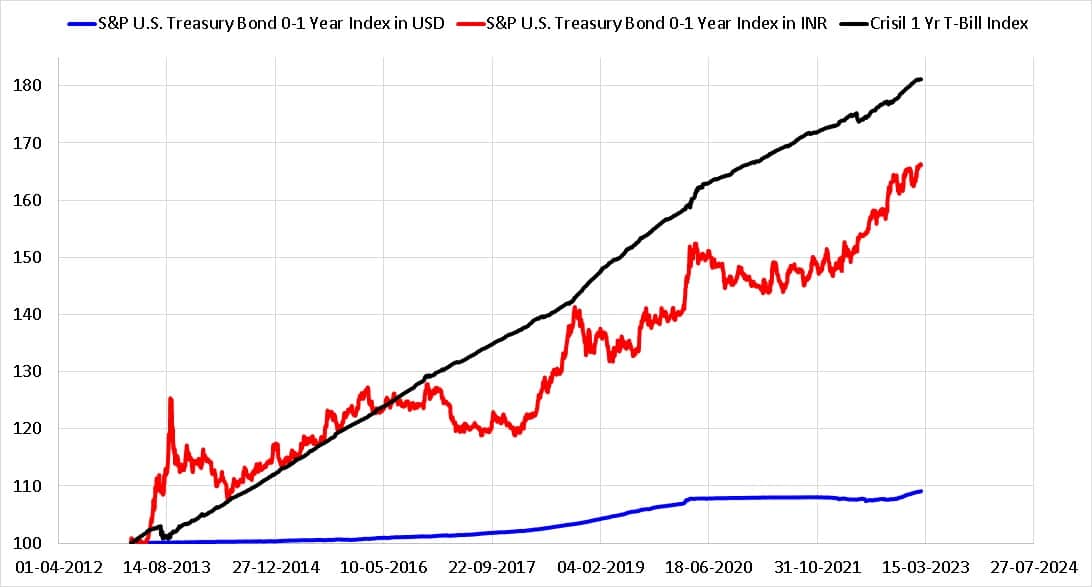
Not so fast! No party will last forever! Let us first consider the following three indices.
- S&P U.S. Treasury Bond 0-1 Year Index in USD
- S&P U.S. Treasury Bond 0-1 Year Index in INR
- Crisil 1 Yr T-Bill Index
So what can we learn from their evolution?
- Investing in IDFC US Treasury Bond 0 to 1-year Fund of Fund will essentially be investing in the USD/INR exchange rate as the US treasury bond is essentially cash (money market).
- Therefore, the fund will not be stable like a money market fund but will be quite volatile because exchange rate movements can suddenly become quite volatile. See: Basics: Why does the Rupee fluctuate in value against the US Dollar?
- Over the last ten years, a short-term bond fund (liquid, money market, ultra short-term fund) in India would have resulted in a better reward at significantly lower risk.
Has your enthusiasm for the NFO waned a bit? Good, hang on. Let us now look at the rolling returns of the there indices.
Notice how the first graph above dramatically changes if we add the other two indices.
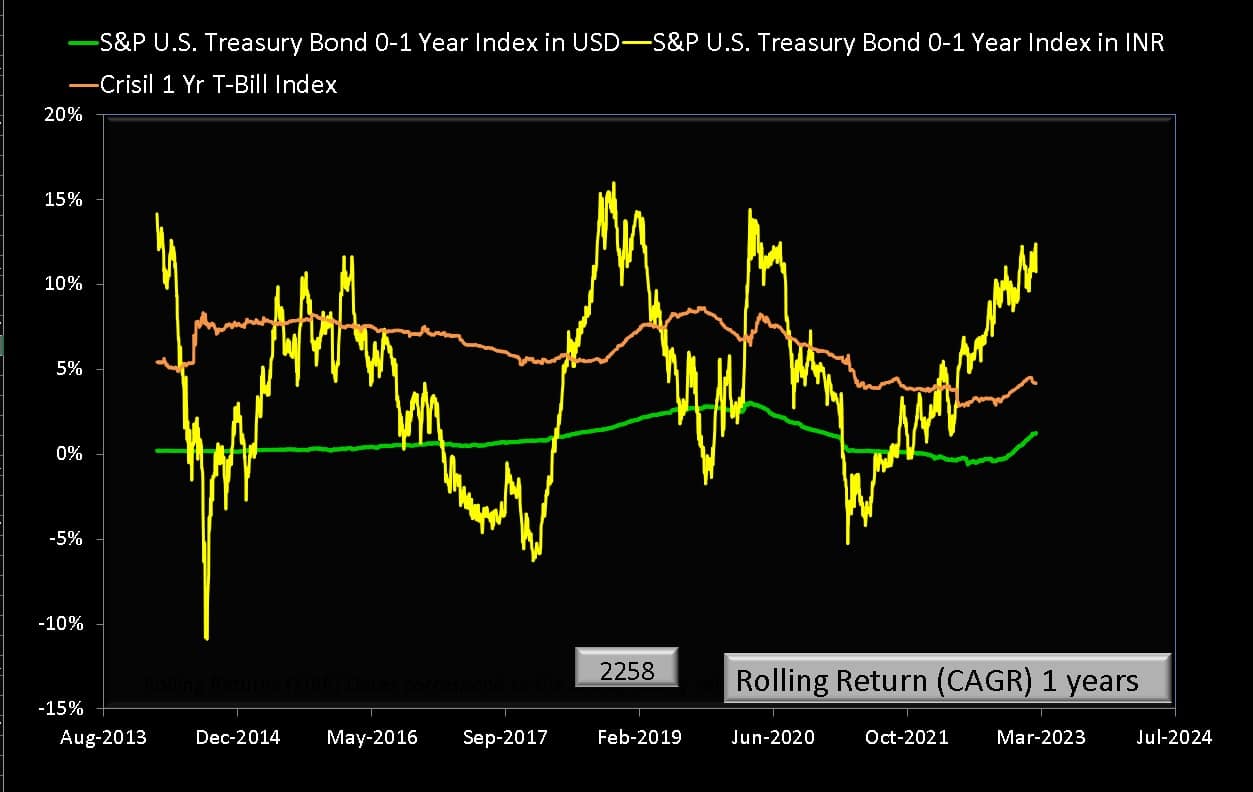
Notice that the US treasury index in INR will not always give positive returns over a year. There have been dramatic losses in the past.
So the AMC’s claim in their one-page presentation that,”With limited duration
sensitivity, intending to create a USD asset for funding a near-term or defined expense
without wanting to take any equity market-linked volatility” should not be taken literally.
Over the short-term, the exchange rate can be as volatile as the equity market! Again even if you had a US-based expenditure, why park money in this fund of funds when you can happily do it in an Indian debt fund or Arbitrage fund?
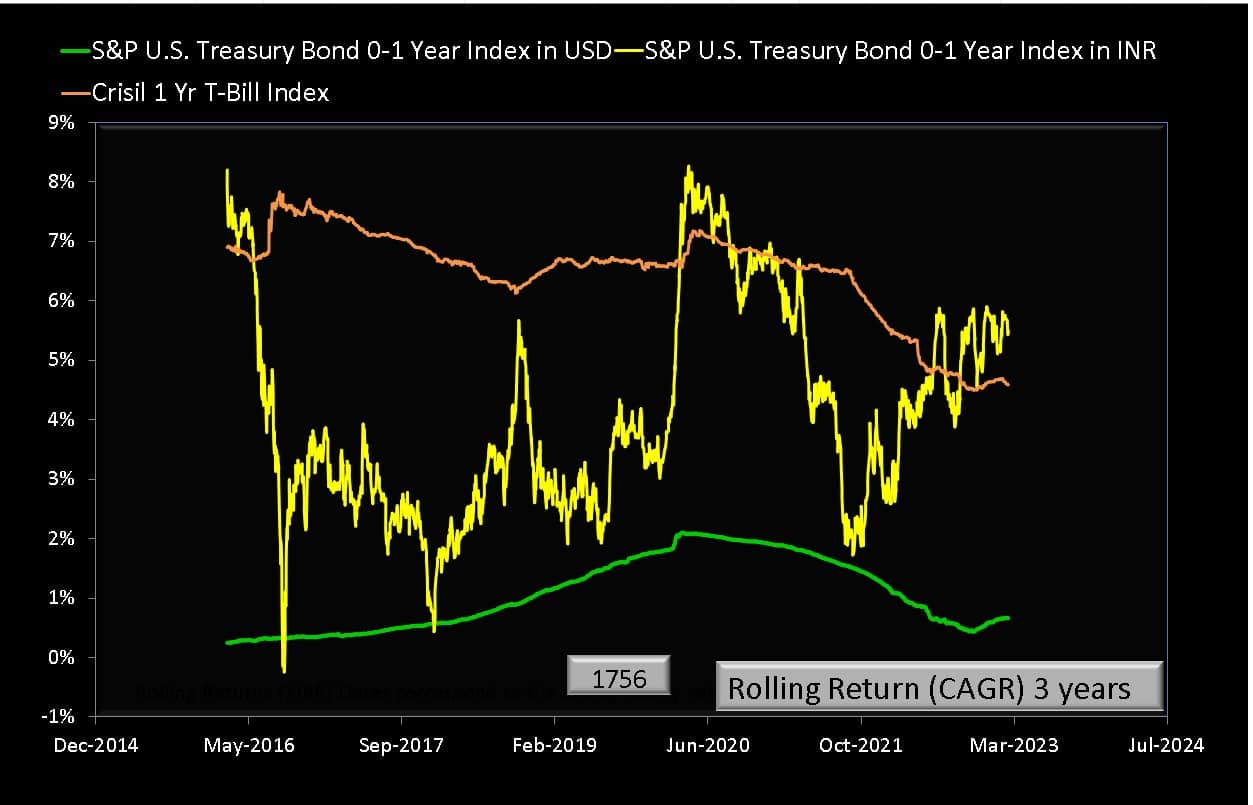
Do things get better over three years? Not really! Please note that this does not factor in expenses or tracking errors. So the returns of all three indices will be a bit lower. More for the fund of fund as it has double expenses to account for.
What about over five years and seven years?
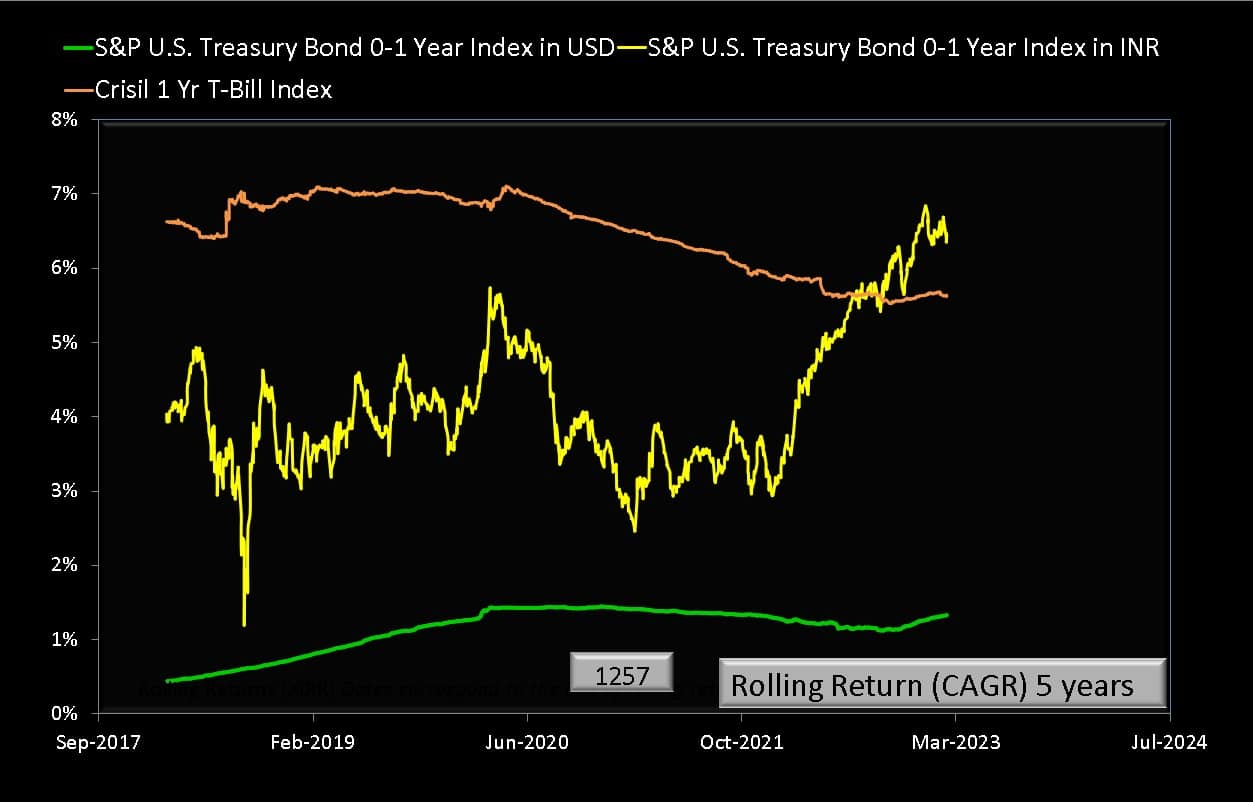
Over the last year or so the 5Y return of the US treasury index in INR is higher than the CRISIL 1Y T-bill index. Do you really think that this will continue on forever?
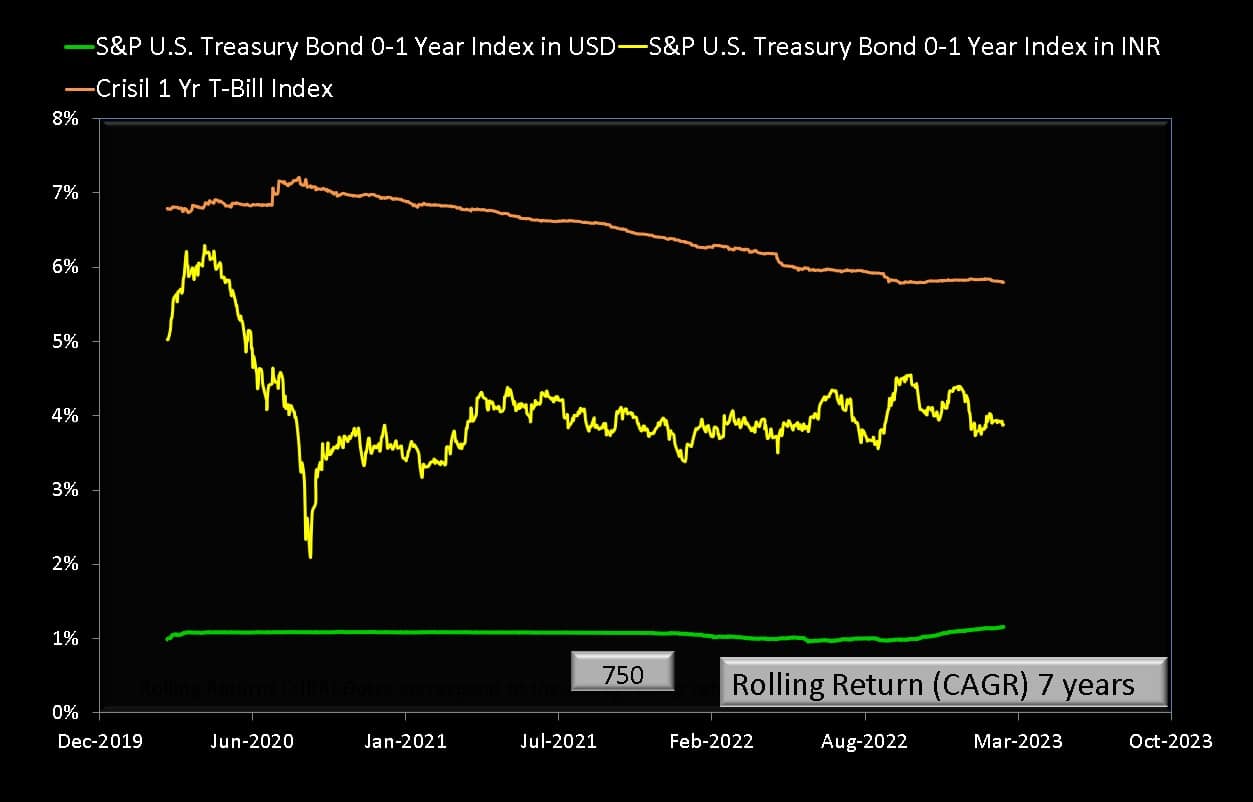
Clearly, an Indian money market or short-term debt fund will get the job done with better reward and significantly lower risk. So why bother with IDFC US Treasury Bond 0 to 1-year Fund of Fund? We recommend that you don’t!
But what about returns from rupee depreciation? Can I not use this fund for that? Please don’t think of me as sentimental, but it is lame to bet against your own country. And I have data to prove it. See, for example.
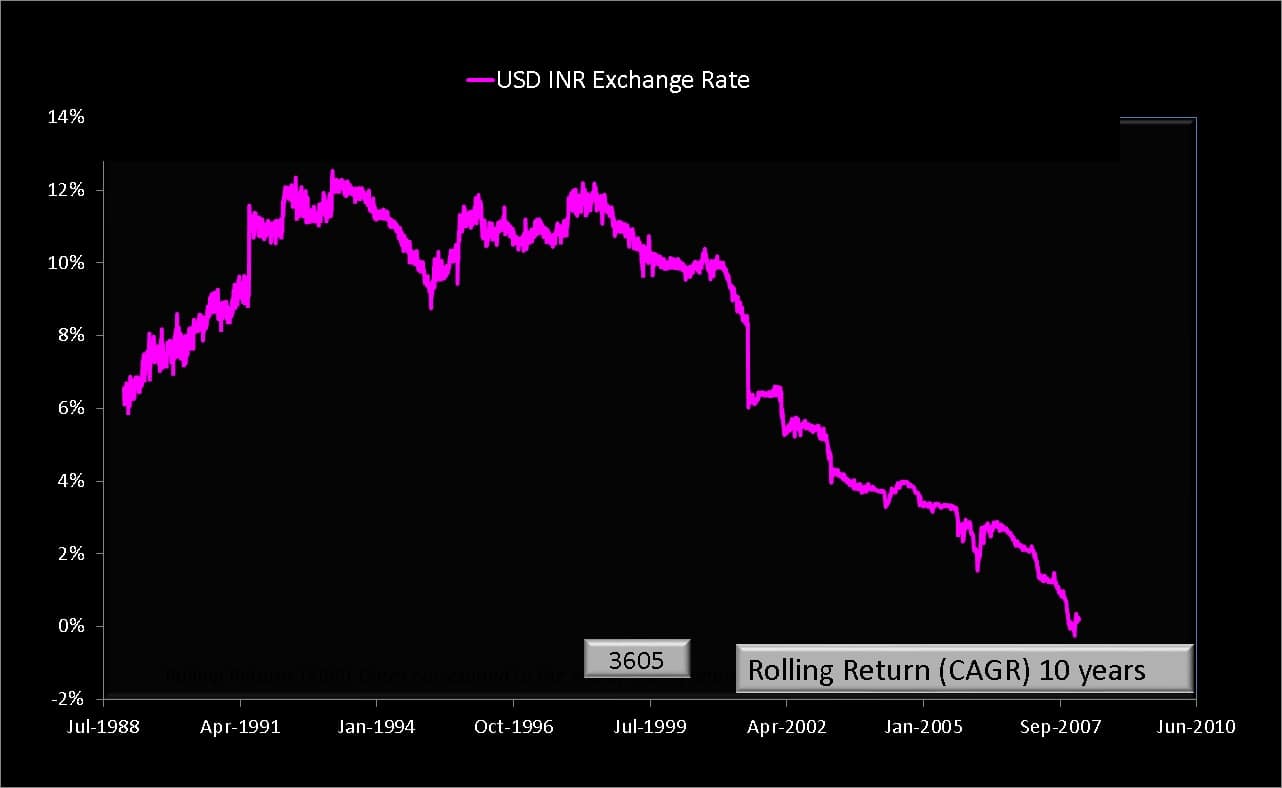
For more charts and commentary, see: Sensex vs S&P 500 vs Nasdaq 100: Which is better for the long term?
And even if you would like to bet against the rupee, you would only get a return similar to a short-term debt fund with enormously higher volatility. This exchange rate business is much ado about nothing.
We, therefore, see no compelling reason to invest in IDFC US Treasury Bond 0 to 1-year Fund of Fund and recommend avoiding it.