Last Updated on December 29, 2021 at 12:11 pm
Here are five index funds based on Sensex and the Nifty that have beat their indices in the last year! Therefore, investors should avoid such funds! Since an index fund has expenses associated with management and commissions (in the regular plan), it is impossible for an index fund to produce a return more than the index that it is tracking. However, this is sometimes possible.
If the portfolio of the index fund has stock weights that differ from the index for an extended period, the index fund will produce a return that is higher (or significantly lower) than the total returns index return (if we include dividends).
While this can happen just from fund management inefficiency, a large inflow or outflow of money from the index can cause. Therefore, index funds with a small AUM are especially vulnerable to such deviations.
🔥Secure your future with our Robo-advisory tool trusted by over 3,500 investors and advisors. From effortless retirement planning to funding your children’s biggest dreams, turn your financial goals into reality. 🔥
Subscribe for money management solutions via email! (Link takes you to our email sign-up form) Join 32,000+ readers in our community.
👉 New Tool Alert! NaviPlan: A Privacy-Focused Multi-asset Tracker and Goal Planner 👈

I was trying to check if there is any correlation between expense ratio and return from the list of large cap funds tracking the Sensex and Nifty. I was shocked to find a huge spread in returns! Here is the full list.Source Value Research
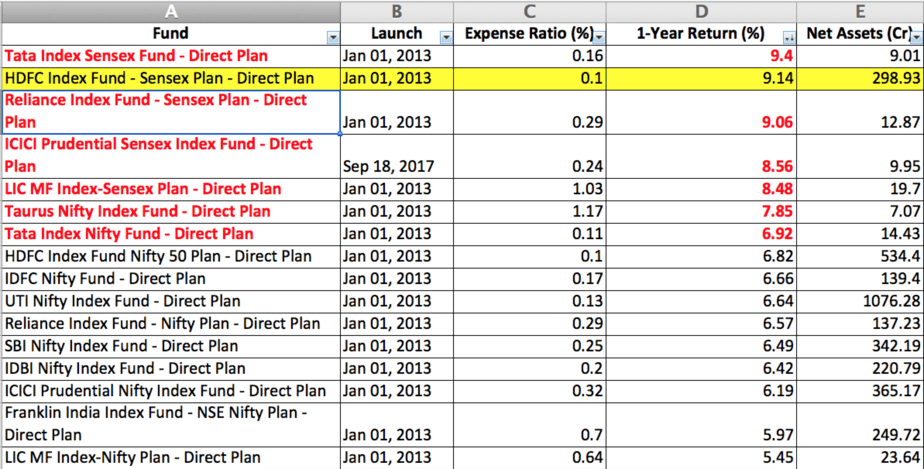
First, Nifty and Sensex returns are nearly the same and for the one year trailing return period considered (6th Feb 2018 to 6th Feb 2019), NiFTY TRI return was 6.93%. Now, notice the return from the funds marked in red.
The HDFC Sensex fund marked in yellow is an exception as the AMC merged its Sensex plus plan with its Sensex fund. The Sensex plus plan was actively managed to a small extent and hence the extra return in this case can be excused.
A 2-2.5% excess return over the benchmark is extremely unhealthy for an index fund. This essentially means that the fund manager did not or could not keep track the index efficiently. The most likely reason for this is clear enough if we inspect the AUM.
Five index funds beat their indices in the past year
| Fund | Expense Ratio (%) | 1-Year Return (%) | Net Assets (Cr) |
| Tata Index Sensex Fund – Direct Plan | 0.16 | 9.4 | 9.01 |
| Reliance Index Fund – Sensex Plan – Direct Plan | 0.29 | 9.06 | 12.87 |
| ICICI Prudential Sensex Index Fund – Direct Plan | 0.24 | 8.56 | 9.95 |
| LIC MF Index-Sensex Plan – Direct Plan | 1.03 | 8.48 | 19.7 |
| Taurus Nifty Index Fund – Direct Plan | 1.17 | 7.85 | 7.07 |
| Tata Index Nifty Fund – Direct Plan | 0.11 | 6.92 | 14.43 |
| HDFC Index Fund Nifty 50 Plan – Direct Plan | 0.1 | 6.82 | 534.4 |
| IDFC Nifty Fund – Direct Plan | 0.17 | 6.66 | 139.4 |
| UTI Nifty Index Fund – Direct Plan | 0.13 | 6.64 | 1076.28 |
| Reliance Index Fund – Nifty Plan – Direct Plan | 0.29 | 6.57 | 137.23 |
| SBI Nifty Index Fund – Direct Plan | 0.25 | 6.49 | 342.19 |
| IDBI Nifty Index Fund – Direct Plan | 0.2 | 6.42 | 220.79 |
| ICICI Prudential Nifty Index Fund – Direct Plan | 0.32 | 6.19 | 365.17 |
| Franklin India Index Fund – NSE Nifty Plan – Direct Plan | 0.7 | 5.97 | 249.72 |
| LIC MF Index-Nifty Plan – Direct Plan | 0.64 | 5.45 | 23.64 |
Among these, the fund marked in red, namely: Tata Index Sensex Fund, Reliance Index Fund – Sensex Plan, ICICI Prudential Sensex Index Fund, LIC MF Index-Sensex Plan, Taurus Nifty Index Fund, Tata Index Nifty Fund have an AUM well below 100 crores. At this such low levels, inflows or outflows can make the funds portfolio deviation from that of the index resuling in a higher (or lower) return,
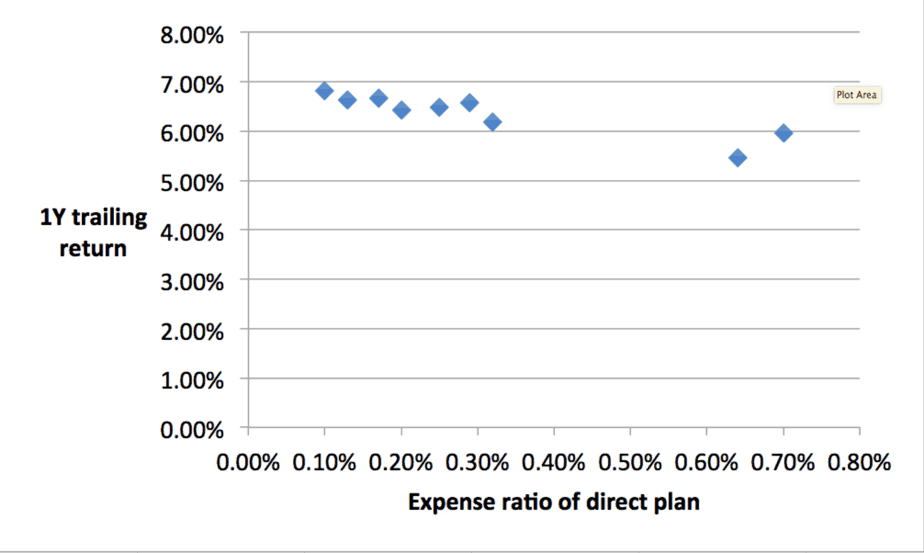
Expene ratio vs trailing return
If the expense ratio of the remaining funds and their last one year trailing retuns are plotted, it is comforting to see that higher the expense ratio, lower the return – as it should be.
What should index investors do? How to choose an index fund?
Investors wanting to build a passive equity portfolio should not just consider the expense ratio. They should avoid low AUM funds and stick to funds with as high an AUM as possible. In fact, a higher AUM (at least 100+ crores) should be first filter for selection.
In this report we have only considered Sensex and Nifty index funds. Other index funds tracking Nifty Next 50, Nifty 50 Equal Weight and Nifty 100 Equal Weight should also be prone to such errors as many of them do not have a large AUM. Therefore investors should be wary of performance.