Last Updated on December 29, 2021 at 5:54 pm
Kotak International REIT FOF is an open-ended fund of fund scheme investing in units of SMAM ASIA REIT Sub Trust fund and/or other similar overseas REIT funds. The NFO period closes on Dec 21st 2020. In this review, we explain how a Real Estate Investment Trust (REIT) works and what kind of return one can expect from this fund of fund.
What is a REIT? Just as an equity mutual fund pools investor money together and buys stocks, a real estate investment trust pools money to buy/sell real estate. The resulting capital gains or rent shall be passed on to investors. Most of the rental income is usually passed on as dividends to holders.
How will Kotak International REIT FOF work? It will invest our money in an international RIET Fund like SMAM ASIA REIT Sub Trust fund (called underlying fund) This invest in properties across the Asia-Pacific excluding Japan. The dividend income and capital appreciation from these properties would be reinvested by Kotak into the underlying fund on our behalf.
What are the risks? The NAV will fluctuate according to real estate market demand and supply. If you buy a property to receive rental income, you would not be valuing the property daily. It is only at the time of sale, the market price would matter. Also as long as you receive rent regularly the playability risk is invisible (like credit risk in bonds). When you buy a RIET the property prices would fluctuate on a daily basis. There could be bull runs or bear runs like in a stock market. Economic conditions can impact returns. If a large chunk of properties need to be sold to meet redemptions, there is a chance that the fund manager may have to settle for a lower than market price (liquidity risk).
🔥Secure your future with our Robo-advisory tool trusted by over 3,500 investors and advisors. From effortless retirement planning to funding your children’s biggest dreams, turn your financial goals into reality. 🔥
Subscribe for money management solutions via email! (Link takes you to our email sign-up form) Join 32,000+ readers in our community.
👉 New Tool Alert! NaviPlan: A Privacy-Focused Multi-asset Tracker and Goal Planner 👈
Buying a RIET is not the same as letting out a portion of your house for rent. The volatility as we shall see below is comparable to the stock market.
Thes screenshot below is from the REITs latest factsheet (linked above). Notice both the volatility in the NAV and the huge dividend component.
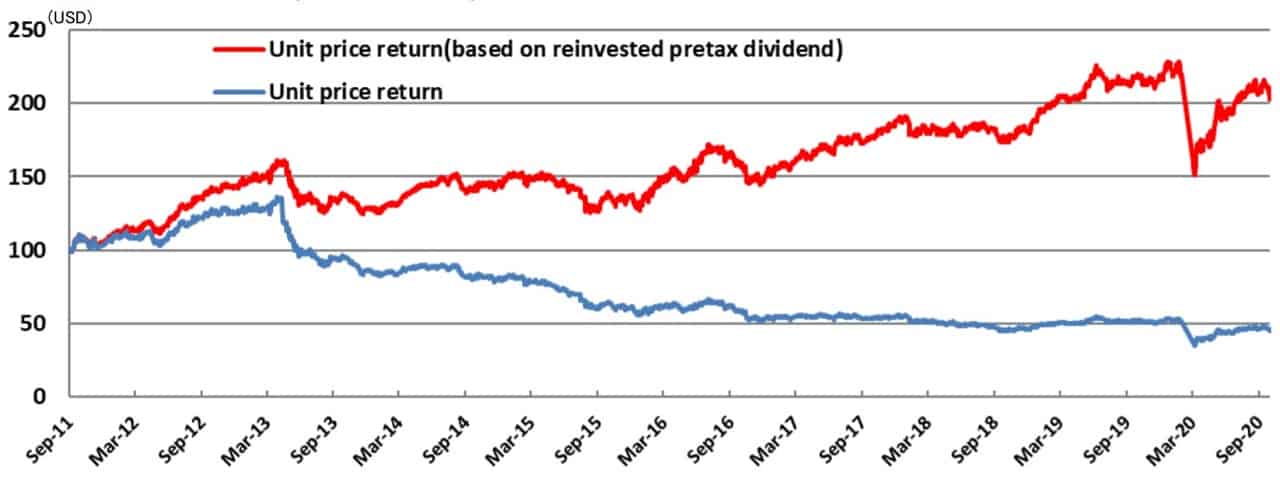
Before we analyse this further, let us first compare the risk and reward of REITS with equity, bonds and gold.
REITs vs Equity vs Bonds vs Gold: Risk-reward comparison
We present the three, five and ten year annualized risk (standard deviation of monthly returns) and annualised returns (CAGR) of S&P Pacific REIT Total Returns in INR*, S& P 500 Total Returns in INR; S&P BSE Sensex Total Returns in INR, S&P BSE India 10-year Sov Bond Index in INR and Nippon Indian Gold BeEs ETF Price return in INR. Source: Factsheets from spglobal.com
* The RIET index comprises of the full Asia Pacific including Japan but we shall use it to appreciate associated risk/reward. The index returns in USD was converted into INR using the same scaling factor bet S&P 500 USD and INR. Therefore they are approximate.
In the three graphs below, scan the blue bars from left to right. They represent the annualised risk.
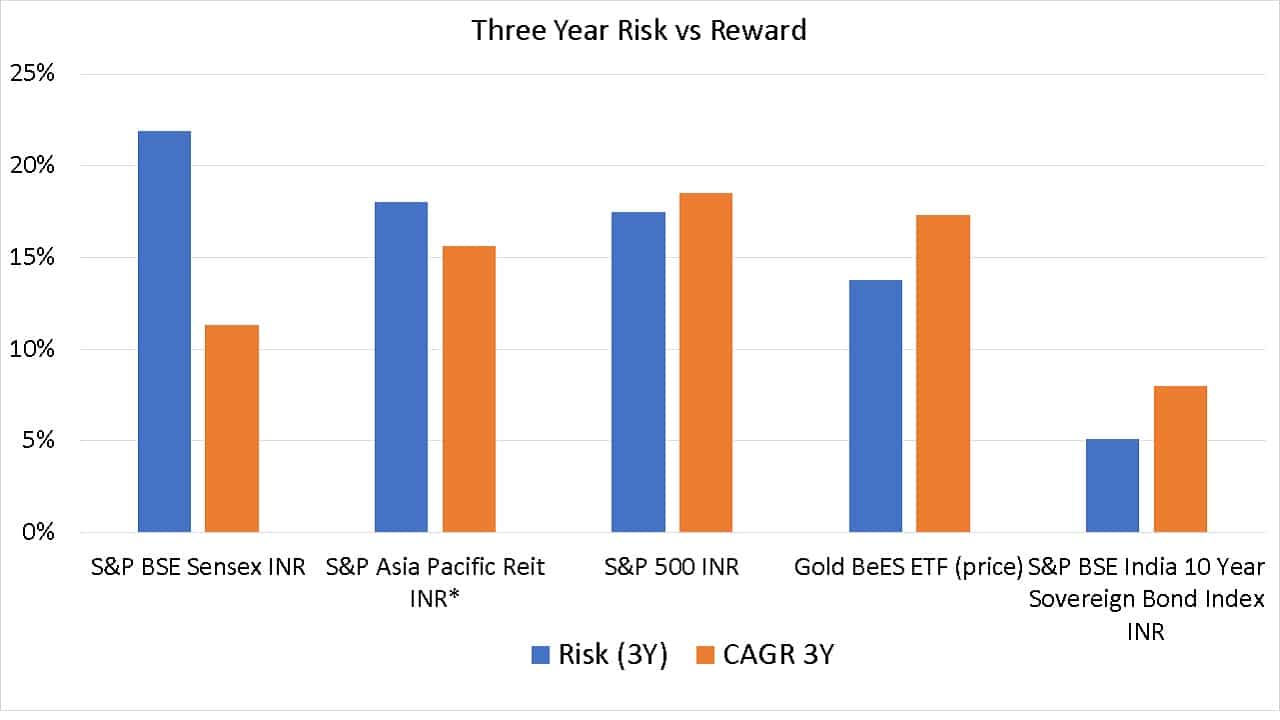
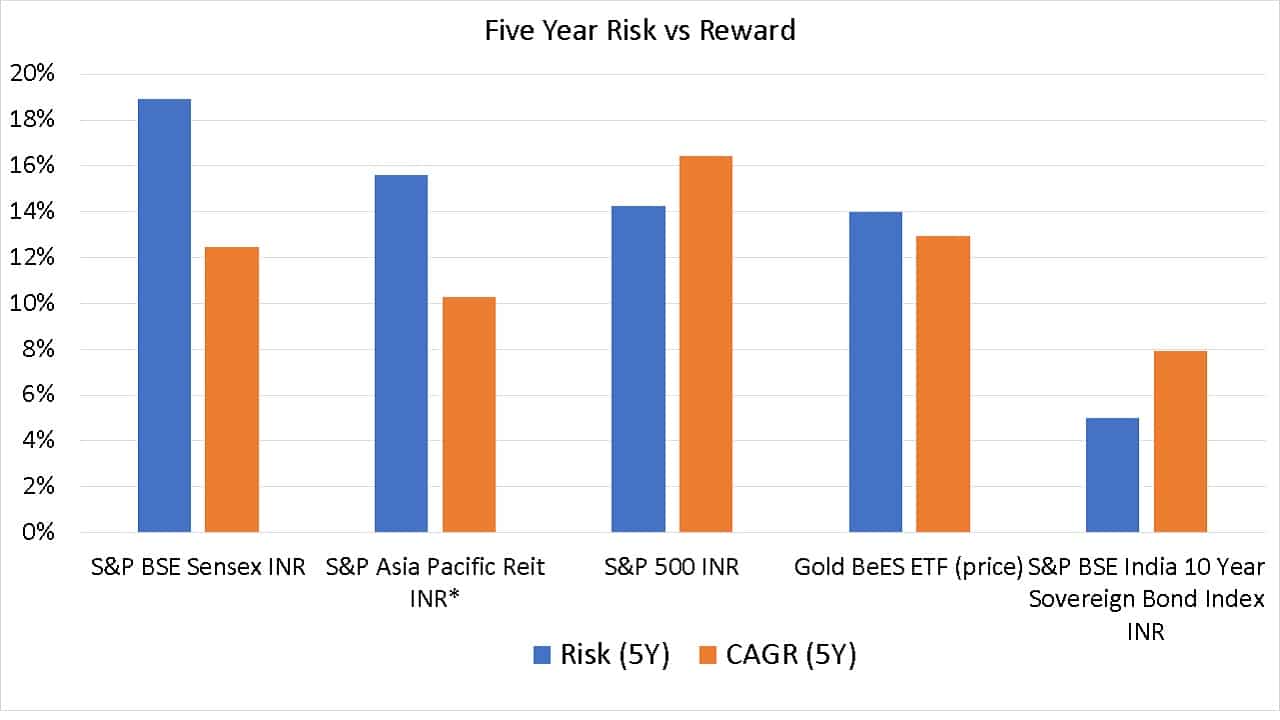
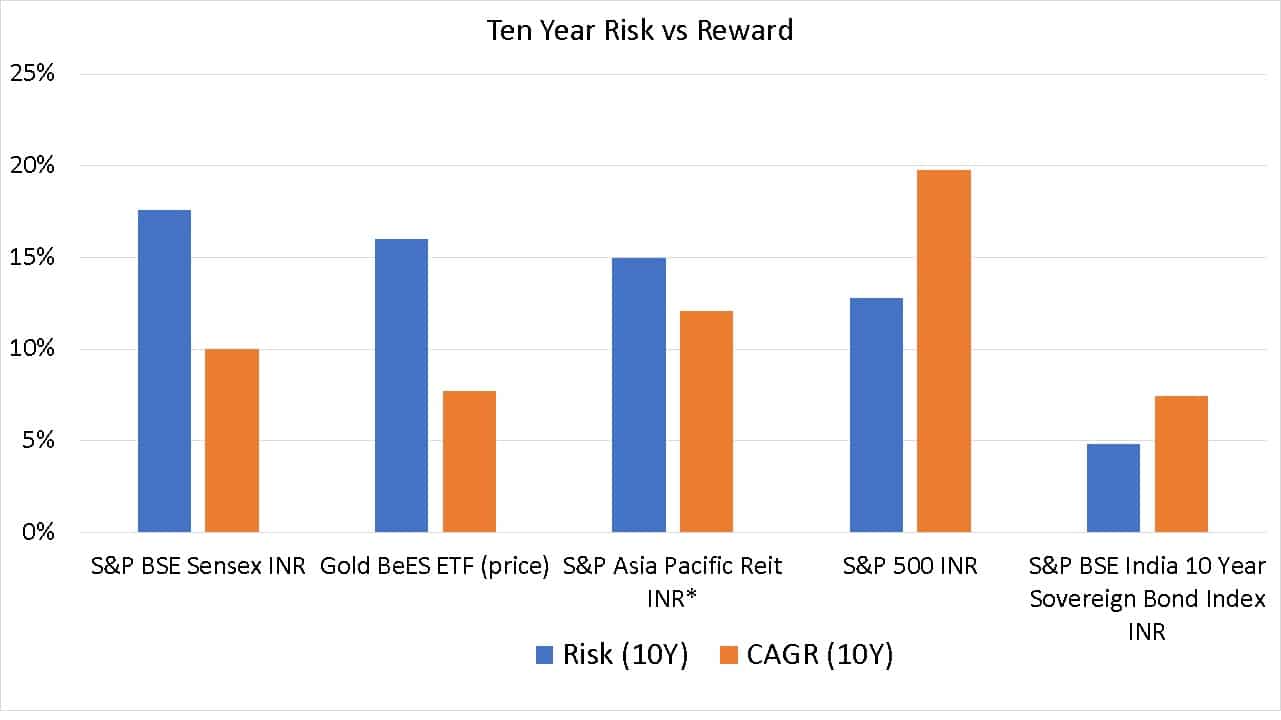
Notice that REIT volatility is comparable to that in the equity and gold markets. The returns can fluctuate. The adage “higher risk results in higher reward” is wrong as can be been from the above. There is no simple correlation between the two.
What return can I get from Kotak International REIT FOF? Investors should first expect a risk comparable to equity from this fund of fund. Just like one cannot expect returns from an equity fund – see: Do not expect returns from mutual fund SIPs! Do this instead! – one should not expect returns from this REIT of as well.
What return can I expect from Kotak International REIT FOF?
To determine this, let us study the rolling returns of SMAM ASIA REIT Sub Trust fund. The NAV of this fund could not be downloaded from the AMC site (in spite of Chrome’s excellent translation of Japanese). Therefore we used WebPlotDigitizer to get the time series approximately (red dots on the red line shown above)
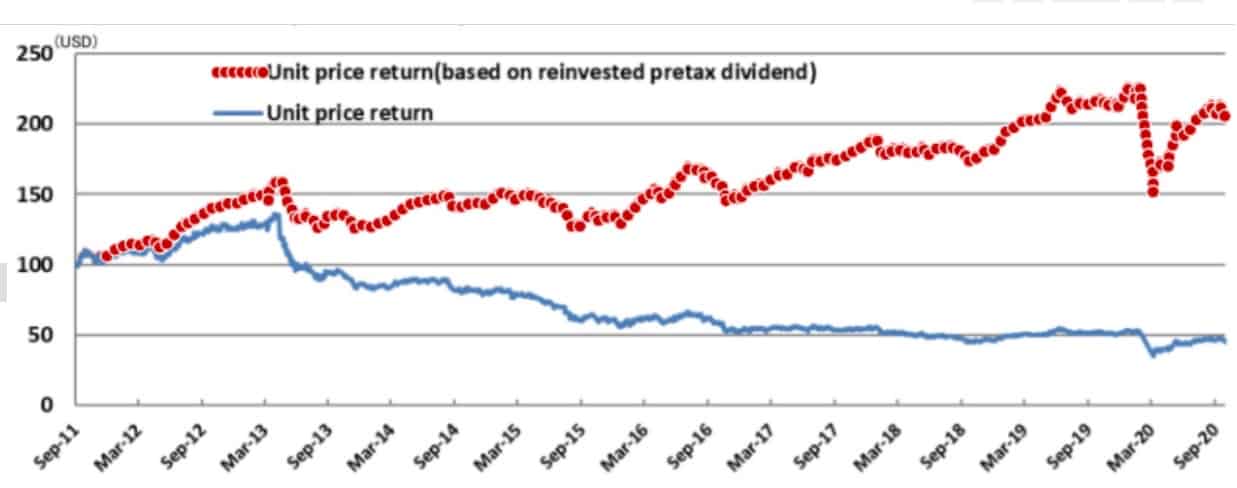
This can be used to give an estimate of the kind of returns in USD (incl dividends) one can expect from this REIT over three and five years.
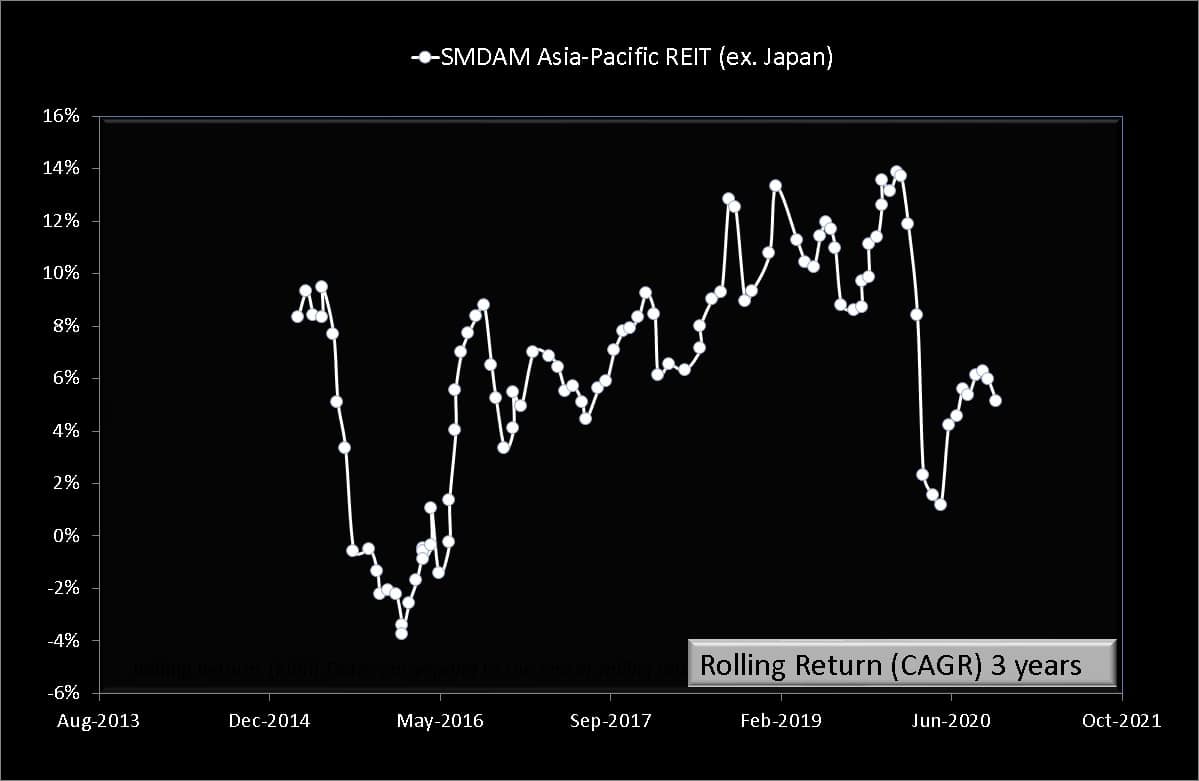
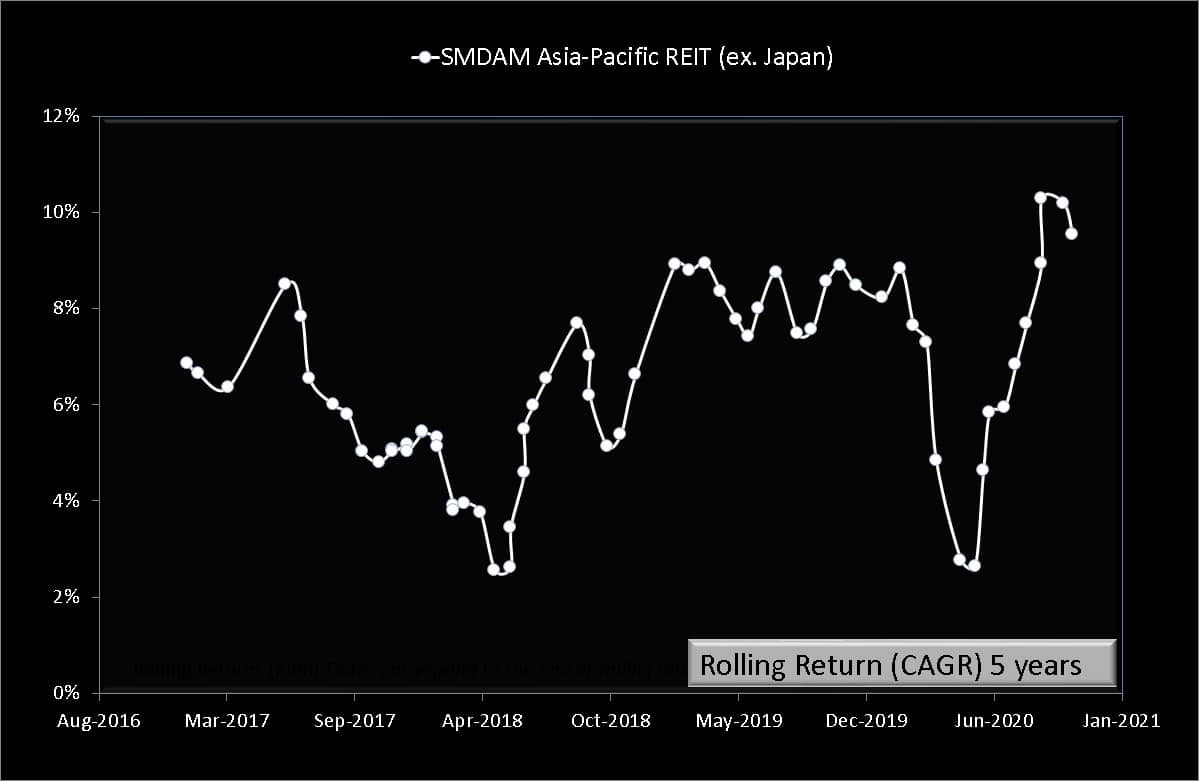
Notice that returns have swung from -4% to 14% (approx) over three-year windows and from 2% to 10% (approx) over five-year windows. An investor should appreciate this kind of risk before investing. The Indian real estate is entirely unregulated and returns are anecdotal and unsubstantiated. If you invest in a REIT, market risk is the price to pay. Also see: Real Estate Investing: Practical aspects retail investors should keep in mind
In summary, it makes little sense to invest in Kotak International REIT FOF. In any case, the exposure will be small compared to fixed income or equity components in our portfolio. Such small exposure to something so volatile is not worth it.