Last Updated on December 29, 2021 at 5:52 pm
Motilal Oswal 5 Year G-Sec ETF is an open-ended scheme replicating/tracking Nifty 5-year Benchmark G-Sec Index. It is being marketed as a “safe” and “a low-cost alternative to FDs”. In this review, we show this is not true and what investors need to know about this ETF.
Suppose you buy a five-year G-sec bond vis NSEgoBid. See how to do this here: Can I get a pension using GOI bonds instead of LIC pension? There is practically no risk if you hold it until maturity.
Try to sell it mid-term then you will face market volatility. Sometimes you can make a spectacular gain or a big loss. When you buy an open-ended mutual fund or ETF, its NAV will reflect the daily market price and hence your investment will be subject to demand and supply risk.
In addition in an ETF, you will have to buy and sell not from the AMC (like in a normal MF) but from/to a private pool of fellow investors. Therefore, you may buy the NFO at the set price but once the ETF lists, the NAV of the ETF is irrelevant. Only the price matters.
🔥Secure your future with our Robo-advisory tool trusted by over 3,500 investors and advisors. From effortless retirement planning to funding your children’s biggest dreams, turn your financial goals into reality. 🔥
Subscribe for money management solutions via email! (Link takes you to our email sign-up form) Join 32,000+ readers in our community.
👉 New Tool Alert! NaviPlan: A Privacy-Focused Multi-asset Tracker and Goal Planner 👈
The price at any given point in time may differ significantly from the NAV depending on the demand and supply among the ETF investors. So in addition to the market volatility, there is an additional layer of volatility or uncertainty in an ETF and this depends on how actively the ETF is being traded.
Suppose you are simply tracking the benchmark Nifty 5-year Benchmark G-Sec Index. This is how the price has varied since Sep 2001.
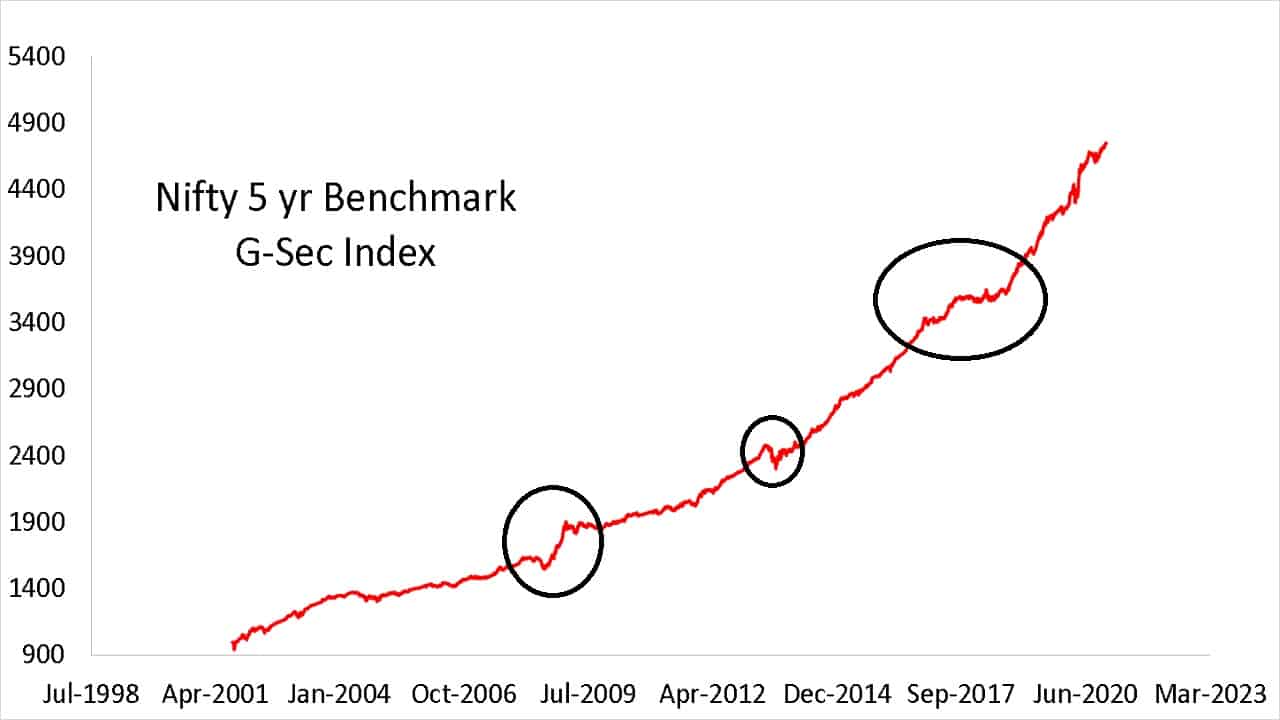
Notice how the index zoomed in the wake of the 2008 financial crisis and then the growth sharply decreased and in July 2013 when the Rupee crashed against the dollar, the index fell when rates were increased. Another period of stagnation during 2017-18 is also indicated. This should be enough evidence that Motilal Oswal 5 Year G-Sec ETF is not safe!
What return can I expect from Motilal Oswal 5 Year G-Sec ETF?
The truth, no one knows. Sometimes it can beat the best equity MF or sometimes less than a liquid fund or an FD. These are 3596 five-year rolling returns data of the above index (before expenses, before price-NAV fluctuations aka impact cost, and before taxes).
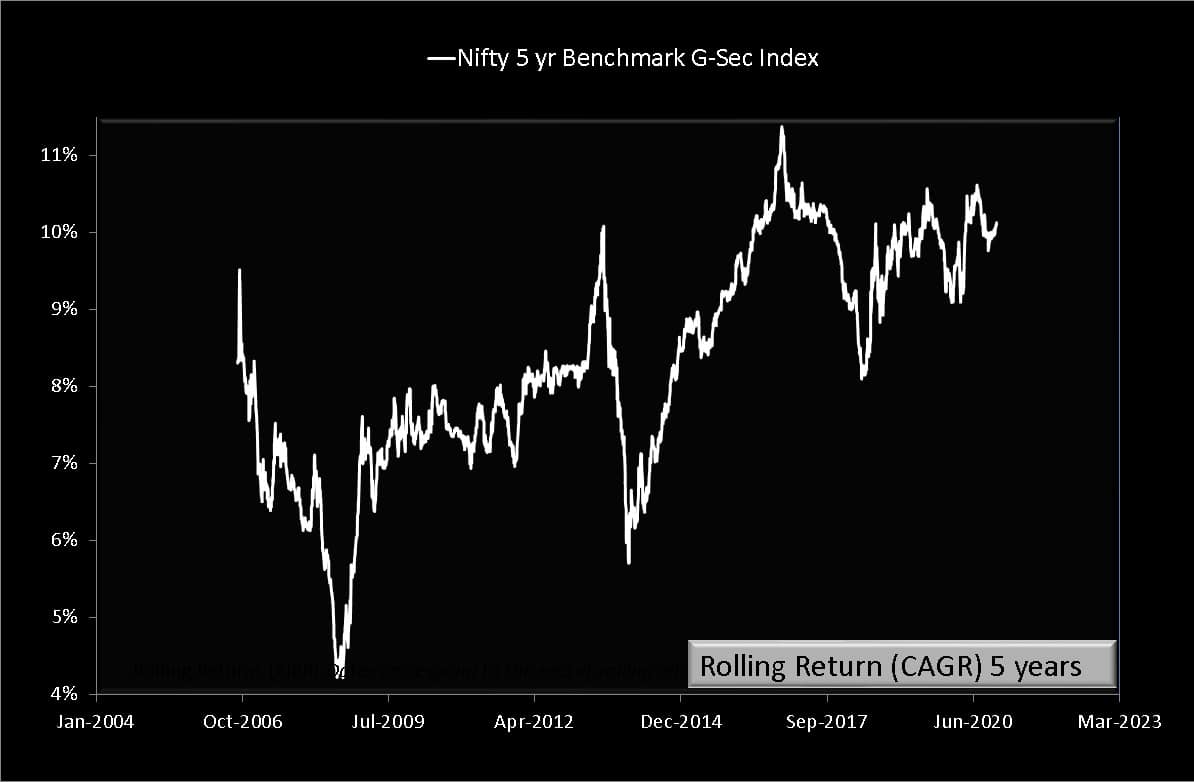
Simply take the average and it would be 7.8%. That sounds awesome is it not? This hides the fact that the returns can fluctuate rather widely. The simple reality is, no one knows what return you would get. Therefore, Motilal Oswal 5 Year G-Sec ETF is neither safe nor a fixed deposit alternative!
The fund house claims five-years “falls in a sweet spot between short & long duration”. That is mathematically true: 5 is greater than one and less than ten. That is about it. Unless the investor is intimately familiar with the market risk associated with gilts, they are likely to be disappointed sooner or later with this ETF.
Yes, a five-year bond index would be significantly less volatile than a 10-year bond index but that does not mean you can invest in it for the “short or medium-term”! Of course, a 5-year gilt index could be used as a debt component in a long-term investment portfolio.
Unfortunately, this is an ETF. Say you gradually accumulate units for a long-term with this ETF. LIke equity you will have to reduce exposure to this as its volatility close to the goal could be harmful. You may have difficulty in trying to sell large amounts because of poor ETF liquidity.
Considering the above, and considering that most retail investors have a poor understanding of gilt volatility, it would be best to give Motilal Oswal 5 Year G-Sec ETF a miss.