Last Updated on December 28, 2021 at 3:16 pm
Would you prefer a fund that beats the index whenever the index moves up or would you prefer a fund that falls lower than the index? Our first response would be, why not both? Unfortunately, it is not as simple as that. Very few funds manage to do both. In this post, I discuss why downside protection is important in choosing a mutual fund.
In this post, I would prefer to steer clear of exact definitions. Those interested can consult: Nov 2017 Freefincal Equity Mutual Fund Outperformance Screener
What is upside performance consistency?
It is a measure of how often the fund beats the benchmark/index, when the index (market) moves “up”
What is downside protection consistency?
It is a measure of how often the fund protects (falls less) the investor when the market moves “down”
🔥Secure your future with our Robo-advisory tool trusted by over 3,500 investors and advisors. From effortless retirement planning to funding your children’s biggest dreams, turn your financial goals into reality. 🔥
Subscribe for money management solutions via email! (Link takes you to our email sign-up form) Join 32,000+ readers in our community.
👉 New Tool Alert! NaviPlan: A Privacy-Focused Multi-asset Tracker and Goal Planner 👈
What is return outperformance consistency?
How often the fund has beaten the benchmark (see the video for an example).
Why can I have the best of both worlds?
Let us plot the return outperformance of 228 equity mutual funds vs their upside performance consistency. This is a schematic of the four sections. I discuss 7-year returns, but the trends are similar over 5Y and 3Y as well. You can check that with the screener file linked above.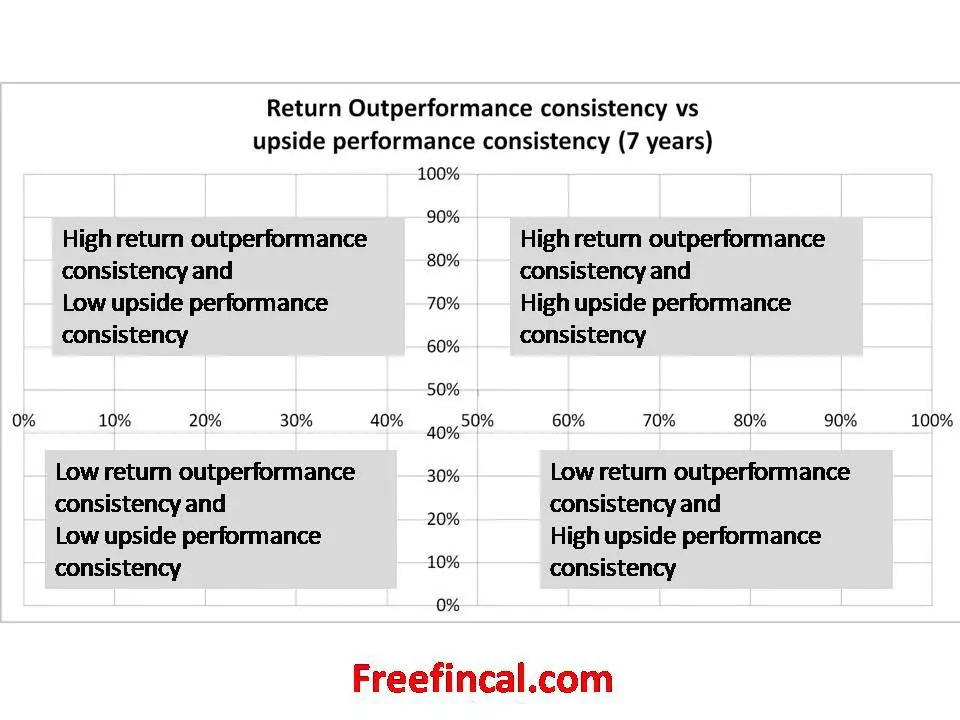
Now for the data:

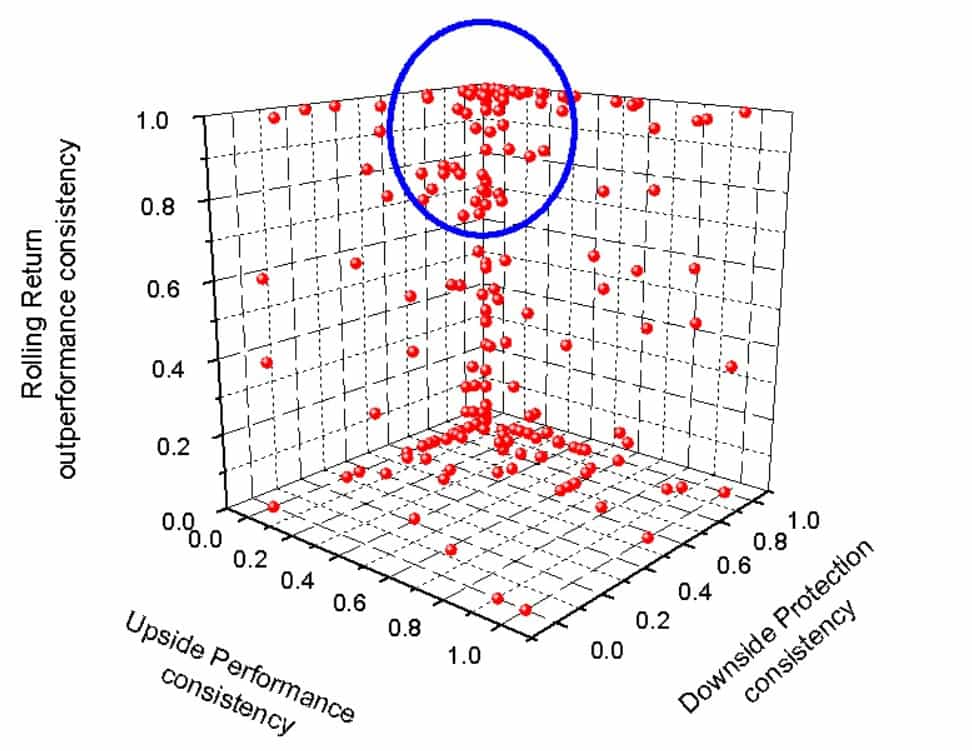
Notice that most funds that beat the benchmark do not seem to do well when the market moves up! This is counterintuitive and this is why downside protection is important as explained below.
What is mutual fund downside protection?
It is better to choose funds that beat the benchmark by protecting gains during market falls. This keeps the investor calm.
Even if the fund has failed to beat the benchmark, a good downside protection is valuable. More on this on a post about index investing.
The essential point is that the journey matters and not just the end points (returns).
This is a 3D summary of the video. Thanks to Anish for the suggestion.