Last Updated on December 29, 2021 at 5:07 pm
Will you choose a risky mutual fund if it has a chance of beating the index? This is a question that can be convincingly answered, yes or no. Here is how 233 investors responded and what it means to our understanding of risk and reward. We shall discuss three other related polls on the investment journey.
Before you read this article any further, I would like you to answer five questions. It would be great if you could take a pad, jot down answers and then continue reading. The first one is the title: What would you do? Will you choose a fund that is known to be risky, that is more volatile than the index if it has a chance of beating the index?
The second one is, you have to transfer a precious package from point 1 to point 2 and can choose between courier companies A and B. Company A has a history of delivering faster than promised and has a motto of “speed matters” Company B has a history of delivering as promising and has a motto of “safety first”. Which company will you choose to deliver your package?
The third one is, You have to choose ONE fund from (only) A and B. None of them are index funds and both have comparable expense ratios.
A: has a history of being riskier (volatile) than the index and sometimes produces more return than the index
B: has a history of being less risky than the index with a return that is often close to or equal to that of the index. Which would you choose?
🔥Secure your future with our Robo-advisory tool trusted by over 3,500 investors and advisors. From effortless retirement planning to funding your children’s biggest dreams, turn your financial goals into reality. 🔥
Subscribe for money management solutions via email! (Link takes you to our email sign-up form) Join 32,000+ readers in our community.
👉 New Tool Alert! NaviPlan: A Privacy-Focused Multi-asset Tracker and Goal Planner 👈
The fourth one is a question with a picture! You are given the 10Y portfolio growth graph of three stock portfolios (and no other information). Which portfolio will you choose?
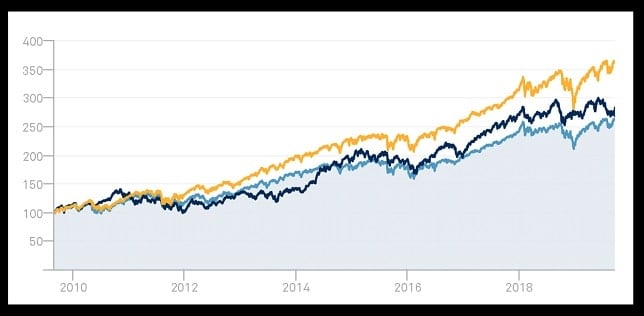
The fifth question is, can you spot the similarity among the above four questions? All these four polls were conducted at Facebook group, Asan Ideas for Wealth. Now, on to the answers.
Question 1: Will you choose a risky mutual fund if it has a chance of beating the index?
Out of the 233 investors who participated, almost half, 108 chose, need more information; 81 said no; only 41 said yes. What do these choices mean?
Yes: I do not mind a risky fund if it has a chance of beating the index. The chance of beating the index here can be interpreted as the fund has such a record. This also means that it does not matter how frequently the fund has beat the index in the past (or if it has a history!!). A good example of such a fund is Axis Focused 25 Fund (Review: Outperformance at extra risk!)
No: I will not touch a fund more volatile than the index even if it has a chance of outperformance regardless of how frequently it has done so in the past. Again this is a fair choice. Either the investor wishes to choose index funds or wants to select outperformers with a less risky track record. You can select such funds this way: Want lower risk & higher return mutual funds? Spot them easily now!
Need more information: One can argue in two ways here. A: We need more information, such as how frequently the fund has beat the index in the past. This is a fair demand, although this does not translate into a chance for the future. B: Past return outperformance does not matter as it can go down in future and therefore more information is not necessary (past risk outperformance can be maintained in future by simple diversification)
My take: It is easy enough for active investors to find less volatile mutual funds that result in a higher return than the index. So it makes sense to say no to this question. Passive investors will anyway say no. There is no need for me to choose a risky path when I can get my job done in less risky ways. The nature of the path we choose is the subject of the remaining three questions.
There is also another question up for debate. Past performance is all that we have in judging a fund or stock, but past performance does not repeat in future. That is a tight spot to be in.
Question 2: Faster delivery vs safer delivery?
Let us go through the question again: You have to transfer a precious package from point 1 to point 2 and can choose between courier companies A and B. Company A has a history of delivering faster than promised and has a motto of “speed matters” Company B has a history of delivering as promising and has a motto of “safety first”. Which company will you choose to deliver your package?
A good 424 investors participated in this, and the overwhelming choice was (379) was B. This seems like a no-brainer does it not? I want my package delivered. I gain nothing by getting it delivered a day or two faster by taking on more risk. Safe delivery is “obviously” more critical than speedier delivery. Okay, let us take question three and discuss more.
Question 3: Risky fund vs safer fund?
This is the question again: You have to choose ONE fund from (only) A and B. None of them are index funds and both have comparable expense ratios.
A: has a history of being riskier (volatile) than the index and sometimes produces more return than the index
B: has a history of being less risky than the index with a return that is often close to or equal to that of the index. Which would you choose?
Out of the 298 investors who participated, 203 said fund B and 95, fund A. First, notice the similarity between questions 3 and 1. There is some similarity between 3 and 2 as well, but this can be debated. Second notice that more than twice the number of people voted for fund B than courier B. In fact, many voted differently. They prefer a safer courier but do not mind a risky fund.
A safer courier is the obvious choice because we have the end goal in mind: delivery. So we are worried about the journey. We want it to be safe. We understand that a courier who goes too fast, on a one-way, on the pavement etc. can get into an accident or in trouble with the law and delivery will be delayed or impossible. This is obvious to us.
However, when it comes to equity, the risk between now and the long term does not seem to matter. Most of us believe – and this is because of effective propaganda by the industry and its distributors – that daily risk does not matter in the long term. Even NSE peddles this openly: Worried about market volatility? NSE says it is temporary!
We believe, in the end, everything will be fine. The market will always recover, will always go up. Since the Indian economy has space to grow at a good pace, so will out portfolios. This is naive and dangerous. Proof of this behaviour is found below.
Also, how we pose the question makes a big difference! Only 38 people said yes to Will you choose a risky mutual fund if it has a chance of beating the index? However, 92 preferred fund A, which has a history of being riskier (volatile) than the index and sometimes produces more return than the index.
Naturally, the questions were asked on different days so the participants would have been different, but I cannot but help think there is more to it.
Twitter also had a similar reaction.

Fund A- has beaten the index more than half the time, but at higher risk.
Fund B – has mostly tracked the index, but at a lower risk.
The results could be very different!
Question 4: What is your colour?
Out of the 259 participants, a little more than half choose the orange colour (the numbers below indicate the votes).
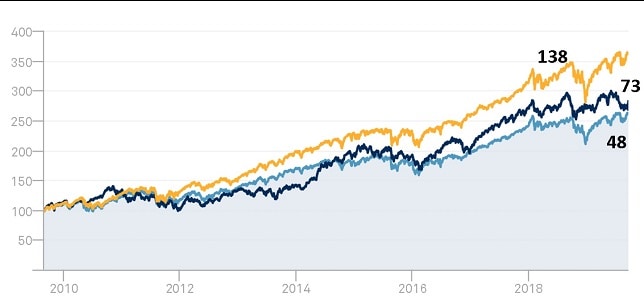
This is hindsight bias at its best. On a damp and muggy morning, the cricket ball was swinging square. With three slips and a gully, a batsman played a drive. The ball got a thick edge and just missed the outstretched hands of 3rd slip and went for a four. The commentator said, “in the end, there was no risk in the shot”. This is how investors behave.
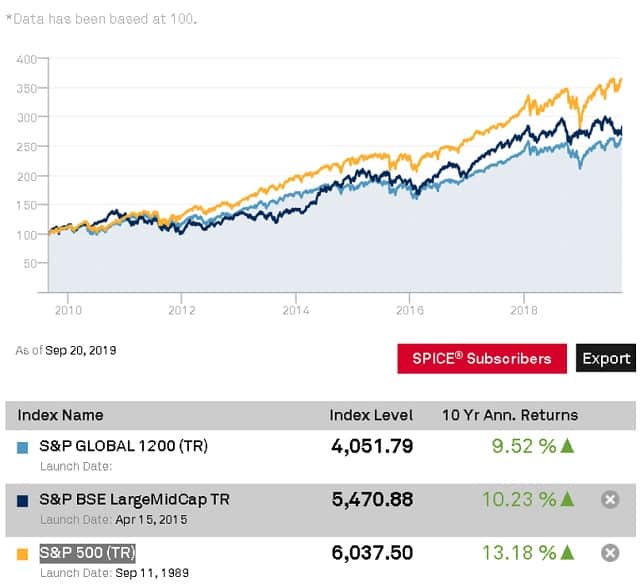
So what are these portfolios anyway? The orange is S&P 500 TRI, the dark blue BSE Large&Midcap Index (TR), the light blue S & P Global 1200. This has 1200 stocks from S&P 500® (US), S&P Europe 350, S&P TOPIX 150 (Japan), S&P/TSX 60 (Canada), S&P/ASX All Australian 50, S&P Asia 50 and S&P Latin America 40. All images are courtesy of S&P.
Over to you!
What were your choices? Do you think the journey matters in equity investing or will long term investing always be successful? Notice that questions can always be posed in a way to get the answer we want (in the majority!) Will you prefer fund A or B, orange, light blue or dark blue?