Last Updated on December 29, 2021 at 6:02 pm
The market rally in the last few months has had a dramatic impact on SIP returns especially when you track them on a monthly basis. The Nifty 10-year SIP return as on 4th Feb 2021 is a healthy 14% (including dividends but before expenses, tracking error and taxes). What does this mean for investors? An analysis.
The fate (return) of an unmanaged mutual fund SIP depends purely on timing luck – that is when you started the investment and when you evaluate returns. A 10-year SIP from Feb 2010 to Feb 2020 would have returned 9.66% – annualized computing via XIRR.
The return of a 10-year SIP started just a month later, that is from March 2010 to March 2020 is 3.85%. Mutual fund distributors and investors in denial dismiss this as a “one-off”. It is not. In fact in Jan 2020 – a good two months prior to the bottom of the crash we had reported that ten-year Nifty SIP returns have reduced by almost 50% – a fact that persists to the day (see below).
Show below is the 10-year rolling SIP data for the Nifty created with the Mutual Fund SIP and Lump Sum Rolling Returns Calculators. Each data point is a 10-year SIP XIRR return.
🔥Secure your future with our Robo-advisory tool trusted by over 3,500 investors and advisors. From effortless retirement planning to funding your children’s biggest dreams, turn your financial goals into reality. 🔥
Subscribe for money management solutions via email! (Link takes you to our email sign-up form) Join 32,000+ readers in our community.
👉 New Tool Alert! NaviPlan: A Privacy-Focused Multi-asset Tracker and Goal Planner 👈
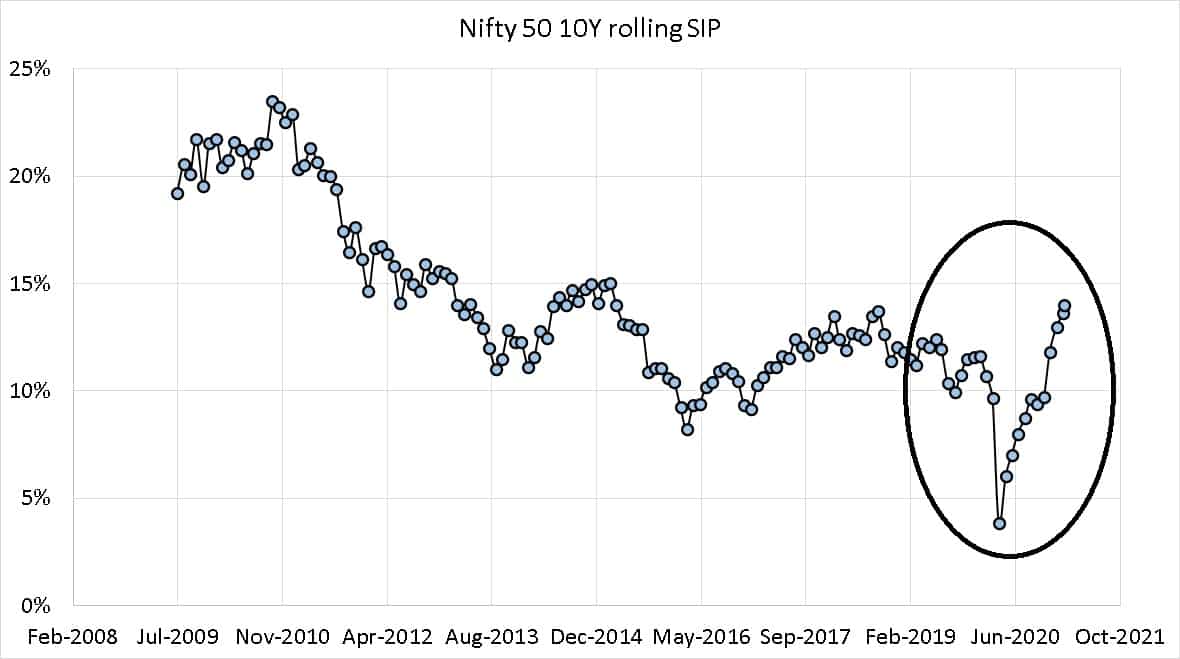
The return of a 10Y SIP started Feb 2001 is almost exactly 14% (as on Feb 4th 2021). This is good news for distributors as the only they can sell mutual funds is by projecting unrealistic returns and proclaiming volatility is “temporary” – which of course is not true, but the sad part is even the NSE claims this!
Notice how (1) the SIP returns have steadily declined in the last decade although the market has moved up. Also see: Nifty 50 SIP Returns Jump up by 7% but returns trend is opposite to price! (2) SIP returns depend on market movements.
That is, you may have started your SIP 5Y ago, 10Y ago, 15Y ago or 20Y ago. If at the time of computing returns or redemption, the market is “down”, your returns will be “down”. This is what is referred to as timing luck above. SIPs do not reduce risk; after a few months, there would be no difference between a SIP and a lump sum investment. See: SIP vs Lump Sum Investment: Which reacts to market changes more?
You can see from the 15 Y SIP rolling returns data that “long term returns from equity will always be high; falls are temporary” is nothing more than a sales pitch.
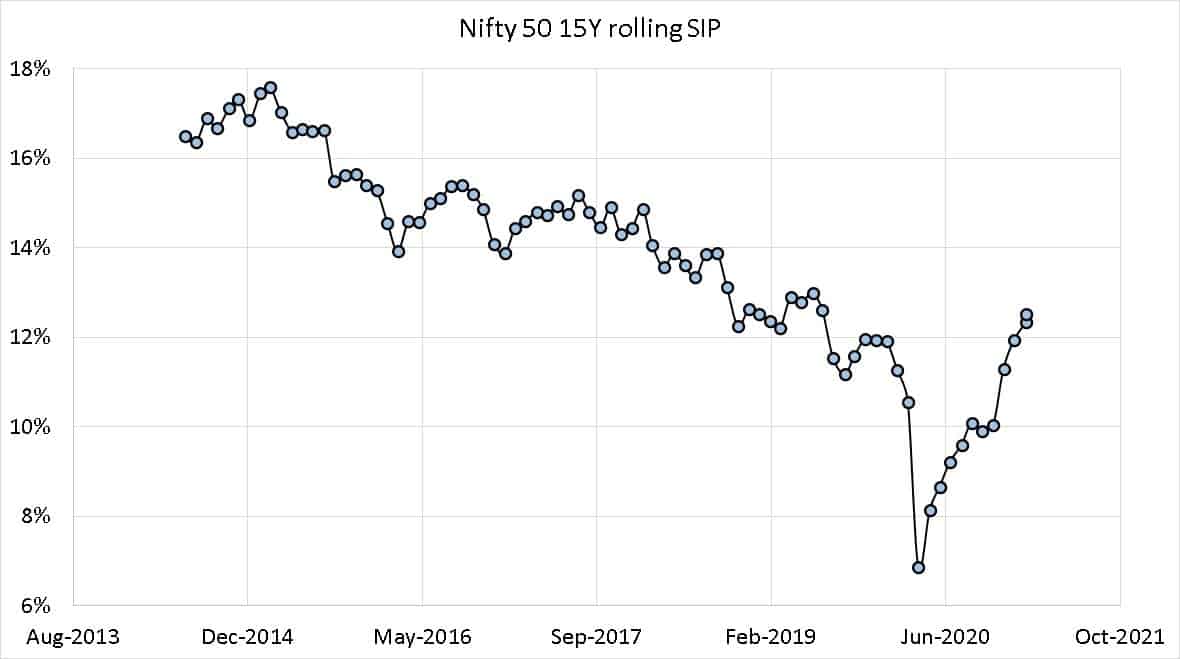
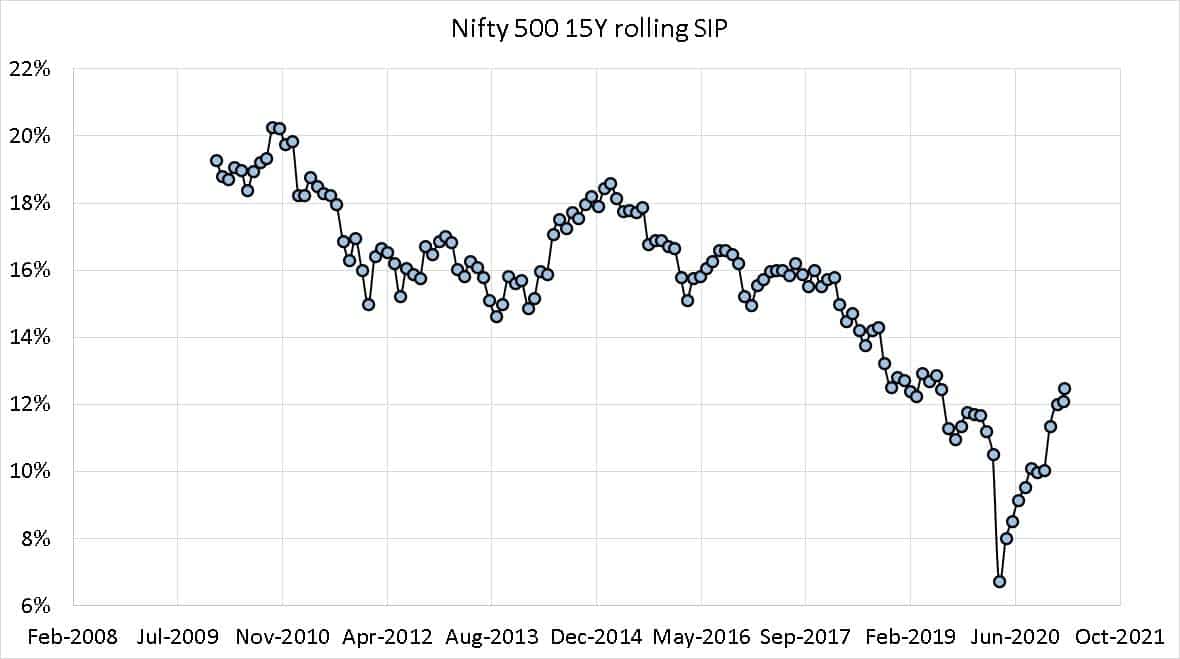
Curiously NIfty 500 TRI history is older than Nifty 50 TRI or Sensex TRI. So this is how those 15Y SIP returns look. The fall in returns has been the norm for the last 11 years. The markets may have recovered from the 2020 crash, as of now it only looks like it has just got back to the falling trend.
It is instructive to look at the corresponding data (15-year SIP) for the S & P 500 TRI. First the more recent data. The US market has been on almost non-stop up move from the 2008 crisis. The 2020 crash seems like a non-event even in this small window.

If we zoom out and plot from Jan 1900 (date source: Schiller PE file with inflation removed; data exists from 1873 but Excel cannot handle dates before 1st Jan 1900!)
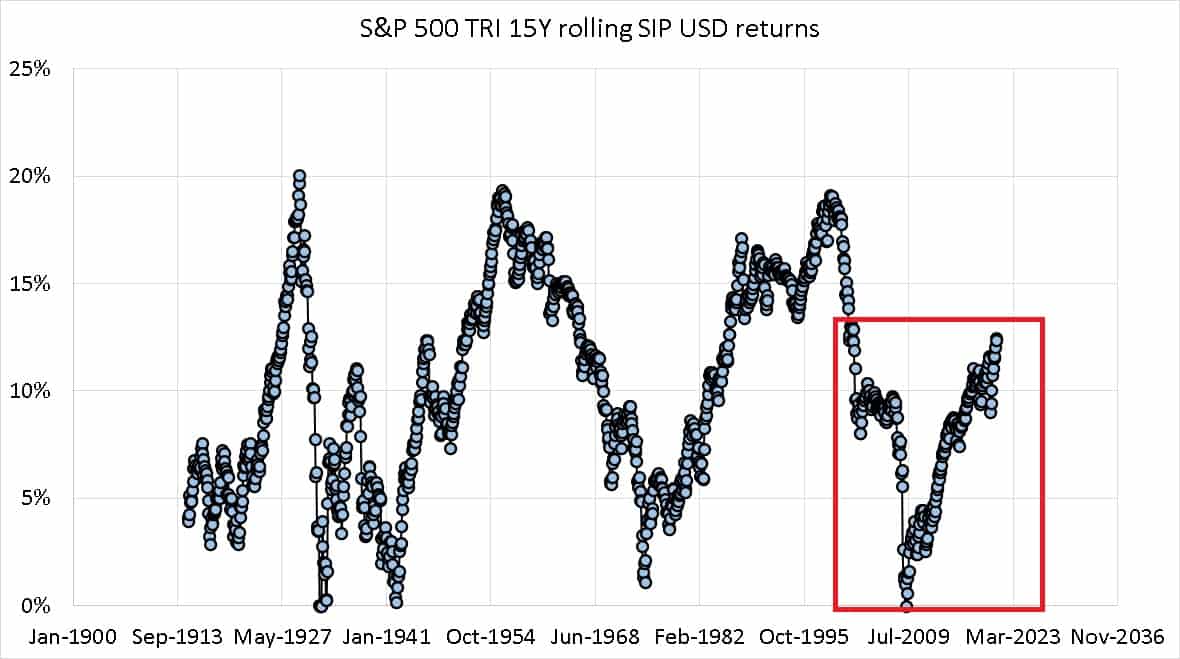
If we assume that after the oil crisis on the last 70s and early 80s, the US was firmly a “developed economy” returns last peaked in July 1999. That is returns were falling even 7-8 years before the 2008 crisis. It is tempting to look for “cycles” but economy changes significantly from one crest(trough) to another.
What does this mean for investors? Although the Nifty 10Y, 15Y SIP returns have shot up in the last few months, the overall trend is still “down”.
- Plan for goals with about 9% returns from equity (after-tax) and not hold more than 50-60% equity initially for long-term goals
- Plan to reduce equity allocation well in advance and from day one.
- Stick to an asset allocation plan
- Avoid portfolio clutter by adding new products
- Do not waste time worrying about “market levels”
If you are a newbie, you can start with this free seminar: Basics of portfolio construction: A guide for beginners