Last Updated on January 17, 2022 at 3:47 pm
A common question investors have is, “should I use the Nifty or the Sensex for passive investing?” In this article, we report the return difference between the Sensex and Nifty for various durations to appreciate how a 30 stock index can differ from a 50 stock index.
Sensex is the oldest stock index of India. It has the top 30 stocks by market capitalization trading in the BSE representing 40% of the total market cap at BSE. The Nifty has the top 50 stocks traded at the NSE. Both indices are weighted by a float-adjusted market capitalization method.
Both indices suffer from concentration risks highlighted earlier – Do index fund returns depend upon just a few stocks (Concentration risk)? – and one would expect, the Sensex has more of it. In Oct 2020, RIl occupies about 15% of the Nifty and about 17% of the Sensex. HDFC Bank about 9.6% in the Nifty and 10.5% in the Sensex.
If we look at the total returns index price movement from June 1999, there is not much difference between the two.
🔥Secure your future with our Robo-advisory tool trusted by over 3,500 investors and advisors. From effortless retirement planning to funding your children’s biggest dreams, turn your financial goals into reality. 🔥
Subscribe for money management solutions via email! (Link takes you to our email sign-up form) Join 32,000+ readers in our community.
👉 New Tool Alert! NaviPlan: A Privacy-Focused Multi-asset Tracker and Goal Planner 👈

Now let us look at the Sensex minus Nifty return difference over progressively increasing durations such as 1,3,5,7,10 years.
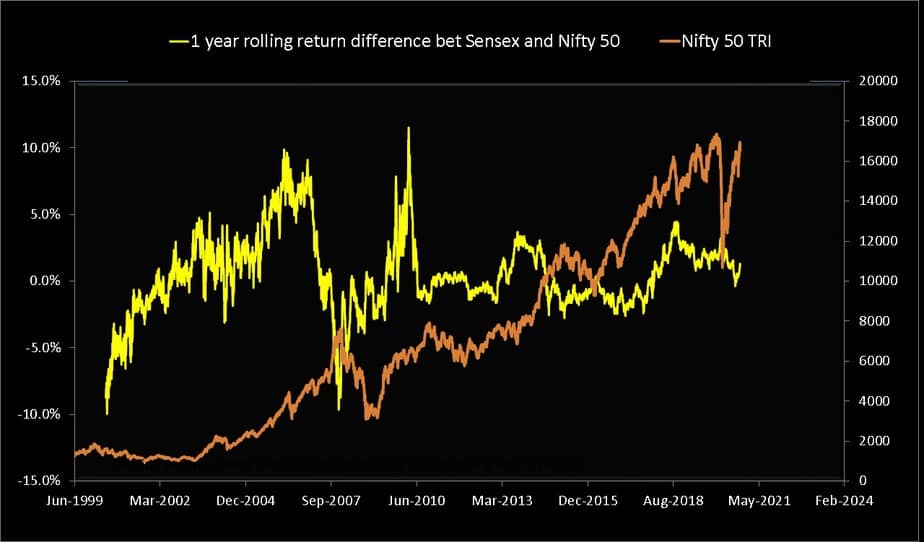
The return difference is on the left (yellow). Notice that in the last decade, even over this short duration, the difference has relatively subsided which is healthy.
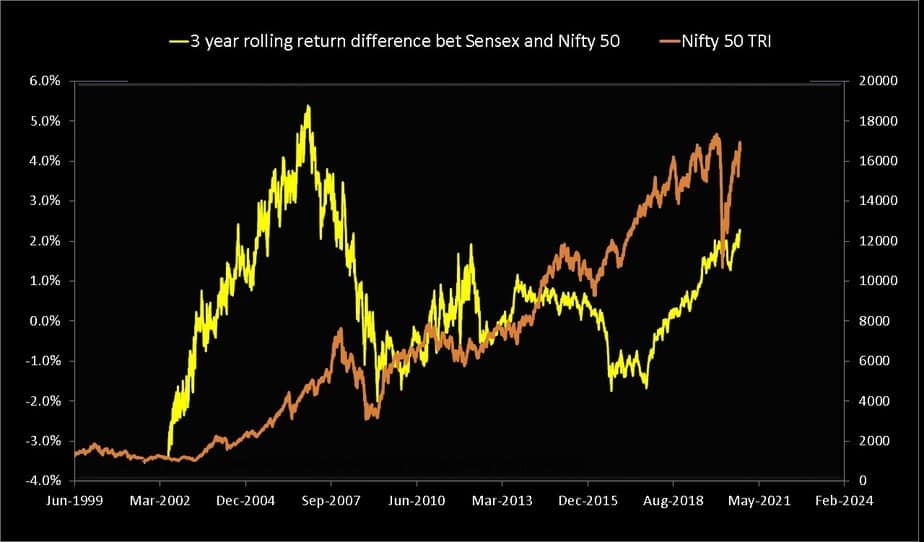
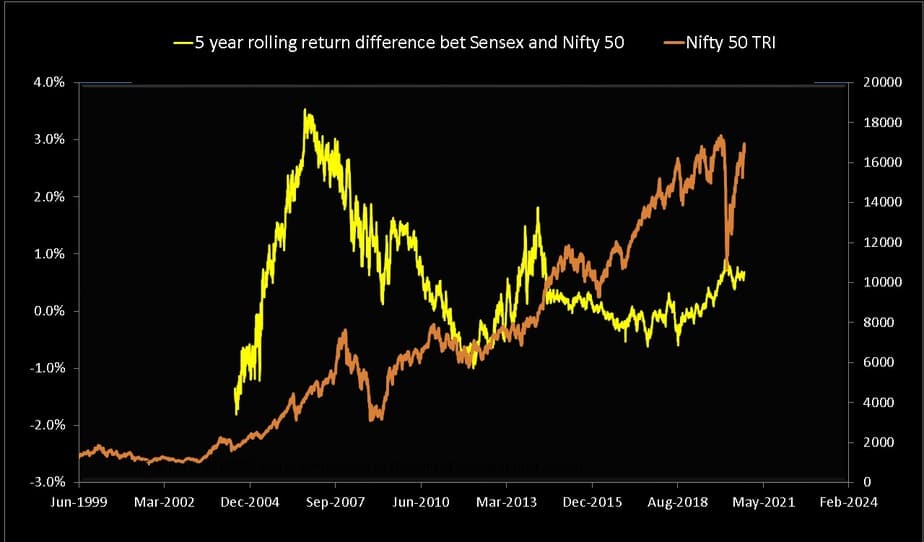
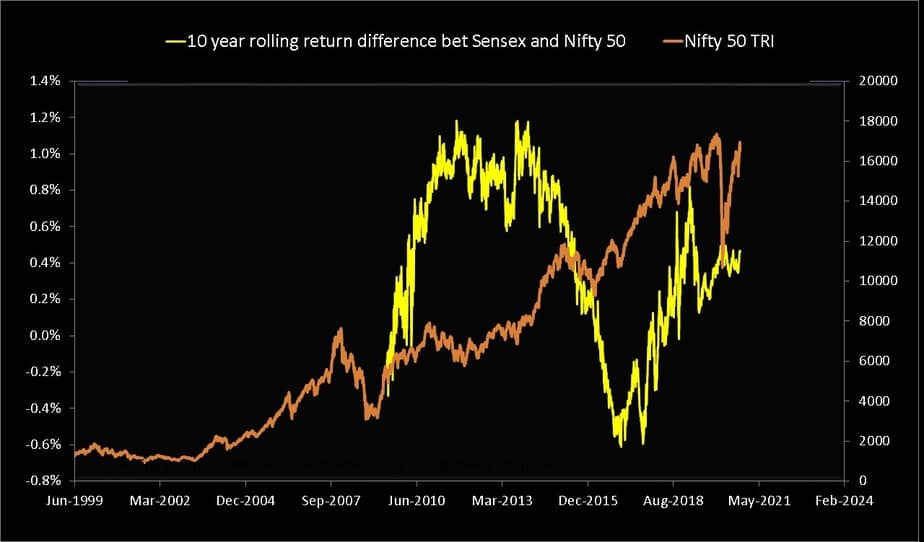
You can see the return difference progressively reduce. Even if we assume a 1% return difference, sometimes it could be in favour of the Sensex and sometimes the Nifty. It would be hard to tell when – not in the past but in the future in real time.
Question: Nifty vs Sensex: Which should I choose for passive investing?
Answer: Since this should be used only for long-term investments, the return difference becomes small over time and therefore it does not matter much which is used. Both options are equally good. Those worried about the concentration risk can go with Nifty.
A related and natural question is: Will Nifty 100 or NIfty 500 reduce concentration risk? In Oct 2020, Nifty 100 has almost 13% exposure to RIL and 8.4% of HDFC Bank. Nifty 500 has about 10.4% of RIL and 6.7% of HDFC Bank. There is however a price to pay: The fund manager effort is higher, the tracking error would be more and the expenses would be more. Read more: Axis Nifty 100 Index Fund Impressive AUM but is it expensive? and Motilal Oswal Nifty 500 Fund: Avoid & stick to Nifty 50 Index funds