Last Updated on August 22, 2022 at 11:27 pm
Nippon India Nifty 50 Value 20 Index Fund is an open-ended passive fund that will track the Nifty 50 Value 20 Index. The NFO period of this fund is from Feb 4th to Feb 12th 2021. This article looks at the risk and reward of the underlying index and answers if it makes sense to add this fund in our portfolio.
The Nifty 50 Value 20 Index chooses 20 stocks from the Nifty 50 with low PE (Price to Earning), low PB (Price to Book) and high DY (Dividend Yield) & ROCE (Return on Capital Employed).
Stocks are ranked with 40% weight to ROCE, 30% to PE, 20% to PB, 10% to DY. Stocks with relatively lower PE and PB get a better rank, and stocks with higher DY and ROCE receive a better rank. We had earlier compared the PE, PB and DY of this index with NIfty 50: Nifty 50 Value 20 (NV20) Index: Is this better than Nifty 50?
After ranking, the top 20 stocks are part of the index which is rebalanced once a year in December. There is a weight capping of 15% for each stock – relatively the Nifty has no such capping and the low volatility indices have a 5% cap at the time of rebalancing (but may increase in between).
🔥Secure your future with our Robo-advisory tool trusted by over 3,500 investors and advisors. From effortless retirement planning to funding your children’s biggest dreams, turn your financial goals into reality. 🔥
Subscribe for money management solutions via email! (Link takes you to our email sign-up form) Join 32,000+ readers in our community.
👉 New Tool Alert! NaviPlan: A Privacy-Focused Multi-asset Tracker and Goal Planner 👈
An investor in Nippon India Nifty 50 Value 20 Index Fund would expect a higher return than the Nifty 50 on an absolute basis or at least similar return but lower volatility. It must be kept in mind such index funds would typically have a 5-10 times higher expense than a Nifty Index fund (0.1% for direct plans). Therefore it would be that much harder to beat a Nifty 50 index fund.
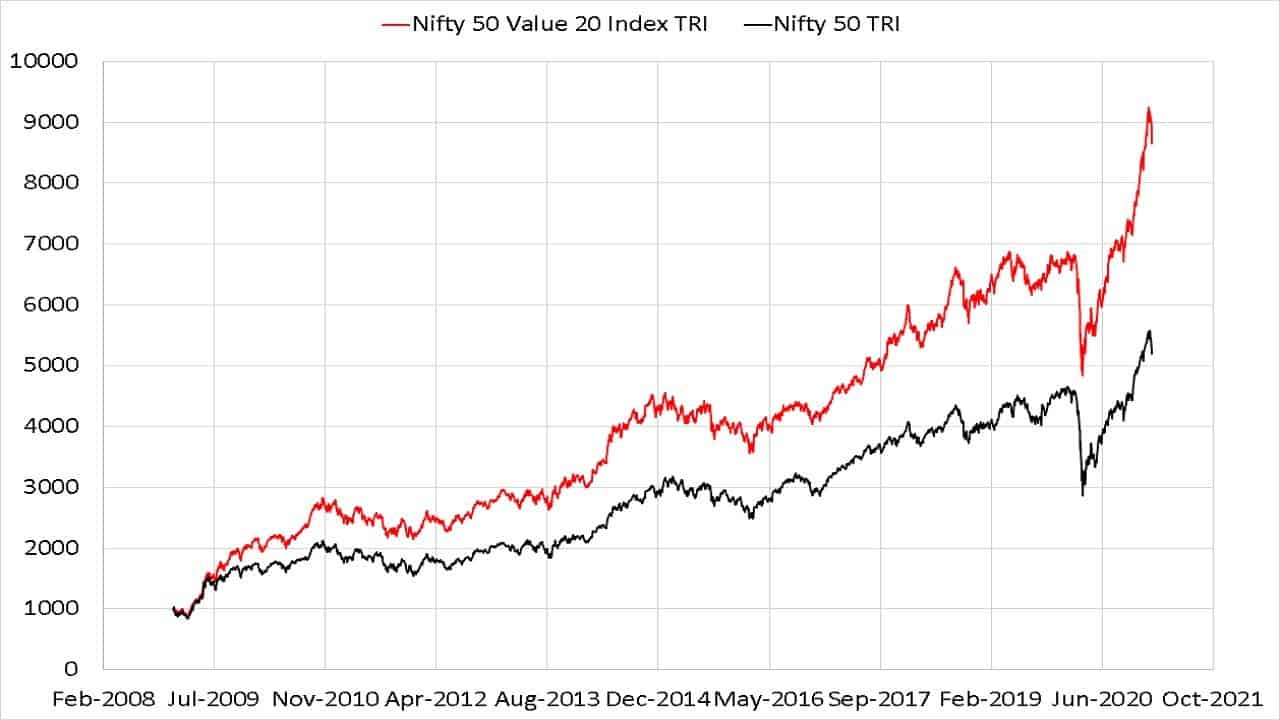
The since inception (Jan 2009) movement of Nifty 50 Value 20 Index TRI is no doubt impressive compared to Nifty 50 TRI; however, the index’s actual trading date is only March 28 2014. We will also have to consider rolling returns and risk to understand what one should expect from this index.
Shown below is every possible five-year return between 1st Jan 2009 and 29th Jan 2021 for Nifty 50 Value 20 Index TRI, Nifty 50 TRI and Nifty Next 50 TRI.
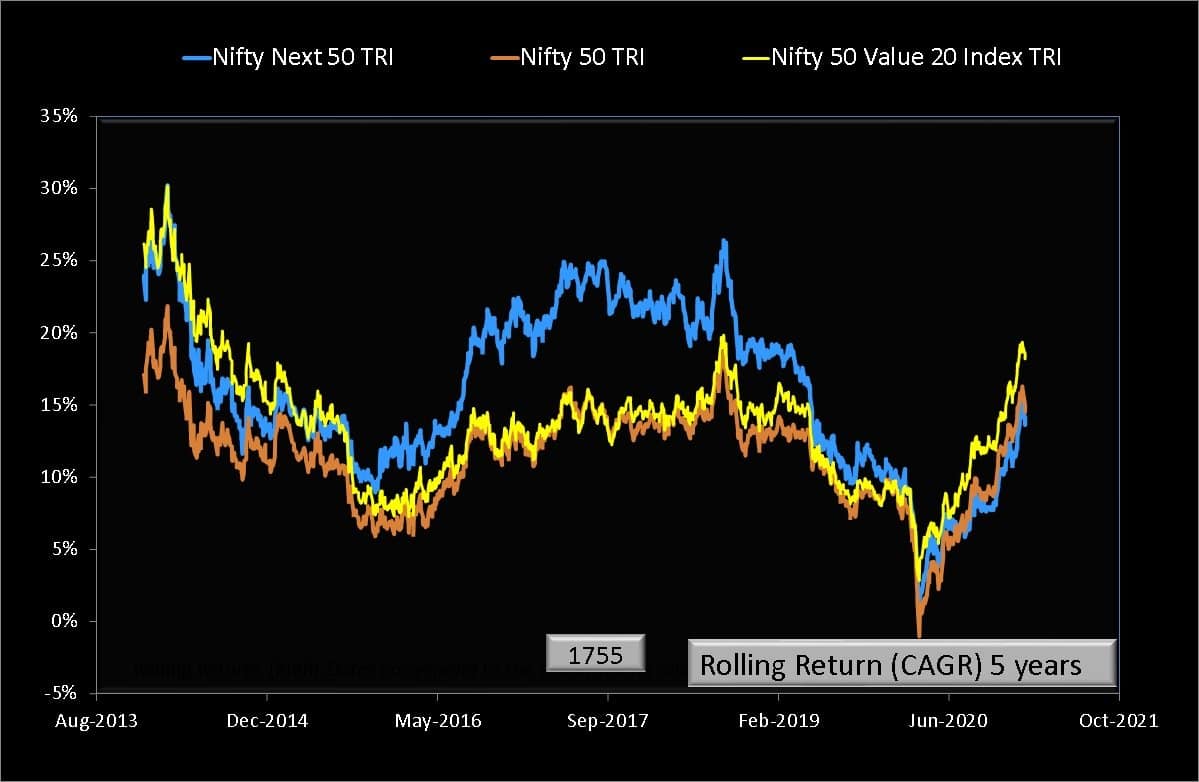
There are 1755 data points for each index. The five year period ends between late Jan 2013 to Jan 2021 – that is, all investments were made during an eight-year time frame. The value index had comfortably outperformed the Nifty 50 only twice – when the sideways market after the 2009 recovery ended and post-2020 crash recovery.
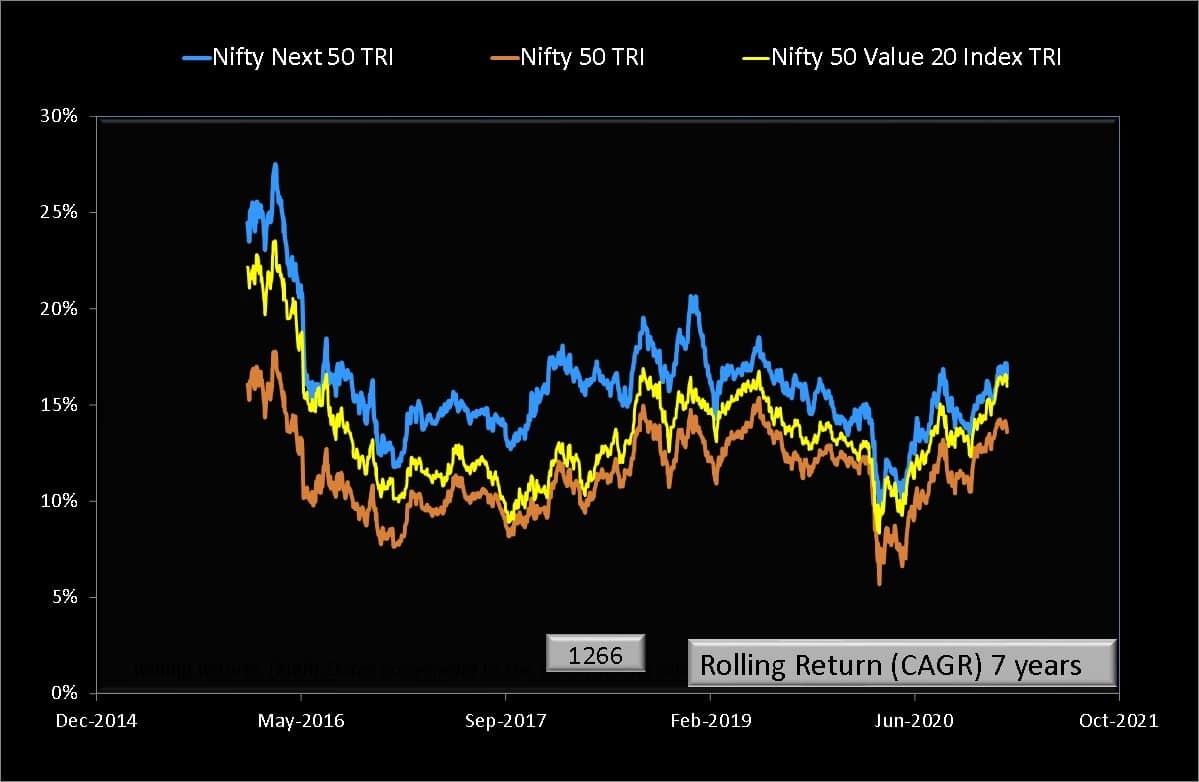
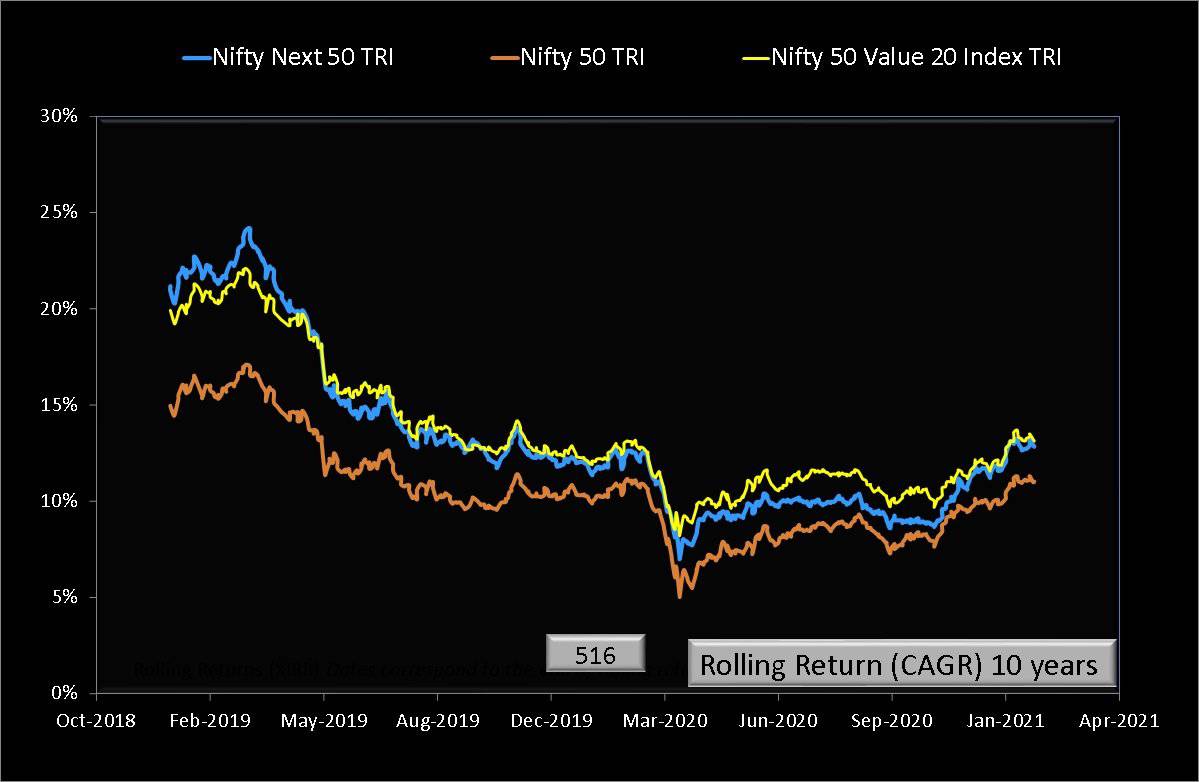
If we account expenses and tracking errors (if AUM is small) the Value index would have underperformed an above-average Nifty 50 TRI index. Over seven and ten-year windows, Nifty 50 Value 20 Index TRI has outperformed the Nifty, but the investment window also has to just three years for the 10-year set – meaning we do not have enough history.
Will the so-called long-term investor withstand five years of pain in the hope of beating the Nifty with fund over longer durations? Easier said than done.
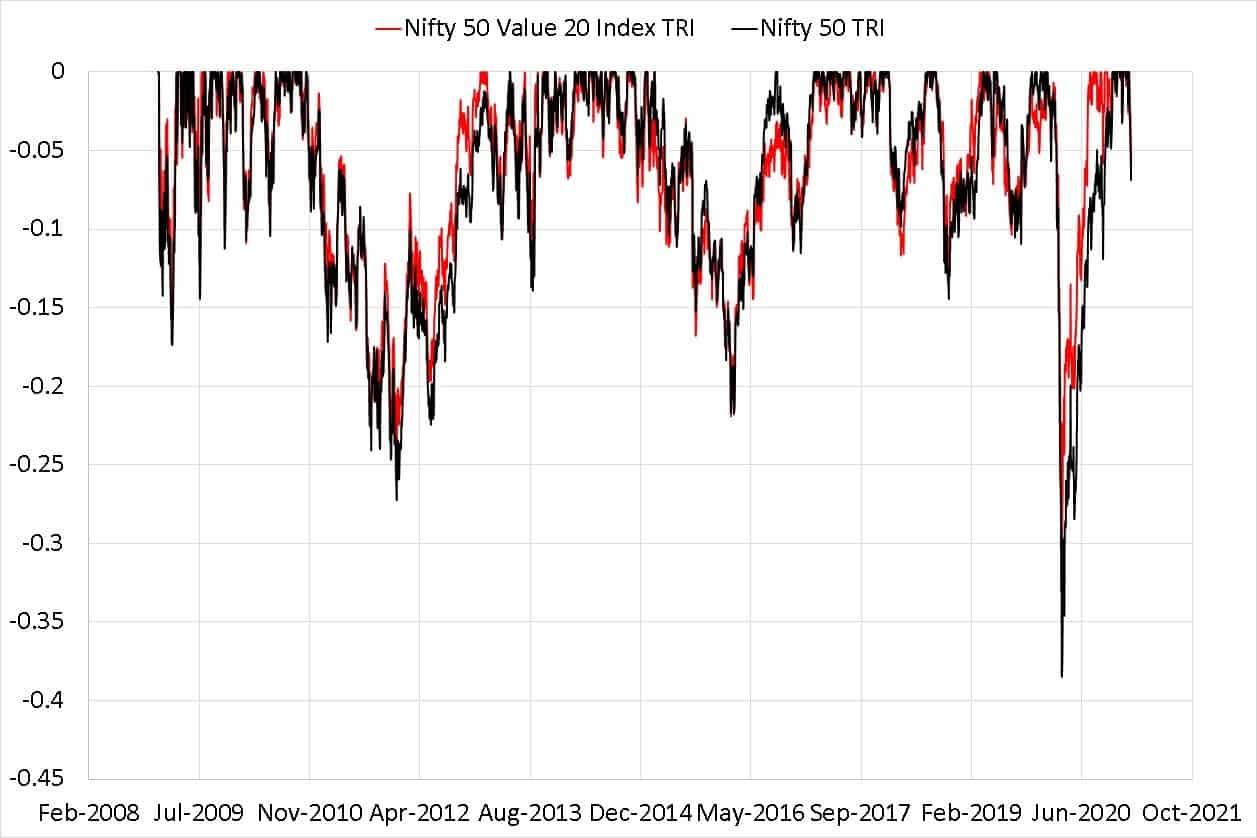
In terms of risk, the Nifty 50 Value 20 Index TRI does not differ much from Nifty 50 in terms of both rolling volatility (standard deviation) or drawdown (fall from peak).

Nippon India Nifty 50 Value 20 Index Fund: Should we invest?
If we look at past data, Nifty 50 Value 20 Index TRI has outperformed NIfty over seven years or more consistently at the same risk levels. The underperformance wrt Nifty 50 TRI over five years or less can be frustrating.
If we compare this situation with S& P 500 Pure Value Index and S & P 500 (both TRI), the situation is quite different. The value index used PE, PB and price to sales ratios to filter stocks.
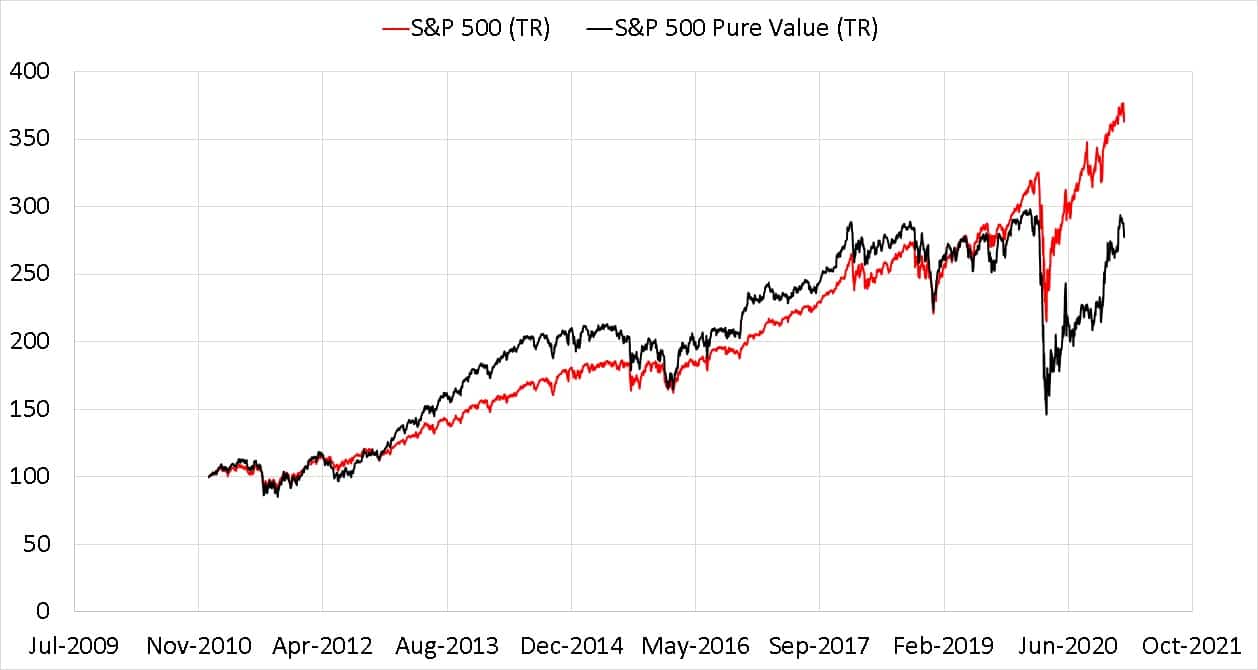
The Value is significantly more volatile and has underperformed the S&P 500 TRI over the last ten years (the S&P 500 is a large cap index). Regular readers may recall we encounter this with Nifty 500 Value 50 TRI: Is it time to exit ICICI Value Discovery & Quantum Long Term Equity?
Value investing, although romanticised by several “experts” is intrinsically riskier than buying the “market” – until the market discovers these stocks, returns would be subdued. The US scenario could be reproduced in India as its market depth increases.
Therefore I think it does not make sense to buy the Nippon India Nifty 50 Value 20 Index Fund. The usual Nifty and Nifty Next 50 mix could get the job done at low cost: Combine Nifty & Nifty Next 50 funds to create large, mid cap index portfolios.
It would be hard to find a spot for Nippon India Nifty 50 Value 20 Index Fund in an existing active or passive portfolio (assuming the investor is worried about such positioning).
NB: Both momentum and value indices independently do not beat the S&P 500, but the combination of the two has done better: Momentum Stock Investing in India: Does it work?
Resources: