Last Updated on October 1, 2023 at 9:16 pm
Nippon India Nifty Smallcap 250 Index Fund is an open-ended scheme that will track the Nifty Smallcap 250 Index. Should passive investors add this to their portfolio? Should one invest in a small cap index fund instead of an actively managed small cap fund? If one does choose this index fund, how should they invest? A discussion.
For an investor holding Nifty 50 and Nifty Next 50 index funds (or active hybrid or large and midcap oriented funds), the introduction of a midcap or a smallcap index fund seems like an exciting development. They could now buy more of the market with zero overlap. Investing in Nippon India Nifty Smallcap 250 Index Fund seems like an obvious choice.
We need to dig deeper to understand if a small cap index investment makes sense. When you buy Nifty, you are invested in 50 stocks (and most of your money in the top 10) which are established businesses. The failure rate here is non-zero but the lowest.
🔥Secure your future with our Robo-advisory tool trusted by over 3,500 investors and advisors. From effortless retirement planning to funding your children’s biggest dreams, turn your financial goals into reality. 🔥
Subscribe for money management solutions via email! (Link takes you to our email sign-up form) Join 32,000+ readers in our community.
👉 New Tool Alert! NaviPlan: A Privacy-Focused Multi-asset Tracker and Goal Planner 👈
The small cap segment is filled with business relatively young and relatively less robust and relatively more likely to fail. Buying the market – that is buying all 250 of such stocks makes little sense even intuitively. When we are worried about tracking error of Nifty or Sensex index funds, imagine the task before the small cap index fund manager!
This is a segment where the impact cost is huge. That is, try and buy or sell large quantities of a small cap stock then the mismatch between buying and selling price would be significant. During volatile market conditions, the fund can deviation significantly from the benchmark.
Even if we assume active small cap fund managers have beat the benchmark due to luck and not skill, we cannot discount the fact that they have up to 20% freedom to hold cash or large caps or midcaps or a mix of these and about one-fifth the number of stocks in Nifty Smallcap 250 index. This is an expensive cushion (higher expense ratio) but a cushion nonetheless.
Active Smallcap Funds vs Nifty Smallcap 250 Index
Let us consider the performance of 13 funds which are currently labelled as small cap funds. Almost all of them would have been small cap and mid cap oriented funds before May 2018. Quant Small Cap Fund was a debt fund in its previous avatar and hence ignored in this study. Small cap funds from BOI AXA, Canara Robeco, Edelweiss, IDBI, Invesco India, Principal and Tata do not have a five-year history and hence excluded.
| Fund | No of rolling return entries Fund (5 years) | No of times fund has outperformed index (5 years) | rolling return outperformance Consistency Score (5 years) |
| Franklin India Smaller Companies Fund – Direct – Growth | 676 | 676 | 100% |
| DSP Small Cap Fund – Direct Plan – Growth | 675 | 675 | 100% |
| HSBC Small Cap Equity Fund – Growth Direct | 675 | 657 | 97% |
| Kotak-Small Cap Fund – Growth – Direct | 675 | 675 | 100% |
| Nippon India Small Cap Fund – Direct Plan Growth Plan – Growth Option | 675 | 675 | 100% |
| Sundaram Small Cap Fund – Direct Plan – Growth Option | 675 | 499 | 74% |
| Aditya Birla Sun Life Small Cap Fund – Growth – Direct Plan | 672 | 672 | 100% |
| ICICI Prudential Smallcap Fund – Direct Plan – Growth | 660 | 322 | 49% |
| SBI Small Cap Fund – Direct Plan – Growth | 459 | 459 | 100% |
| Axis Small Cap Fund – Direct Plan – Growth | 446 | 446 | 100% |
| L&T Emerging Businesses Fund – Direct Plan – Growth | 339 | 339 | 100% |
| Union Small Cap Fund – Direct Plan – Growth Option | 316 | 240 | 76% |
| HDFC Small Cap Fund – Direct Growth Plan | 307 | 307 | 100% |
Nifty Smallcap 250 vs Nifty Midcap 150 vs Nifty Next 50
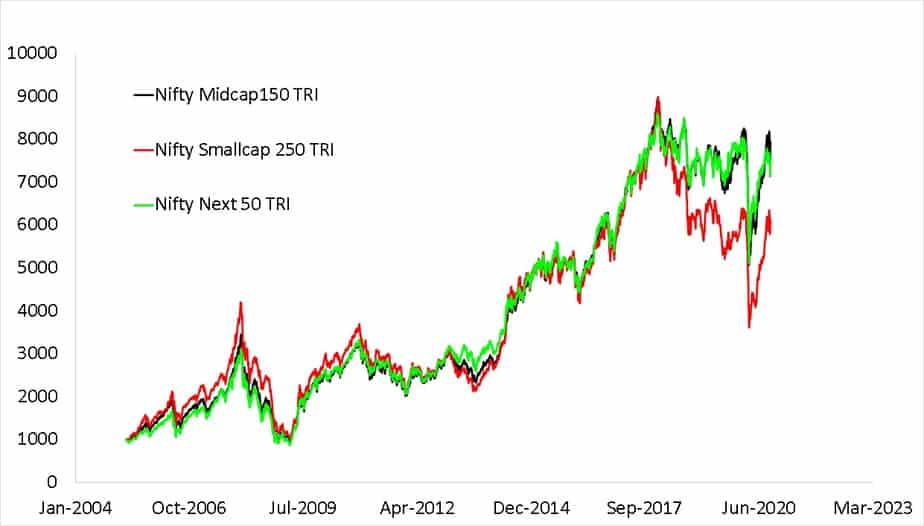
For those who wish to have further proof, 1367 10-year data points are presented below.
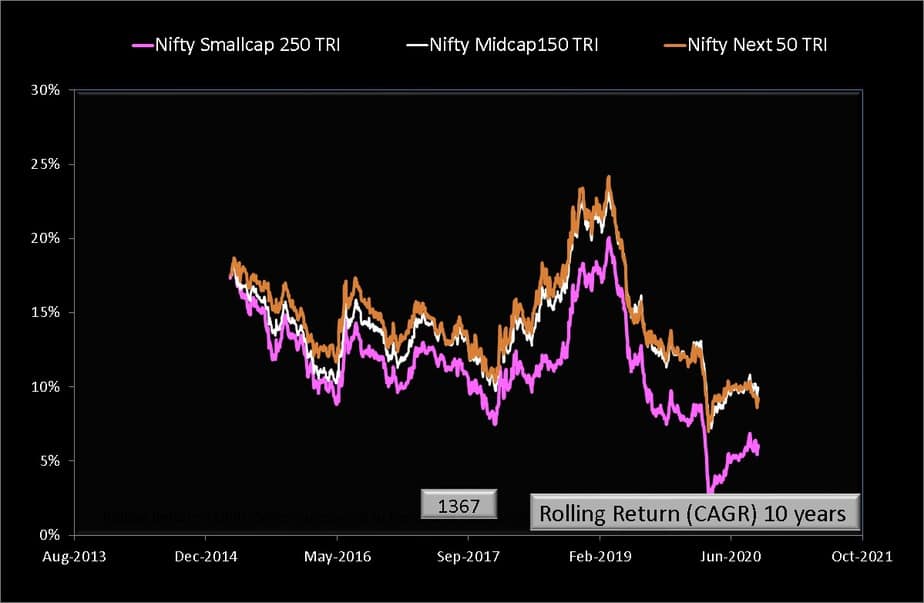
Passive fans are better off sticking to their Nifty Next 50 index funds.
How to invest in smallcap funds?
Now that we have established that Nippon India Nifty Smallcap 250 Index Fund can be happily avoided, how should one invest in this category? The best way to invest in small cap stocks would be to avoid all small cap funds and simply buy the “new” multicap fund (after they realign) with 25% small cap exposure.
The worst kind of unsubstantiated notion that gets peddled around is, more small cap exposure would result in more returns in the long term. This is peddled by sales guys seeking higher profit margins. See: Large Cap vs Mid Cap vs Small Cap Funds: Which is better for long term investing?
This brings us to the worst way to invest in small cap funds – via the great SIP. See: Why a SIP in Small Cap Mutual Funds is a waste of money and time.
To summarize, avoid this NFO; avoid all small cap funds, at the very least avoid systematic (aka blind) investing in small cap funds. Tactical investing is an option for those with conviction and discipline: Do not use SIPs for Small Cap Mutual Funds: Try this instead! Also see: Is it time to book profits from Small Cap Mutual Funds?
Announcement: The new course, How to get people to pay for your skills is now open! The course content is available in an exclusive Facebook Group where the course videos are hosted. The early-bird discount price (one-time) is Rs. 2000 – this is 60% off the full price of Rs. 5000. Sign up via: How to get people to pay for your skills: A guide to win trust and build income. The discount is applicable until October 5th 9 am.