Last Updated on May 17, 2022 at 3:15 pm
A tactical entry and exit strategy for small cap mutual funds is discussed in this article. The impact of the strategy on the worst-performing small cap fund is promising enough to emerge as a better option than a buy and hope for the best SIP in a small cap mutual fund.
Regular readers may be aware that freefincal has always opposed the idea of investing in small cap mutual funds. Due to their highly volatile nature, returns can swing from spectacular to disastrous in quick time and is most impacted by sideways market movements.
Retail investors who naively believe in “the SIP” would simply leave the fate of their investment to luck if they start small cap SIPs as recently shown: Why a SIP in Small Cap Mutual Funds is a waste of money and time. An alternative tactical buy/sell strategy for small cap mutual funds was earlier shown to be fruitful: Profit Booking from Small Cap Mutual Funds: Does it work?
🔥Secure your future with our Robo-advisory tool trusted by over 3,500 investors and advisors. From effortless retirement planning to funding your children’s biggest dreams, turn your financial goals into reality. 🔥
Subscribe for money management solutions via email! (Link takes you to our email sign-up form) Join 32,000+ readers in our community.
👉 New Tool Alert! NaviPlan: A Privacy-Focused Multi-asset Tracker and Goal Planner 👈
We do not have much of market history to rigorously test the efficacy of such a method, but based on past backtests, it should reasonable to assume the following. The tactical approach will not always lead to more returns, it would typically lower risk and could enable the disciplined investor to sleep better.
In the current article, we shall apply the method successfully applied to equity (Sensex), gold and gilts to a small cap mutual fund. In particular the worst-performing small cap mutual fund (wrt return) over the last 10,15Y. The fund has either mirrored its current benchmark, S&P BSE 250 SmallCap TRI or underperformed it.
- Equity backtest: This “buy high, sell low” market timing strategy surprisingly works!
- Gold backtest: Is this a good time to buy gold? A tactical buying strategy for gold
- Gilt Backtest: Can we get better returns by timing entry & exit from gilt mutual funds?
- Related read: When should I rebalance my portfolio?
The use of the “worst fund” is only to satisfy the author’s curiosity. A small cap index used in the previous backtest. It is quite possible that a SIP in an ‘above average’ fund could perform better. Nonetheless, the core idea of tactical entry and exit remains unchanged.
Method 1: Using double moving averages
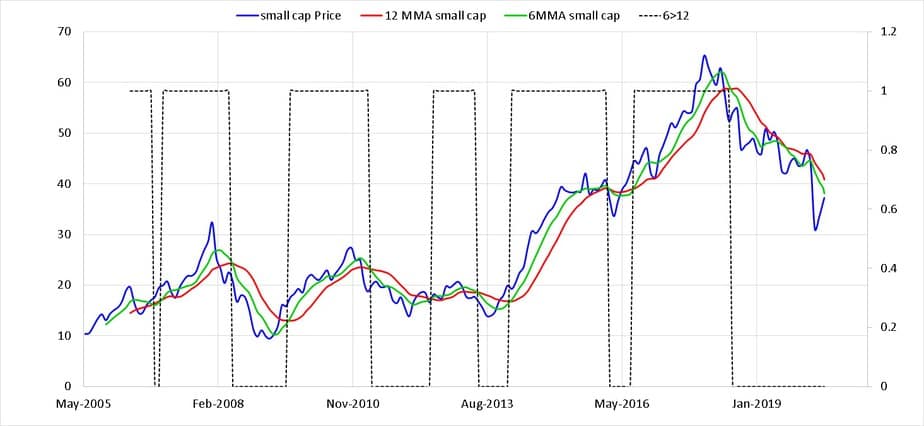
Shown below is the NAV (blue), the six-month moving average (green), the twelve-month moving average(red) and the dotted line which is equal to “1” when the green line is above the red line (6MMA > 12MMA) and “0” if 6MMA < 12MMA.
- Systematic strategy: Normal SIP in a small cap fund (HSBC in this study)
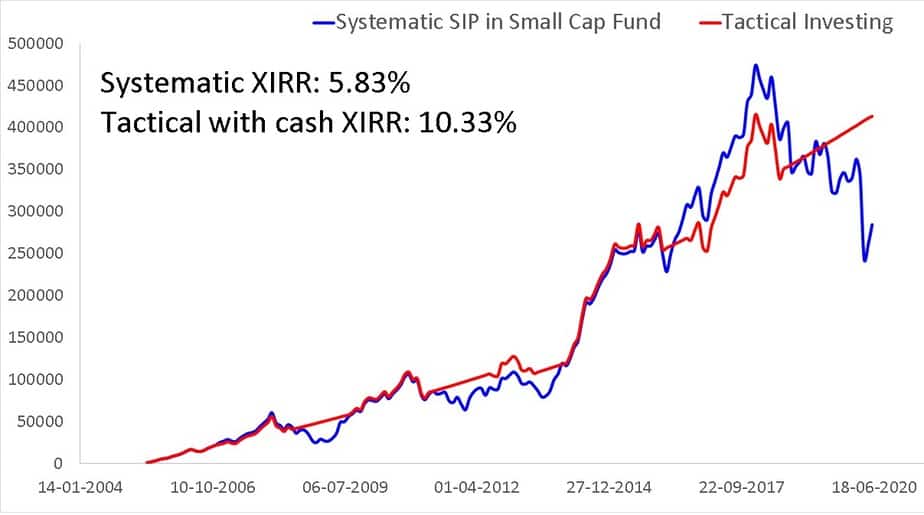
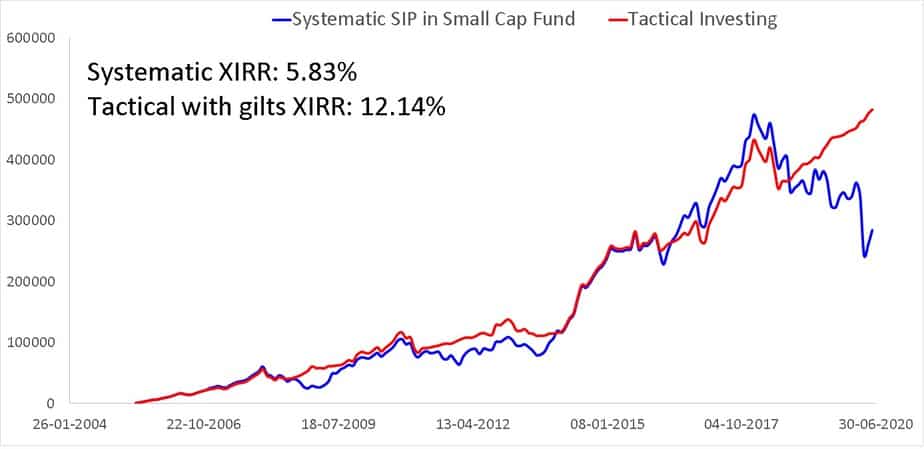
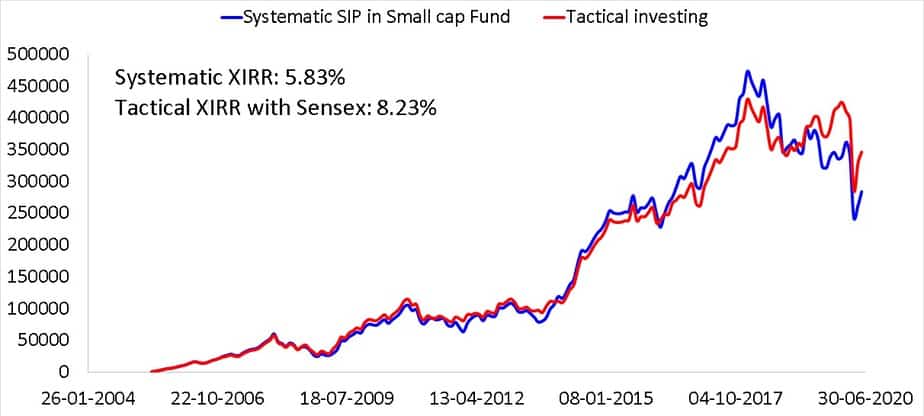
- Tactical strategy with double moving averages: If 6MMA > 12MMA, push all money into the small cap fund. If 6MMA < 12 MMA, exit the small cap fund and buy either cash or Sensex or gilts (three different options).
- You can count the no of times the dotted lined changed value = 11, this is reasonable for a 15-year period.
We shall look at a single 15-year period. The returns are shown in the graph and do not include taxes and exit load. There is not enough history to roll this over. Important: the tactical strategy will not beat the systematic strategy every time in terms of return. The key idea behind timed exit and entry is risk reduction. If this does not appeal to you, please do not try this.
Tactical asset allocation (6,12 MMA) with small cap MF and cash
Tactical asset allocation (6,12 MMA) with small cap MF and gilts
Tactical asset allocation (6,12 MMA) with small cap MF and Sensex
Method 2: Using a single long-term moving average
A second method is to use a single moving average: 10 months (= 200-day moving average) or 12 months or longer can be used. I have used an 18 moth moving average here is to reduce frequent buy and sell transactions (aka whipsaw by traders)
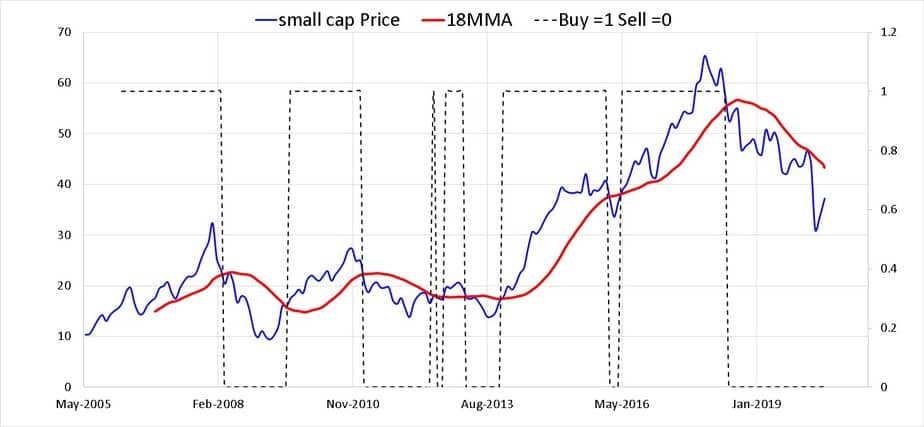
Here again, the no of transactions is a 15-year period is a reasonable eleven.
Tactical asset allocation (18 MMA) with small cap MF and cash
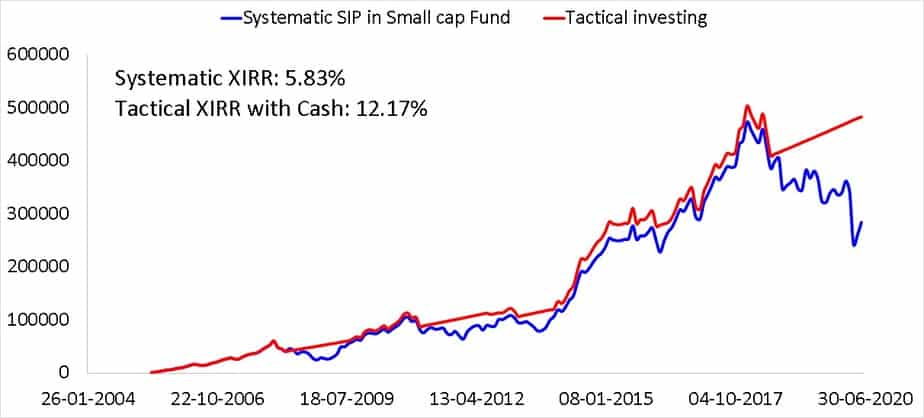
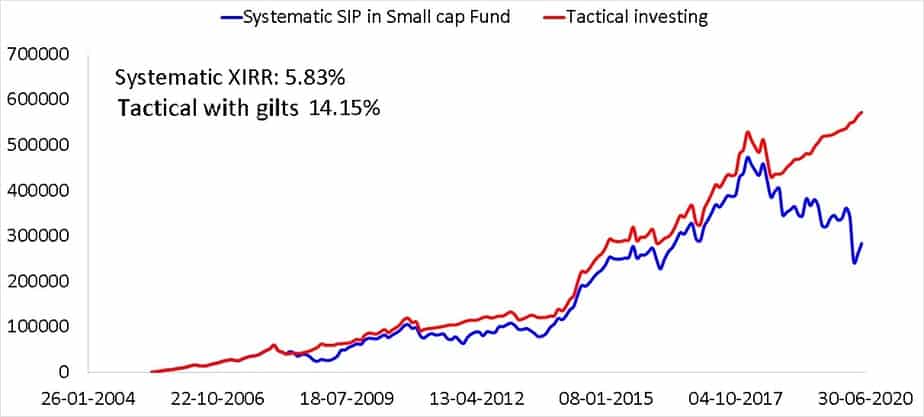
Tactical asset allocation (18 MMA) with small cap MF and gilts
Tactical asset allocation (18 MMA) with small cap MF and Sensex
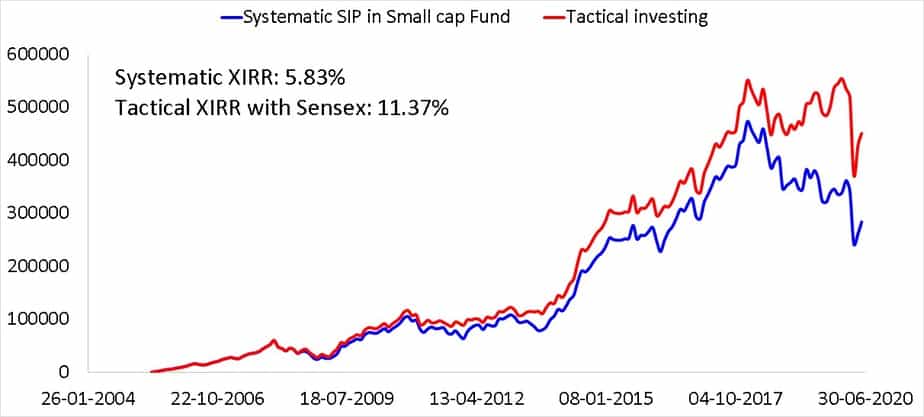
For this particular 15-year period, the 18MMA has done better. That does not mean it would always will. The central takeaways from this study are: (1) A simple SIP in a small cap fund is leaving the fate of your money to luck; (2) A tactical asset allocation strategy is mandatory for small cap funds to reduce risk; (3) Maturity and discipline to carry out the strategy is key (like all other things in life).