Last Updated on December 29, 2021 at 5:28 pm
An overnight mutual fund invests in bonds of the shortest maturity: one day. This means its portfolio is essentially cash and changes each day! While the loss of capital in this category is the lowest among all mutual funds, there are other risks that investors have to appreciate.
Debt mutual funds suffer from two primary types of risk: credit risk and interest rate risk. The interest rate risk has two components: (A) Higher the tenure of the bonds held by a fund, more the NAV will fluctuate due to market supply and demand changes.
In extreme situations, even liquid funds can react to demand and supply: Why Liquid funds and money market funds also fell in the last few days. (B) The second type of interest rate is known as reinvestment risk.
🔥Secure your future with our Robo-advisory tool trusted by over 3,500 investors and advisors. From effortless retirement planning to funding your children’s biggest dreams, turn your financial goals into reality. 🔥
Subscribe for money management solutions via email! (Link takes you to our email sign-up form) Join 32,000+ readers in our community.
👉 New Tool Alert! NaviPlan: A Privacy-Focused Multi-asset Tracker and Goal Planner 👈
This is much less appreciated as it does not lead to an actual loss of capital. Instead, It leads to a lower return when fresh bonds have a lower interest rate. All short-term debt funds such as overnight funds, liquid funds, money market funds and ultra short-term funds suffer from this risk, It is a risk because the fund would fail to meet the return expectation of the investor.
Both the equity and bond market suffered from investor pull out last month. RBI had to step in to buy bonds to arrest the fall in yields. The lack of demand in the cash market was compounded by the lowering of the reverse repo rates by as much as 0.9%! This is done to remove from liquidity (money supply) in the system.
This means that financial institutions will find it significantly less rewarding to park money with RBI. This means that yields of short-term bonds will be significantly lower. Both these factors have affected all money market funds including liquid funds and overnight funds.
This is where reinvestment risk comes into play. Since overnight funds will be the first to immediately buy the new bonds with a lower interest rate, their NAV will be affected the most. The NAV will not fall, but the rate at which it moves up will significantly change. If you remember high school math, the slope of the NAV vs time chart will fall. When the slope falls, the returns will fall.
This is shown for Kotak Overnight fund in the image above. Going forward, the returns from all overnight funds should head close to that of an SB account. Investors who use these funds to park cash without return expectations will however not be affected.
The table below shows how the 7-day absolute return of overnight funds for two different weeks have suddenly changed.
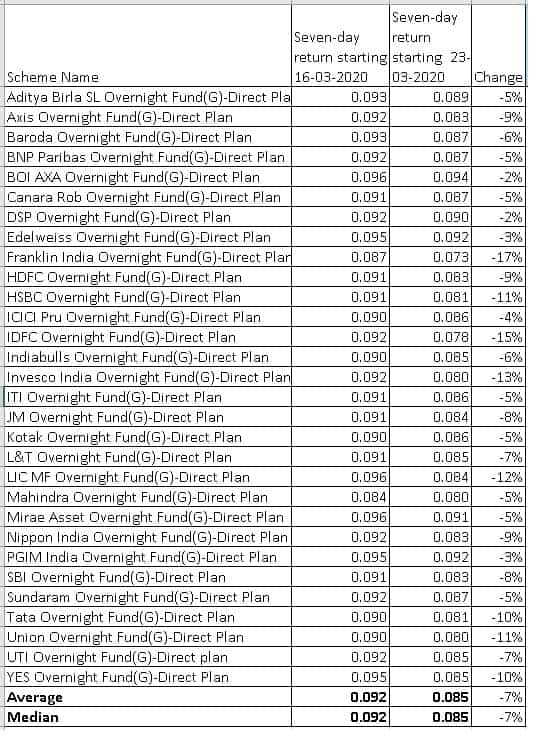
Investors who shifted money from liquid funds in fear to overnight funds will have to pay the price with guaranteed lower returns.
What should retail investors holding overnight funds do? Nothing other than appreciating reinvestment risk! Stay put but do not expect much returns in the coming months. Also do not make hasty decisions like shifting money into overnight funds (from other debt funds) or pulling out of overnight funds. We can run from investment risk but cannot hide. There is always a price to pay.