Last Updated on December 29, 2021 at 6:17 pm
In this article, we review Quant Active Fund, which seems to have caught the attention of young DIY investors. Why has it caught the attention of investors? Returns! It is always returns! And in particular the last one year return, without any regard to the fund’s history. Quant Active Fund has delivered 96.1% returns in the last year (trailing, at the time of writing).
Our first step will be to trace the history of the fund. This is a lot more fun than analysing returns, although often frustrating due to difficulty getting data. Quant Active Fund has an inception date of April 2001. Since “Quant” is a relatively new name in the mutual fund space, this means they have acquired an AMC.
Quant Capital acquired Escorts Mutual Funds in late 2017, and the change became official in early 2018. After this, Escorts Growth Fund became Quant Growth Fund. Then, with effect from Oct 2018, Quant Growth Fund became Quant Active Fund.
Quant Growth fund was a fully invested (80%-100%) growth equity scheme benchmarked to the Nifty. This changed to Quant Active Fund, a multi-cap fund that can freely invest across market cap benchmarked to the Nifty 500.
🔥Secure your future with our Robo-advisory tool trusted by over 3,500 investors and advisors. From effortless retirement planning to funding your children’s biggest dreams, turn your financial goals into reality. 🔥
Subscribe for money management solutions via email! (Link takes you to our email sign-up form) Join 32,000+ readers in our community.
👉 New Tool Alert! NaviPlan: A Privacy-Focused Multi-asset Tracker and Goal Planner 👈
Then SEBI changed the asset allocation of multicap funds and then was forced to introduce a new category called flexi-cap to correct this mistake. So from 1st Jan 2021 conformed with the new multicap cap rules. It is now benchmarked to the Nifty500 Multicap 50:25:25 Index. It can now invest 25% to 50% of its assets in large cap, 25-50% in mid cap and 25-50% in small cap stocks separately (min 25% in each cap).
You can see why those with an incurable shiny object syndrome are excited about this fund.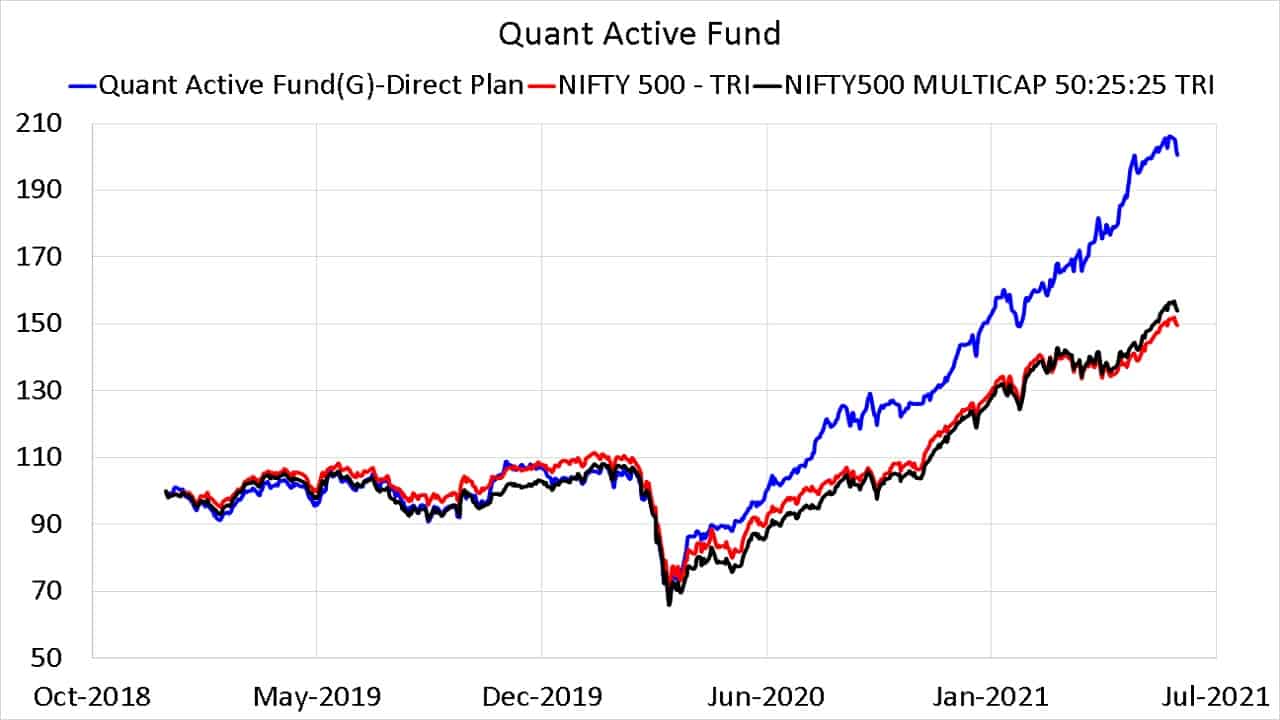
Quant Active Fund vs Nifty 500 TRI and Nifty 500 Multicap 50-25-25 TRI since Jan 2019The reason for this outperformance is possibly due to an increase in small cap exposure after the March 2020 exposure.
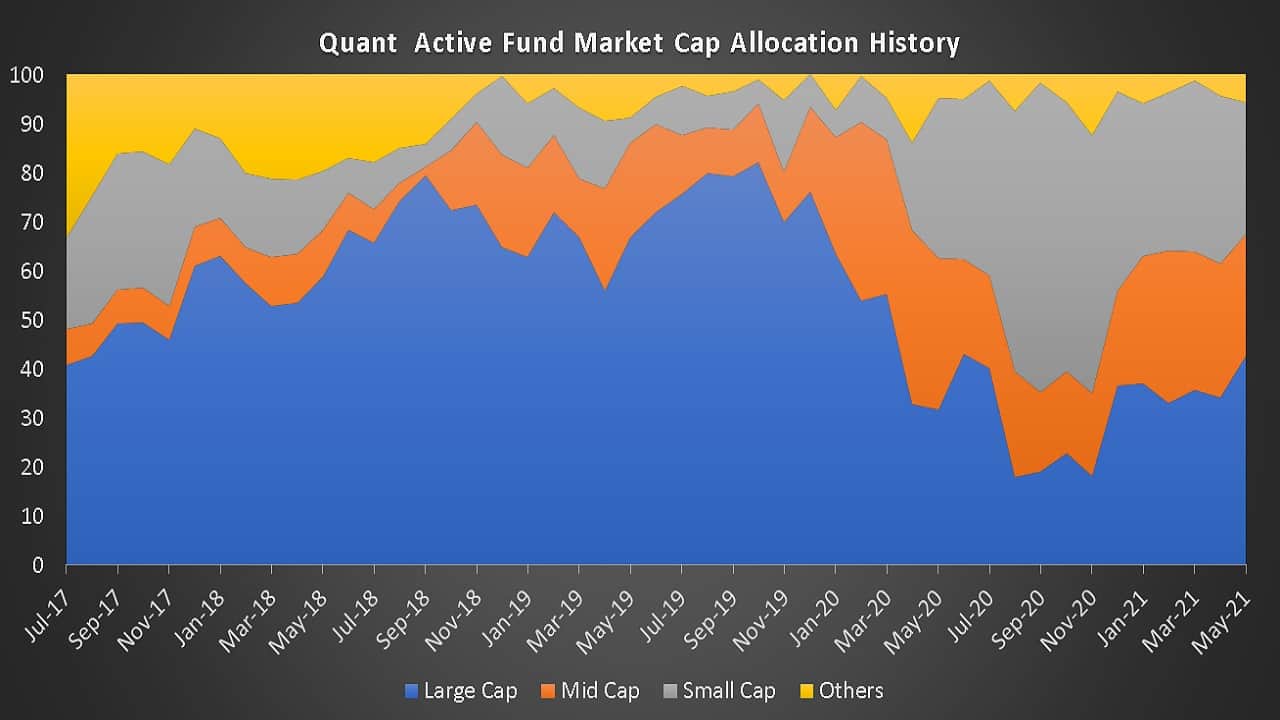
Given this, it is surprising why the fund did not orient itself as a flexi-cap fund with the full freedom to change the market cap. Instead, it chose to be a multicap fund with min 25% exposure to all three capitalization segments. In any case, interested readers must appreciate that the fund has barely any history to analyse returns or risk.
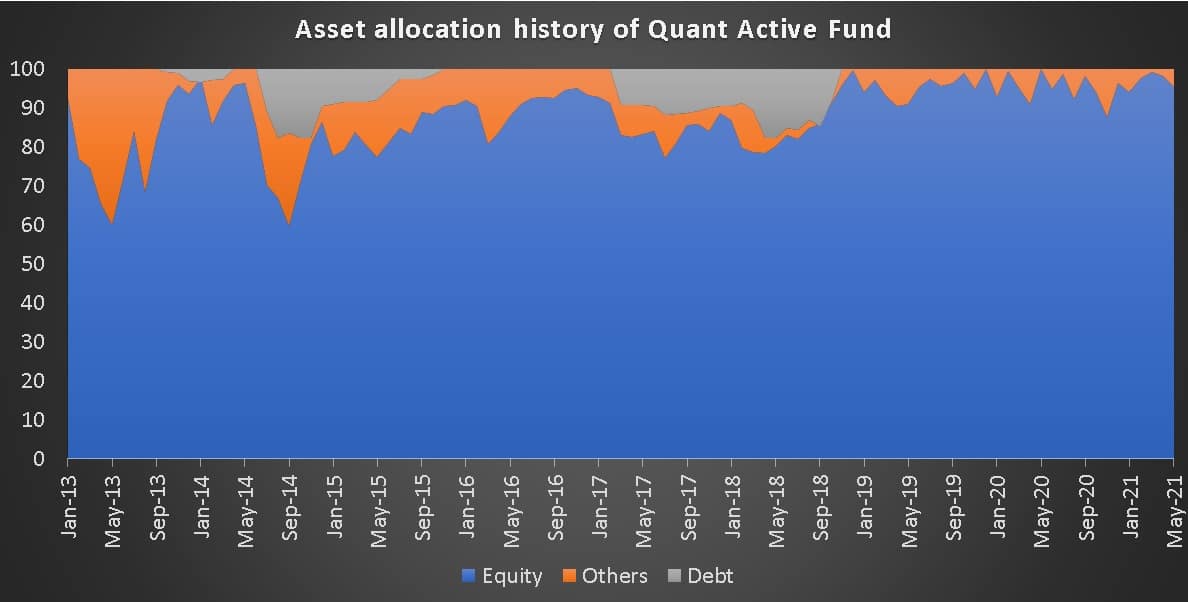
The fund has not made any asset allocation calls (increase in bond holdings) in the last couple of years (it can hold up to 35% in bonds).
The fund had an atrociously high expense ratio for the direct plan until July of last year, when the AUM was just 16 Crores.

After that, the AUM has increased by leaps and bounds. According to AMFI, as of Jan-March 2021 quarter, about 41% of the fund’s AUM is in the direct plan. Before the expense ratio drop in direct plans and possibly a rejuvenated marketing campaign among distributors, the direct plan AUM share was only 24% in April-June 2020 quarter.
The regular plan AUM increased by about 16 times from April-June 2020 to Jan-March 2021 quarters (1506% increase), while the direct plan AUm increased by 35.5 times (3448% increase).
Much of this AUM increase is due to inflows and not returns, as seen from the spike in the red line below. This is the change in AUM minus the change in NAV. Notice that the red line was hovering about zero up to June 2020.
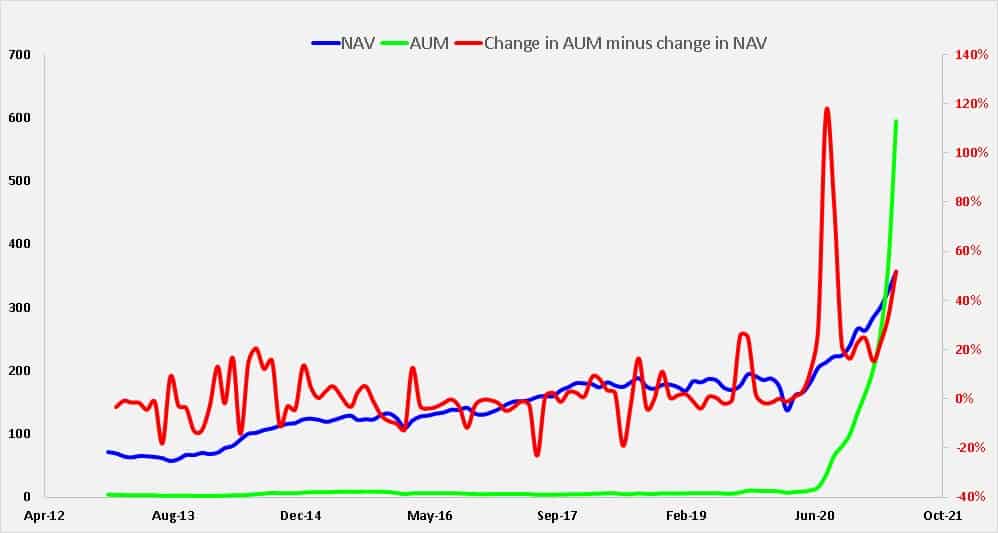
In summary, Quant Active Fund does not have any investor history to analyze past performance. Much of its AUM has come in the last few months, inspired by recent past performance – what we would like to call immature AUM. We strongly urge investors to avoid Quant Active Fund. We must not get carried away by last year’s returns and dig deeper into the fund’s past.