A reader asks, “Sir, can we use Sensex or Nifty ETFs for long term goals instead of index funds? If so, which is better, Sensex or Nifty ETFs?”
We recommend not using any ETF for investing because of possible price-NAV swings during times of crisis and their persistence for weeks. This can happen in any ETF regardless of AUM and typical trading volumes. This is an unnecessary headache for long term investors at the time of rebalancing and eventual redemptions.
Index funds will get the job done without hassle. Index fund tracking errors are typically lower than ETF tracking errors (when measured with price, see explanation below), making them better suited for long-term investing. For data, see the screeners linked below.
Many investors believe ETFs are better than index funds because of their low expense ratios. This is incorrect. Only an ETF with low price-NAV deviations can match up to an index fund. The price-based tracking error will help us search for such ETFs. See ETFs vs Index Funds: Stop assuming lower expenses equals higher returns!
ETFs (at least Indian ETFs at the time of writing) should only be used for trading after considering how quickly price-NAV deviations are extinguished. We compare the tracking errors of Sensex and Nifty ETFs to find out which is better for trading.
🔥Secure your future with our Robo-advisory tool trusted by over 3,500 investors and advisors. From effortless retirement planning to funding your children’s biggest dreams, turn your financial goals into reality. 🔥
Subscribe for money management solutions via email! (Link takes you to our email sign-up form) Join 32,000+ readers in our community.
👉 New Tool Alert! NaviPlan: A Privacy-Focused Multi-asset Tracker and Goal Planner 👈
From an index standpoint, there is little to distinguish between the Sensex and the Nifty. The Nifty has 50 stocks with the largest free-float market capitalization traded at the NSE. The Sensex has the corresponding 30 stocks traded at the BSE. Since the weights are determined by the free-float market cap, the top 10 stocks in both indices account for 60% or more of the total weight in the NIfty and about 70% in the Sensex. See: Do index fund returns depend upon just a few stocks (Concentration risk)?
As a result, the extra 20 stocks in the Nifty do not contribute much to shaping index risk or reward. As a result, there is barely any difference between the two indices. See: Nifty vs Sensex: Which should I choose for passive investing?
However, when these indices are put into a product like an index fund or an ETF, the tracking error, the AUM, the volumes traded, and the expense ratio determines the investor’s actual risk or reward.
Regarding index funds, we have repeatedly shown that some Sensex funds can compete with Nifty funds. So at least in principle (and limited practice), both index funds have similar efficiency in tracking the index as measured by the tracking error. See Index fund tracking error screener August 2022.
Thanks to the ETF tracking error screener Aug 2022, we are now in a position to compare Sensex and Nifty ETFs.
The tracking error is the ETF’s standard deviation minus index monthly return differences. The lower the tracking error, the more efficient the ETF is in following the index.
In an index fund, there is only the NAV. In an ETF, the units are typically traded during market hours like stock with an associated price determined by supply and demand. An AMC-appointed intermediary is supposed to keep the price close to the NAV, but often this does not happen.
The fund manager must ensure the NAV tracks the benchmark in an index fund. In an ETF, not only should the NAV track the benchmark, but the price also should track the benchmark (or equivalently track the NAV).
ETF tracking errors are usually reported using the NAV. The tracking error or tracking difference information does not tell us if the price follows the NAV closely. We will have to guess this by looking at trading volumes. The ETF screener will help change that.
As we have repeatedly shown, tracking NAV-based tracking errors seriously is a big mistake. See, for example, Conventional ETF tracking errors can be misleading here is how to correct them. This link also has examples of how the tracking error is computed.
We buy and sell ETF units at market price; therefore, the price should be used to compute tracking errors and tracking differences. An ETF with a low NAV-based tracking error can have a high price-based tracking error. This means that the ETF price is not tracking the NAV properly.
By measuring tracking error with the ETF price, we can instantly know how efficiently the ETF is tracking the benchmark. Or, in other words, how efficient the AMC-appointed intermediary is in arbitraging the price-nav differences. An efficient intermediary can help minimise price-nav deviations even in low-AUM ETFs. Also, high AUM does not mean price-NAV deviations are automatically low in the ETF.
The last 1Y tracking errors calculated from the ETF price are shown below. The x-axis is just the ETF serial no and can be ignored. There are 16 Nifty ETFs with a 1Y history at the time of writing and 9 Sensex ETFs.
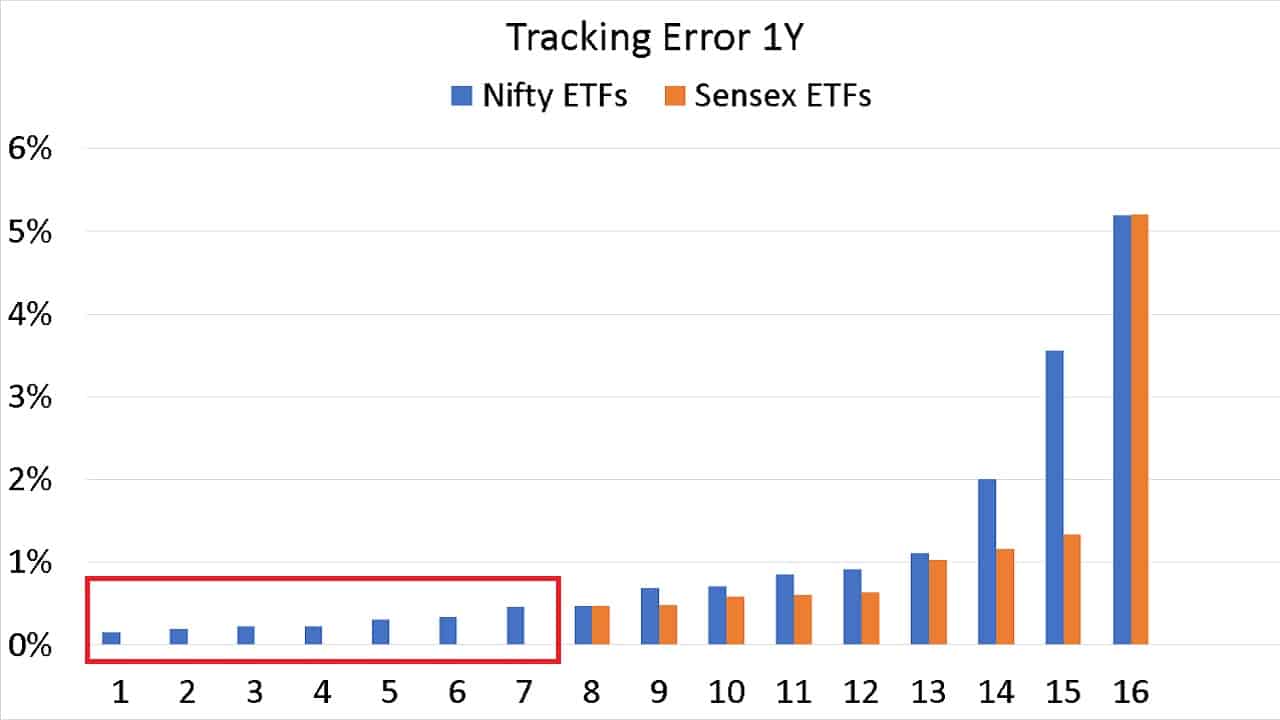
One can see from the distribution of price-based tracking errors that 7 Nifty ETFs are better at tracking the index. Only two Sensex ETFs are below the median value of all NIfty ETFs.
What does this mean?
- Price-NAV deviations in Sensex ETFs are much higher than in popular Nifty ETFs.
- This probably means Sensex ETF trading volumes are typically lower than (popular) Nifty ETF trading volumes.
- Sensex ETFs are therefore less suited for trading compared to Nifty ETFs. We recommend not trading in Sensex ETFs.
- We would also like to reiterate our thumb rule to not use any ETF for investing.