Last Updated on December 29, 2021 at 5:32 pm
A 19% monthly return from the stock market without any background or context would seem something to cheer about. However with India at least weeks away from flattening the curve, the worst for stock investors is yet to come.
In April the Sensex gained 19.3% and since the after biggest intraday fall on Mar 23rd which sent the 10-year Nifty SIP Return crashing to 2.3%, and 14-year SIP Return to 5%, we also saw the biggest intraday gain after 10Y on April 7th. Since March 23rd the Sensex has gained almost 30%!
Even if we assume there are no further lower circuit breaking (at the time of writing the Sensex is down 4% at pre-open) drops, we are long way from recovery. The finances of central and state governments have been stretched too thin.
🔥Secure your future with our Robo-advisory tool trusted by over 3,500 investors and advisors. From effortless retirement planning to funding your children’s biggest dreams, turn your financial goals into reality. 🔥
Subscribe for money management solutions via email! (Link takes you to our email sign-up form) Join 32,000+ readers in our community.
👉 New Tool Alert! NaviPlan: A Privacy-Focused Multi-asset Tracker and Goal Planner 👈
On 28th April, India has borrowed 1.5 Billion USD from the Asian Development Bank to fight the pandemic. Even a casual market observer would tell us that several businesses are likely to report losses for at least a couple of quarters.
The lockdown could close several startups and small cap businesses. The slowdown or recession debate has been settled and we are firmly in the clutches of the latter. According to the Centre for Monitoring Indian Economy, unemployment in India has increased three-fold in April to 23.5%
While the market recovery during the lockdown was reasonably steady, there is not much to look forward to. While the pandemic did not run out of control so far, it has not shown any signs of slowing down either.
Increased testing only at the fag end of the lockdown could be a reason for this. However, there is some good news. The rate of daily compounding of COVID cases has been continuously decreasing for most of April. The data is sourced from covid19india.org. This site live updates state press releases and the data is almost a day early from daily Centre updates.
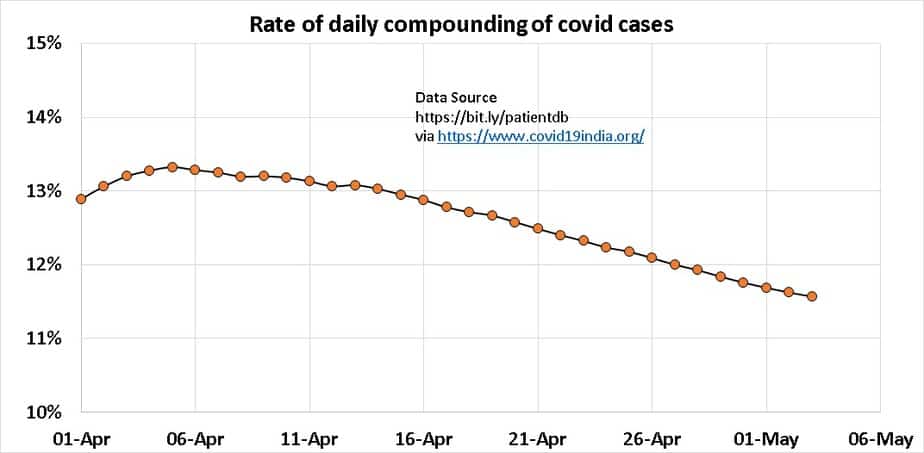
Based on this rate of fall, a crude estimate can be done to answer when will India flatten the curve.
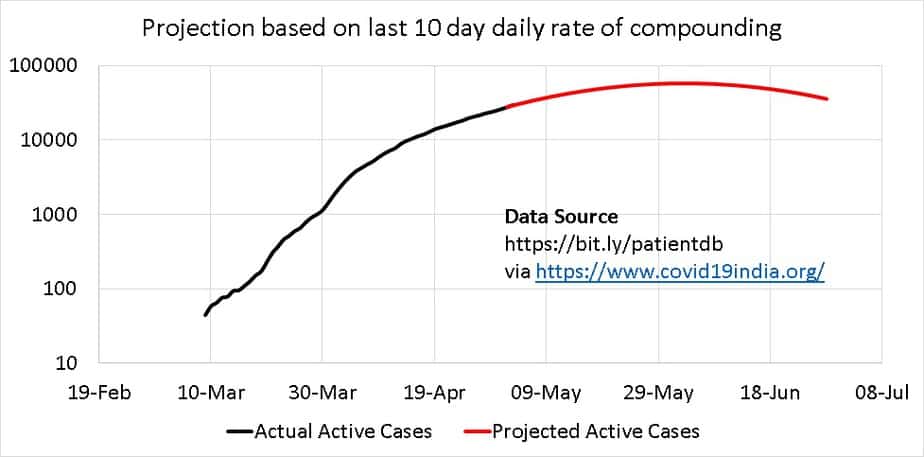
It might be end-May or early-June for the number of recovered patients to be equal to the no of daily new cases (when the curve will start flattening). The above is a simplistic projection, real data could differ significantly. The above graphs are daily updated in the freefincal Twitter account.
Given this, the stock market is likely to “wait” for signs of lasting economic recovery. Meaning, an extended sideways market is likely for some time to come. At what level this happens is not possible to predict.
What should investors do? For young earners, this is a golden time to (1) invest systematically, (2) ramp up investments systematically, (3) correct asset allocation to 50-60% equity (if necessary). Naturally, a risk management plan is important, but “waiting for the market to move up” is a waste of time and could prove risky too (due to the time wasted).
However, no one should expect returns for at least a few years. Unless we bear this pain, wealth cannot be made, we cannot change our lifestyle.
Investors with goals more than ten years away can also continue to invest but must have a clear asset allocation plan. Other investors may have to bear the loss and increase fixed income allocation keeping their future corpus in mind.
Retirees will also have to re-think their strategy preferably with professional help from a SEBI registered fee-only advisor