In India, buying a traditional life insurance policy is almost a family tradition. It is often the first thing people buy when they start a job. But recently, you might have heard a lot of noise from financial experts or friends. They keep saying, “Why are you keeping that old policy? Surrender (close) it immediately and put that money into Mutual Funds. You will get much better returns there!”.
About the author: Ajay Pruthi is a fee-only SEBI-registered investment advisor. He can be contacted via his website plnr.in. Ajay is part of the freefincal list of fee-only advisors and fee-only India.
It sounds like an exciting idea, right? But before you rush to the insurance office to close your policy, we need to ask a very important question:
Is this advice always true for everyone?
The answer is no.
Join 32,000+ readers and get free money management solutions delivered to your inbox! Subscribe to get posts via email! (Link takes you to our email sign-up form)

🔥Want to create a complete financial plan? Learn goal-based investing? Exclusive access to our DIY tools? Increase your income with your skills? Use this link to enjoy massive discounts on our robo-advisory tool & courses! 🔥
It is not a simple Yes or No. It depends on your specific situation. Let’s break this down into simple parts. Before moving ahead,
This is not a suggestion to surrender your policy, make it paid-up, or invest your money in other instruments. Please consult your financial adviser before making an informed decision.
Read this if you are planning to surrender a ULIP policy – How should I exit a ULIP purchased by mistake?
- The Story of Real Loss vs. Dream Profit
First, we must understand how money works when you stop a policy midway. When you surrender a traditional life insurance policy, the insurance company does not give you back all the money you gave them. They cut a large chunk of it as a penalty.
This loss is real. The money is gone from your pocket forever.
On the other hand, the profit you hope to make by investing that money elsewhere (such as in equity mutual funds/stock market) is notional. Notional is just a fancy word for imaginary or assumed. You are basically accepting a guaranteed loss today because you are assuming you will make a big profit in the future to cover that loss. But the future is never 100% sure.
Let’s look at a numerical example: Imagine you bought a policy and have paid ₹5 Lakhs in premiums so far. If you go to the insurance company today to surrender it, they might say, Okay, we will only give you back ₹3 Lakhs.
This means you have instantly lost ₹2 Lakhs. This is a real loss. Now, the people telling you to switch will say, Don’t worry! Take that ₹3 Lakhs, invest it in Mutual Funds, and it will grow to ₹10 Lakhs soon! That sounds great, but remember: you are starting the race ₹2 Lakhs behind. You have to earn a lot just to get back to where you started. The gains are just a dream right now, but the ₹2 Lakhs loss is a reality.
3. The Rishtedaar (Relative) Dilemma
In India, we rarely buy insurance from strangers. We buy it from a Chacha-ji (uncle), a neighbour, a close friend, or even our own parents or in-laws. This makes the decision emotional, not just financial.
If you stop the policy, your uncle might get upset. He might say, I sold you this for your own good, and now you are stopping it? This can make family gatherings awkward.
So, how do you choose between money and relationships? You need to look at the impact on your wallet:
- Scenario A: The Small Token. Let’s say your monthly salary is ₹1 Lakh, and the policy premium is just ₹5,000 per year. This amount is very small compared to your income. In this case, it might be better to just keep paying the premium. You prioritize the relationship because the financial cost is low. You keep the uncle happy, and it doesn’t hurt your wallet.
- Scenario B: The Heavy Burden. Now, imagine the premium is ₹2 Lakh per year, and you are struggling to pay your child’s school fees. In this case, your financial wellness must be your priority. You cannot suffer financially just to keep a relative happy. If the premium is really high and hurting your life, you should choose your financial well-being over the relationship.
3.The Race Against Time Think of your insurance policy like a long marathon race. To decide if you should quit the race, you need to check the Premium Payment Term (how many years you have to pay) and the Policy Term (how long the policy lasts).
Case 1: The Race is Almost Over Let’s say you have a policy where you need to pay premiums for 15 years. You check your records and see that you have already paid for 8 years. You are more than halfway there! In this situation, it is usually better to continue the policy. Why? Because you have already paid the high costs in the beginning. If you quit now, the time left to invest elsewhere and recover your losses is very less. You might not catch up.
Case 2: The Race Has Just Begun Imagine a different policy that lasts for 35 years, and you have paid for 12 years. Even though 15 years sounds like a lot, you still have 23 years left to go! That is a very long time. In this specific situation, you still have a chance to recover your losses. If you take your money out now and invest it in high-growth options (like equity mutual funds), you have 22 years for that money to grow. This long time frame gives you a better chance to beat the losses.
Important Warning: Only choose this option if you have a high-risk appetite. This means you are brave enough to see your money go up and down in the stock market without getting scared.
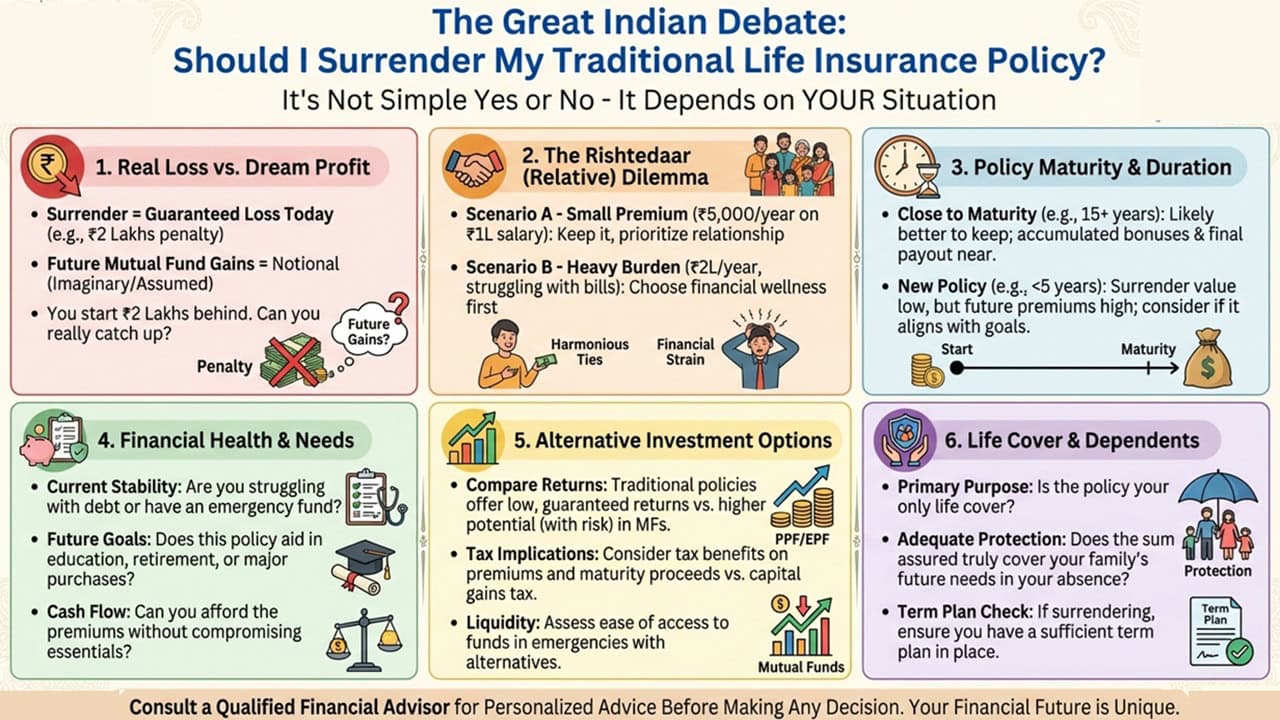
4. Are You Getting Toffee or Gold? You need to check what kind of reward (return) your policy is giving you. Many traditional policies, like Money Back policies, give very low returns—often around 3% to 4%.
If you calculate that your policy is only growing by 4% each year, while prices in the market (like milk, bread, and petrol) are rising by 6% each year, you are actually losing value. In this case, it is better to surrender. Don’t assume your policy is giving you 5-6% or more. Not all policies are that generous. You must do the math.
5. The Helmet Rule: Safety First!
This is the most critical rule of all. If you decide, Okay, I will surrender my old policy, do not do it immediately! You must buy a Term Insurance policy first.
Term insurance is like a pure safety helmet. It gives your family a lot of money if something happens to you, but it costs very little.
Why buy it first? Imagine you surrender your old traditional policy today. Tomorrow, you will apply for a new Term Insurance policy. The new insurance company checks your health and says, Sorry, you have high blood sugar, we cannot give you insurance. Now, you are in big trouble. You have lost the old cover, and you cannot get a new one. You have left your family completely unprotected from both sides.
Example: Always get the new policy letter in your hand before you stop paying for the old one.
6. What If I Don’t Want to Quit?
Maybe you don’t want to surrender. You have other options:
- Align with Goals: Instead of thinking of it as a bad investment, label it. Say, This policy money will be used for my daughter’s college admission or This is my retirement bonus. Treat it as the safe part of your savings (Debt investment).
- Make it Paid-Up: This is a great middle path. You stop paying the premiums, but you don’t close the account. The company keeps your money, and the insurance coverage reduces, but you don’t lose everything. The policy continues until the end, just with a smaller payout.
Try to avoid taking a loan against your policy. It is usually not a good option because the interest rates can be higher than the returns in the policy.
Disclaimer– Nothing in the article is a solicitation, recommendation, endorsement, or offer by the author or the editor. If you have any doubts as to the merits of the article, you should seek advice from an independent financial advisor. *Registration granted by SEBI, BASL membership, and NISM certification does not guarantee the intermediary’s performance or provide any assurance of returns to investors. Investment in the securities market is subject to market risks. Read all the related documents carefully before investing

Use our Robo-advisory Tool to create a complete financial plan! ⇐More than 3,000 investors and advisors use this! Use the discount code: robo25 for a 20% discount. Plan your retirement (early, normal, before, and after), as well as non-recurring financial goals (such as child education) and recurring financial goals (like holidays and appliance purchases). The tool would help anyone aged 18 to 80 plan for their retirement, as well as six other non-recurring financial goals and four recurring financial goals, with a detailed cash flow summary.
🔥You can also avail massive discounts on our courses and the freefincal investor circle! 🔥& join our community of 8000+ users!
Track your mutual funds and stock investments with this Google Sheet!
We also publish monthly equity mutual funds, debt and hybrid mutual funds, index funds, and ETF screeners, as well as momentum and low-volatility stock screeners.
You can follow our articles on Google News

We have over 1,000 videos on YouTube!

Join our WhatsApp Channel
- Do you have a comment about the above article? Reach out to us on Twitter: @freefincal or @pattufreefincal
- Have a question? Subscribe to our newsletter using the form below.
- Hit 'reply' to any email from us! We do not offer personalised investment advice. We can write a detailed article without mentioning your name if you have a generic question.
Join 32,000+ readers and get free money management solutions delivered to your inbox! Subscribe to get posts via email! (Link takes you to our email sign-up form)
About The Author
 Dr M. Pattabiraman (PhD) is the founder, managing editor and primary author of freefincal. He is an associate professor at the Indian Institute of Technology, Madras. He has over 13 years of experience publishing news analysis, research and financial product development. Connect with him via Twitter(X), LinkedIn, or YouTube. Pattabiraman has co-authored three print books: (1) You can be rich too with goal-based investing (CNBC TV18) for DIY investors. (2) Gamechanger for young earners. (3) Chinchu Gets a Superpower! for kids. He has also written seven other free e-books on various money management topics. He is a patron and co-founder of “Fee-only India,” an organisation promoting unbiased, commission-free, AUM-independent investment advice.
Our flagship course! Learn to manage your portfolio like a pro to achieve your goals regardless of market conditions! ⇐ More than 3,500 investors and advisors are part of our exclusive community! Get clarity on how to plan for your goals and achieve the necessary corpus no matter the market condition!! Watch the first lecture for free! One-time payment! No recurring fees! Life-long access to videos! Reduce fear, uncertainty and doubt while investing! Learn how to plan for your goals before and after retirement with confidence.
Increase your income by getting people to pay for your skills! ⇐ More than 800 salaried employees, entrepreneurs and financial advisors are part of our exclusive community! Learn how to get people to pay for your skills! Whether you are a professional or small business owner seeking more clients through online visibility, or a salaried individual looking for a side income or passive income, we will show you how to achieve this by showcasing your skills and building a community that trusts and pays you. (watch 1st lecture for free). One-time payment! No recurring fees! Life-long access to videos!
Our book for kids: “Chinchu Gets a Superpower!” is now available!


Must-read book even for adults! This is something that every parent should teach their kids right from their young age. The importance of money management and decision making based on their wants and needs. Very nicely written in simple terms. - Arun.Buy the book: Chinchu gets a superpower for your child!
How to profit from content writing: Our new ebook is for those interested in getting a side income via content writing. It is available at a 50% discount for Rs. 500 only!
Do you want to check if the market is overvalued or undervalued? Use our market valuation tool (it will work with any index!), or get the Tactical Buy/Sell timing tool!
We publish monthly mutual fund screeners and momentum, low-volatility stock screeners.
About freefincal & its content policy. Freefincal is a News Media organisation dedicated to providing original analysis, reports, reviews and insights on mutual funds, stocks, investing, retirement and personal finance developments. We do so without conflict of interest and bias. Follow us on Google News. Freefincal serves more than three million readers a year (5 million page views) with articles based only on factual information and detailed analysis by its authors. All statements made will be verified with credible and knowledgeable sources before publication. Freefincal does not publish paid articles, promotions, PR, satire or opinions without data. All opinions will be inferences backed by verifiable, reproducible evidence/data. Contact Information: To get in touch, please use our contact form. (Sponsored posts or paid collaborations will not be entertained.)
Connect with us on social media
- Twitter @freefincal
- Subscribe to our YouTube Videos
- Posts feed via Feedburner.
Our publications
You Can Be Rich Too with Goal-Based Investing
 Published by CNBC TV18, this book is designed to help you ask the right questions and find the correct answers. Additionally, it comes with nine online calculators, allowing you to create custom solutions tailored to your lifestyle. Get it now.
Gamechanger: Forget Startups, Join Corporate & Still Live the Rich Life You Want
 This book is designed for young earners to get their basics right from the start! It will also help you travel to exotic places at a low cost! Get it or gift it to a young earner.
Your Ultimate Guide to Travel
 This is an in-depth exploration of vacation planning, including finding affordable flights, budget accommodations, and practical travel tips. It also examines the benefits of travelling slowly, both financially and psychologically, with links to relevant web pages and guidance at every step. Get the PDF for Rs 300 (instant download)