Last Updated on December 29, 2021 at 12:10 pm
One of the most popular beliefs about a mutual fund SIP is that it reduces risk because the buying price is “averaged”. Many also believe a SIP helps achieve higher returns. We show that statements are not true and merely myths propagated by the mutual fund industry for profit.
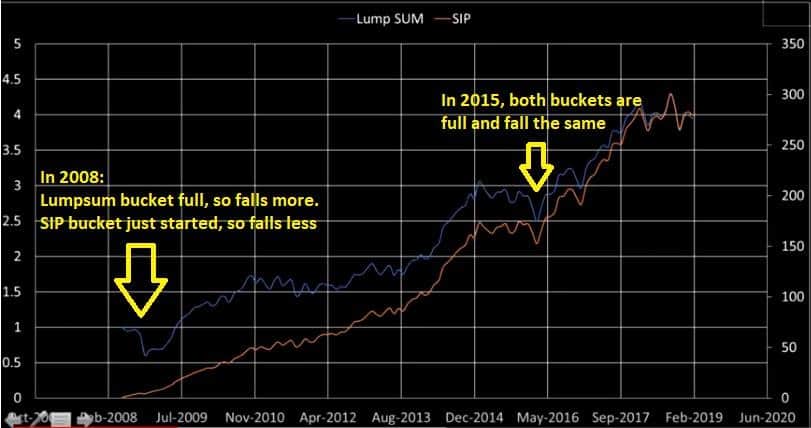
That a mutual fund SIP cannot reduce risk should be intuitively clear and we have shown previously that if there is a market crash today, it will affect even a few decades old SIP. To understand this, I usually use a bucket and mug analogy. Your corpus is the bucket, and the mug is the SIP. Each month, you take a mug of water and fill the bucket. When you keep doing this for months and months, the amount of water in the bucket will be much more than the amount of water you add each month with the mug.
This bucket of water is facing the full market volatility. when the market falls, your corpus will reduce by almost as much (water in the bucket will reduce) regardless of the buying price (when you poured the water).
The risk and reward associated with a mutual fund SIP with become similar to that of lump sum investment
We shall provide proof of this statement in this article.
🔥Secure your future with our Robo-advisory tool trusted by over 3,500 investors and advisors. From effortless retirement planning to funding your children’s biggest dreams, turn your financial goals into reality. 🔥
Subscribe for money management solutions via email! (Link takes you to our email sign-up form) Join 32,000+ readers in our community.
👉 New Tool Alert! NaviPlan: A Privacy-Focused Multi-asset Tracker and Goal Planner 👈
Lump sum SIP investment: Tracing month by month returns
Let us take ICICI Focused Bluechip fund as an example with a SIP started in May 2008 (since inception). Using the freefincal SIP tracker, we can plot XIRR (annualized return) month after month. We also do the same for lump sum started in May 2008 and compare the two.
NOTE: This study shows how the risk and reward of a SIP quickly becomes comparable to that of a lump sum investment. The amount of money invested in the SIP and in the lump sum is not relevant here. We are not trying to find out “which is better – SIP or lump sum?”. There is no point in asking this as it is not practical.
Most of us receive money each month and investing it each month makes perfect sense. If we receive a lump sum, it is natural to split it up into a few installments and invest over a few weeks or months. However, we note that an STP is not in any way superior to a lump sum investing. You can refer to these results for the STP analysis: Investing a lump sum in one-shot vs gradually (STP) in an equity mutual fund (backtest results) and Should I Invest A Lump Sum In One Shot Or Systematically via STP. The STP is merely a trick to lock in the AUM by the AMC.
The singular purpose of this article is to point out that a mutual fund SIP neither reduces risk nor enhances return.
Mutual fund SIP vs Lump Sum: Annualized return month by month
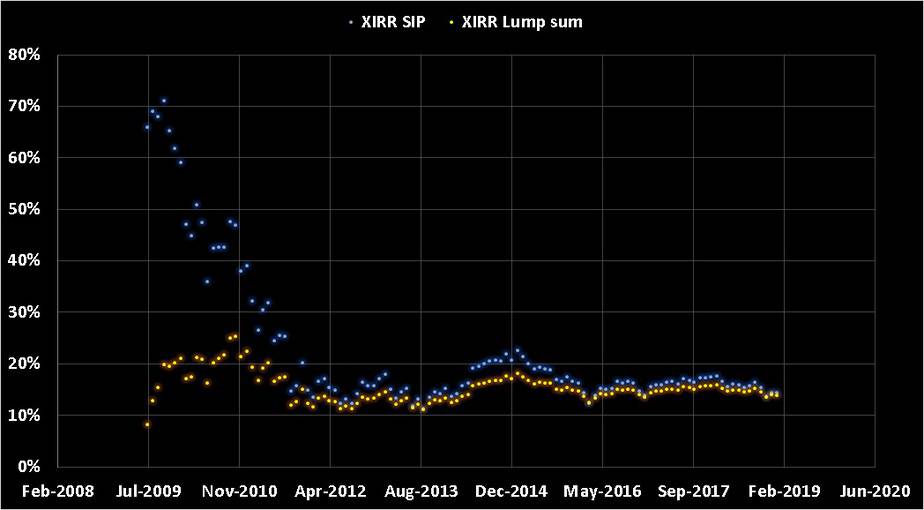
We track the returns with the above-mentioned tool month by month, 12 months after the start of the investment. Notice that the SIP return quickly heads towards the lump sum return and stays close to it. The huge difference initially observed is because each instalment has a different age and the “average” varies a lot.
Mutual fund SIP vs Lump Sum: Annualized return difference
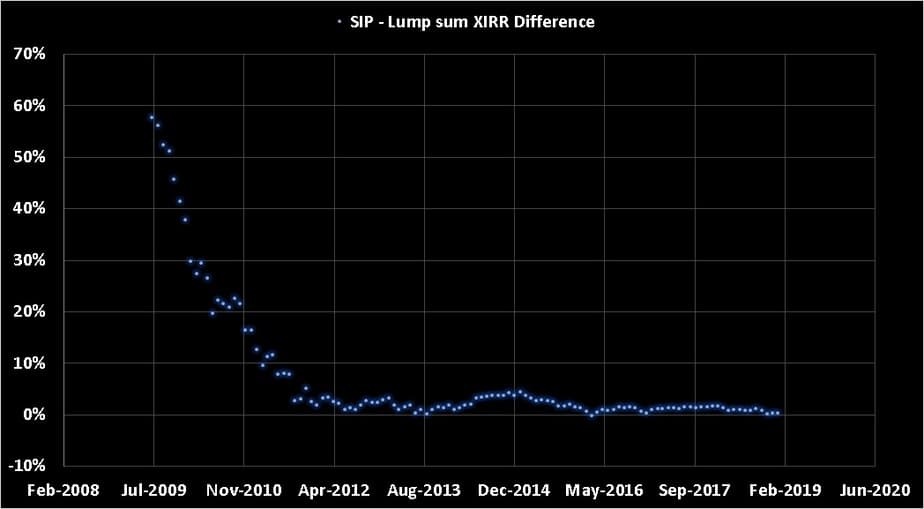
After April 2012, sometimes the SIP return is higher than the lump sum return, however more often than not, the return difference is small. It is important for readers to recognise that we cannot predict when the SIP return will be higher than the lump sum return.
Growth of the corpus

From the evolution of the corpus it should be clear that both the lump sum and SIP investments react to market ups and downs in the same way after a few months. Anath from FB group, Asan Ideas for wealth has annotated this graph in a helpful way with the bucket and mug analogy.
Mutual fund SIP vs Lump Sum: Risk Comparison
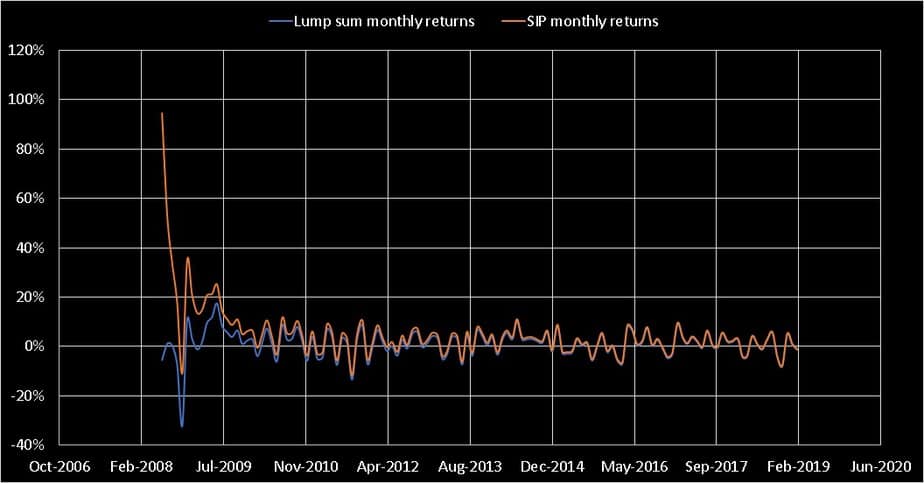
When we compare the fluctuations in monthly returns from the portfolio (a measure of risk), we see that the SIP risk quickly approaches the lump sum risk. In fact, if we factor in the initial fluctuations of the SIP portfolio, the standard deviation of the SIP investment would be higher.
Video Version
Summary
It should be clear that the so called “averaging benefit” of a mutual fund SIP does not result in lower risk or higher returns. Although the buying price of each instalment is different, risk or reward is determined by the final NAV and its importance only becomes stronger with passaging time. There is nothing wrong with starting a SIP. It is merely a convenience. We should not fall selling tactics and assume that a SIP is superior.
Other videos from the freefincal YouTube Channel