Last Updated on December 29, 2021 at 5:31 pm
Here is an example of an all-weather portfolio that works in all market conditions: bull market, bear market, recession, fear, uncertainty, inflation, deflation. Will you use such a portfolio or invest in such a mutual fund if it is available in a tax-friendly manner?
In July 2013, we had analysed the Permanent Portfolio in an alternative investing paradigm developed by American investment adviser Harry Browne in 1981. The permanent portfolio comprises of stocks, bonds, cash and gold in equal proportions (25%)! This sounds bizarre because for long term goals most investment advisers would recommend (1) significant equity exposure. Typically 100-age. That is 65% equity allocation for a 35-year-old and rest in debt. (2) little or no gold exposure (not more than 10%) (3) little or no cash.
How can such an unconventional portfolio allocation work for long term goals? The idea behind the permanent portfolio is fascinatingly simple. In his book (Google PLay ebook for Rs. 379), Fail-Safe Investing: Lifelong Financial Security in 30 Minutes, Browne writes about four possible economic conditions:
🔥Secure your future with our Robo-advisory tool trusted by over 3,500 investors and advisors. From effortless retirement planning to funding your children’s biggest dreams, turn your financial goals into reality. 🔥
Subscribe for money management solutions via email! (Link takes you to our email sign-up form) Join 32,000+ readers in our community.
👉 New Tool Alert! NaviPlan: A Privacy-Focused Multi-asset Tracker and Goal Planner 👈
 Prosperity when markets do exceedingly well
- Recession a general slowdown in one or more aspects of the economy
- Inflation No need to explain this one, right?!
- Deflation Negative inflation. Believe it or not, has occurred in the past!
The idea of the permanent portfolio is to choose instruments which will do well in one or more of the above conditions. According to Browne, these are:
- Stocks When the markets do well. Direct equity or mutual funds. Even an index fund should do.
- Cash during a recession. For example a liquid fund
- Gold during inflation
- Long Term Bonds during deflation and prosperity
Thus the permanent portfolio is 25% Stocks, 25% Cash, 25% Gold and 25% bonds. To ensure in Browne’s words, “an investor is financially safe, no matter what the future brings”.
While it is quite easy to dismiss this portfolio as conservative, it is naturally low volatile, but still effective combination. In this article, the July 2013 study is updated with better data. A tax-efficient alternative is also presented.
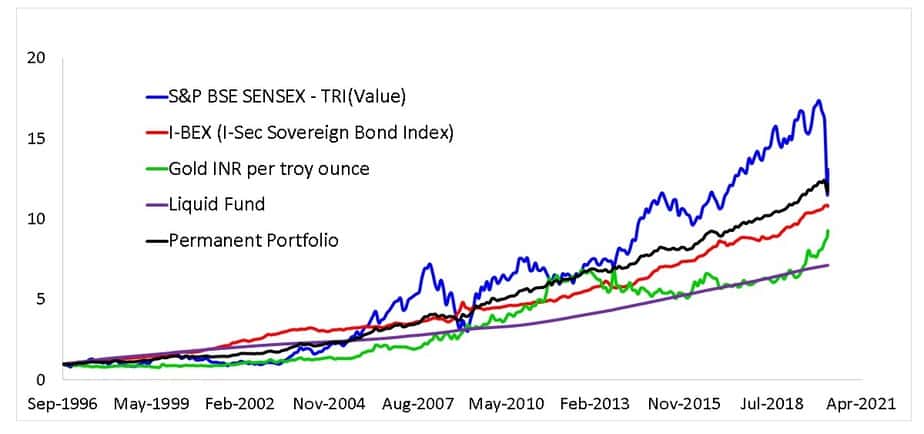
- Stocks: Sensex TRI from Sep 1996.
- Cash: NAV of JM Liquid fund India’s oldest liquid fund is used. The fund was launched on 31st Dec 1997. We have a used a simple extrapolation based on the average of the first 100 daily returns to generate data until Sep 1996
- Gold: Gold price in INR per troy ounce from Sep 1996
- Long Term Bonds: I-BEX Long Term Gilt Index from Sep 1996.
This would be the performance of a mutual fund following the permanent portfolio since Sep 1996 with monthly rebalancing.
Now, it is easy to be dismissive that the permanent portfolio “has done well only after a market crash”. Not true at all when you look at 165 10-year SIP returns.
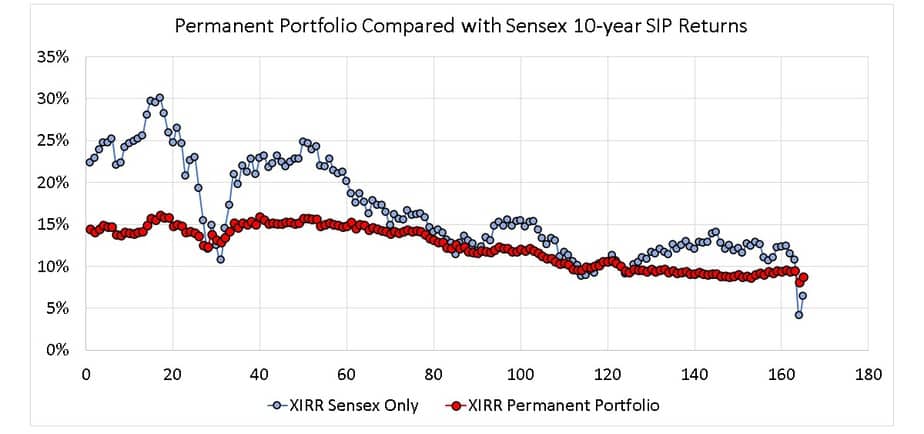
The spread in returns is less and until recently it has managed a double-digit return. The general downward trend is also true for equity as well. The permanent portfolio has also done well with respect to the 50% stocks + 50% bonds portfolio of Ben Graham discussed yesterday.

Now such a portfolio will not be tax efficient even with annual rebalancing and even if a mutual fund adopts this, it will only be classified as a debt fund by the IT depart. Can this idea be implemented via arbitrage?
- Direct Equity 25%
- Arbitrage 40% (total equity 65% to qualify as an equity fund by the IT dept)
- Gold 25%
- Gilts 5%
- Cash 5%
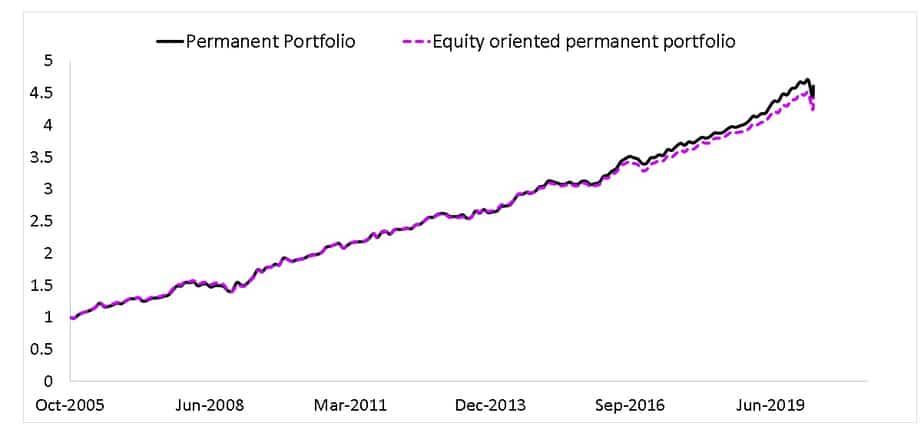
Using Kotak Arbitrage (oldest in the category) this is a comparison of the permanent portfolio with an equity-oriented permanent portfolio. The agreement is reasonable to say the least!
The other asset classes have been included for reference.
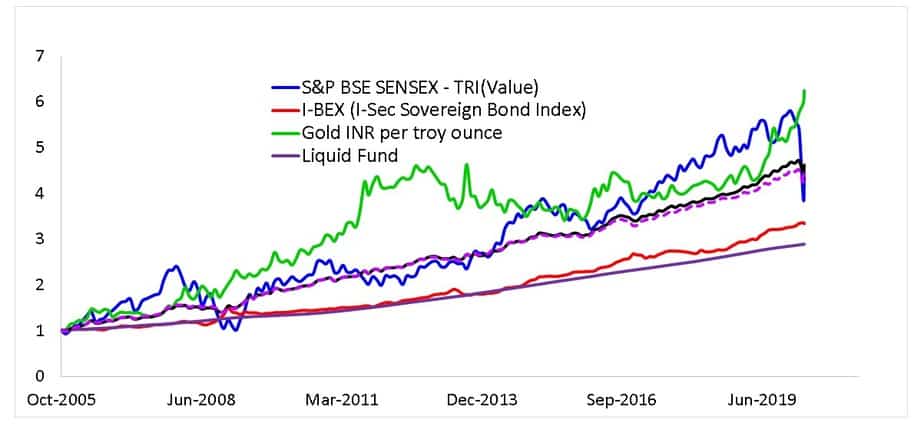
In conclusion, the permanent portfolio is an excellent all-weather portfolio. A simple annual rebalancing is sufficient if an investor implements this, but most will not as they fear taxes more than a capital loss! Mutual funds can implement it with monthly rebalancing but would be treated as debt funds. An equity-oriented variant can easily be constructed.
The key result is, such a portfolio is capable of producing a reasonable return with significantly lower uncertainty. An investor might be quick to criticise, “will such a portfolio beat inflation over the long term?”. Sadly, even a traditional long-term portfolio stuffed with equity does not do this!
An investor who finds this mix appealing also finds the lower uncertainty in future returns appealing. That is prudent thinking, not conservative. Multi-risk funds would do better if they adopt strict asset allocations such as this instead of the vague “min 10% weight to each asset class”.