
Last Updated on March 23, 2023 at 6:26 am
The first brush with a retirement calculator is typically memorable, if not unforgettable(!) for pretty much all investors – including ones who do not take them seriously.
The typical responses would be,
- ‘Why do I need such a huge corpus for retirement?’
- ‘How do you expect me to invest this high an amount each month?’
Here is how retirement calculators go about calculating the corpus and monthly investment required.
For ease of understanding, I will consider the case of a 55 year old man, 5 years away from retirement. You can input desired values in the attached Excel sheet.
🔥Secure your future with our Robo-advisory tool trusted by over 3,500 investors and advisors. From effortless retirement planning to funding your children’s biggest dreams, turn your financial goals into reality. 🔥
Subscribe for money management solutions via email! (Link takes you to our email sign-up form) Join 32,000+ readers in our community.
👉 New Tool Alert! NaviPlan: A Privacy-Focused Multi-asset Tracker and Goal Planner 👈

So here goes,
Name: Captain Haddock
Age: 55
Years to retirement: 5 (age 60)
Year in retirement: 5 (He does not expect to see his 65th birthday, thanks to a livelong association with the bottle!)
Current annual expenses: Rs. 5,00,000
Inflation: 10%
Net post-tax rate of return from the Captains portfolio (equity + debt): 10%
Annual increase in monthly investment: 10%
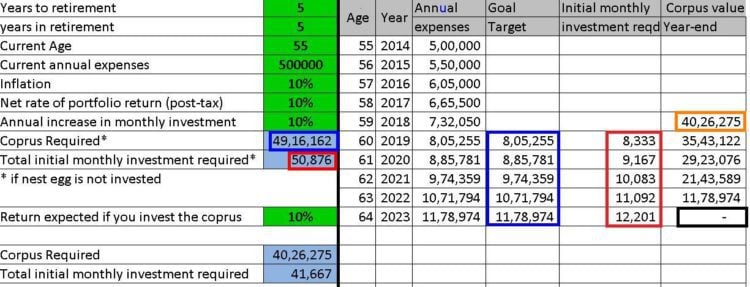
Expenses in the 1st year of retirement:
Age 60
Expenses: E1 = Rs. 8,05,255
Let us treat this as an independent goal.
Captain Haddock must invest an amount X1 so as to have Rs. 8,05,255 after 5 years with a return of 10% and monthly investments increasing each year by 10%.
X1 = Rs. 8,333 (see image; ignore right most column)
Expenses in the 2nd year of retirement:
Age 61
Expenses: E2 = Rs. 8,85,781
Treating this again as an independent goal, we determine the amount of investment required, X2 (10% return, monthly investment increasing each year by 10%)7
X2 = Rs. 9,167 (see image; ignore right most column)
Similarly,
E3 = 9,74, 359 and X3 = 10,083 (expenses for 3rd year in retirement)
E4 = 10,71,794 and X4 = 11,092 (expenses for 4th year in retirement)
E5 = 11,78,974 and X5 = 12,201 (expenses for 5th year in retirement)
The total initial monthly investment required is,
X1 + X2 + X3 + X4 + X5 = 50, 876 (see image; two red rectangles)
This investment is assumed to increase each year by 10%.
The total corpus requires is,
E1 + E2 + E3 + E4 + E5 = 49, 16,162 (see image; two blue rectangle)
This is the corpus required if is not invested anywhere.
Thus in the above scenario, each year in retirement is treated as an independent goal.
Obviously, we can do better than this.
The corpus is invested so that it earns a net post-tax return of 10% (for the sake of illustration!), and at the start of each year in retirement, a sum equal to the expected monthly expenses is redeemed. The rest of the corpus is allowed to grow.
For example, at the start of the first year, a sum, E1 = Rs. 8,05,255 is redeemed. At the start of the second year, a sum, E2 = Rs. 8,85,781 is redeemed and so on.
At the end of the 5th year in retirement (the duration assumed in the example), the corpus is reduced to zero (black rectangle in the image).
Using these assumptions, the corpus required is back-calculated to be Rs. 40,26,275 (orange rectangle in the image).
Notice that the corpus
Has reduced from 49, 16,162 to 40,26,275. Obviously because Captain Haddock now choose to invest the corpus!
Get our most comprehensive retirement calculator: Robo Advisory Software Tool: Build a complete financial plan!