Last Updated on May 24, 2017 at 1:31 pm
Upside and Downside capture ratios are two easy-to-understand measures used to analyze performance of a volatile instrument.
I had earlier written a post on how to use them for mutual fund analysis. Suggest you it along with this post:
Simplify Mutual Fund Analysis with Upside/Downside Capture Ratios
The explanation provided there is quite oversimplified. In this post, I explain how they are calculated and interpreted.
🔥Secure your future with our Robo-advisory tool trusted by over 3,500 investors and advisors. From effortless retirement planning to funding your children’s biggest dreams, turn your financial goals into reality. 🔥
Subscribe for money management solutions via email! (Link takes you to our email sign-up form) Join 32,000+ readers in our community.
👉 New Tool Alert! NaviPlan: A Privacy-Focused Multi-asset Tracker and Goal Planner 👈
I am developing an upside downside capture calculator based on monthly returns. This is much more intuitive than the way in which the mutual fund risk-return analyzer handles them.
What is upside capture ratio?
Suppose we have a set of month returns for say, 5 years.
1) We calculate the net CAGR of the fund with only those months when the benchmark returns are greater than or equal to zero. This is the Upside CAGR of the fund
2) Similarly, we calculate net CAGR of the benchmark with only those months when the benchmark returns are greater than or equal to zero. This is the Upside CAGR of the benchmark.
Upside capture ratio = Upside CAGR of fund/Upside CAGR of benchmark
For example, if upside cagr of the benchmark is 35% and upside cagr of the fund is 34%, the fund has captured 97% of the benchmark returns when it was positive.
Upside capture ratio can also be more than 100% – meaning the fund has outperformed the benchmark when the going was good (benchmark returns were positive)
What is downside capture ratio?
Suppose we have a set of month returns for say, 5 years.
1) We calculate the net CAGR of the fund with only those months when the benchmark returns are lesser than zero. This is the Downside CAGR of the fund
2) Similarly, we calculate net CAGR of the benchmark with only those months when the benchmark returns are lesser than zero. This is the Downside CAGR of the benchmark.
Downside capture ratio = Downside CAGR of fund/Downside CAGR of benchmark
For example, if downside cagr of the benchmark is -15% and downside cagr of the fund is-10%, the fund has captured only 66% of the benchmark losses.
Lower the downside capture ratio, the better downside protection.
Downside capture ratio with be positive only if both downside cagr of fund and benchmark are negative.
If the downside cagr of benchmark is negative while downside cagr of fund is positive, the downside capture ratio will be negative, This is a pretty good thing! It will only be observed over short durations.
What is capture ratio?
Capture ratio = upside capture ratio/downside capture ratio.
Higher the better (unless downside capture ratio is negative)
Here are some examples.
HDFC Top 200
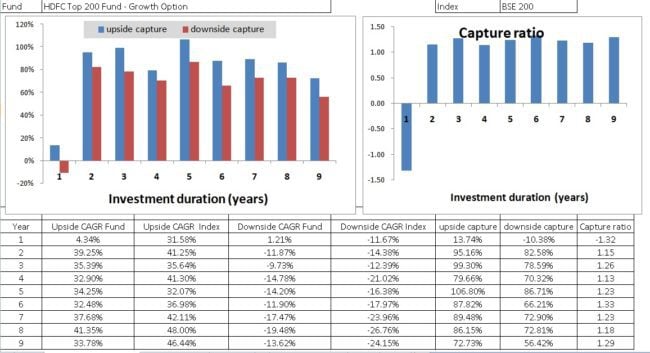
Notice that HDFC top 200 has consistently high upside capture and reasonably low downside capture.
The upside capture is never above 100%. Meaning it did not beat the index if we consider only the good times. How did it generate alpha?
With low downside capture. It did not fall as much as the index during bad times resulting in alpha.
Notice the negative downside capture for 1 year investment period.
Moral of the story: Look for consistent downside protection!
Quantum Long Term Equity
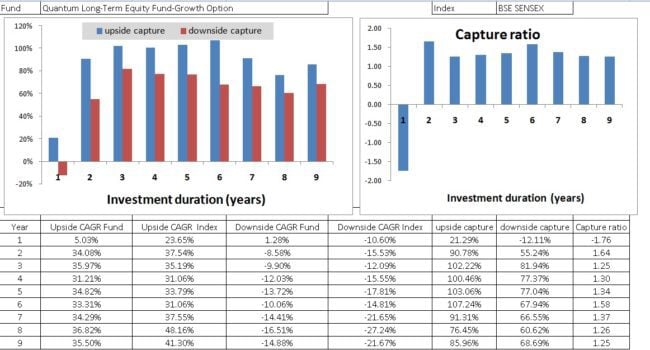
Much is made of QLTE’s cash strategy. It does not reflect here! Its upside and downside captures are more or less similar to Top 200’s.
Moral of the story: Quality of the 65% equity is more important than the 35% cash.
For more details on where to get this ratios online see
Simplify Mutual Fund Analysis with Upside/Downside Capture Ratios
To be continued …..