Last Updated on November 11, 2018 at 5:36 pm
XIRR or extended internal rate of return is a measure of return used when multiple investments (at different points in time) are made in a financial instrument. A look at what XIRR represents and how it is different from CAGR.
What is CAGR?
First, we need to answer a much simpler question.
If I invest Rs. 12,000, and after 5 years the value is Rs. 22,991. What is the average rate at which my investment has compounded year after year?
To find this, we write
🔥Secure your future with our Robo-advisory tool trusted by over 3,500 investors and advisors. From effortless retirement planning to funding your children’s biggest dreams, turn your financial goals into reality. 🔥
Subscribe for money management solutions via email! (Link takes you to our email sign-up form) Join 32,000+ readers in our community.
👉 New Tool Alert! NaviPlan: A Privacy-Focused Multi-asset Tracker and Goal Planner 👈
22991 = 12000 x (1+ CAGR)^5
or
22991 = 12000 x (1+ CAGR) x (1+ CAGR) x (1+ CAGR) x (1+ CAGR) x (1+ CAGR)
Here CAGR represents the year on year compounded growth and is known as compounded annualized growth rate
In the present case, CAGR = 13.9%
CAGR is obviously necessary only when the annual returns vary. If the returns are the same (like in an FD), the maturity value will be known the moment you create the FD.
CAGR vs XIRR
Suppose I invest Rs. 12,000 once a year for 12 years and wish to know what is the average rate at which my investments have compounded year after year, the quantity that gives me information is the XIRR.
We will now see what the XIRR represents and how it is calculated.
This is the annual SIP investment schedule. The investment is made once at the start of each year. A monthly SIP will follow the same logic but is a bit more difficult to perceive.
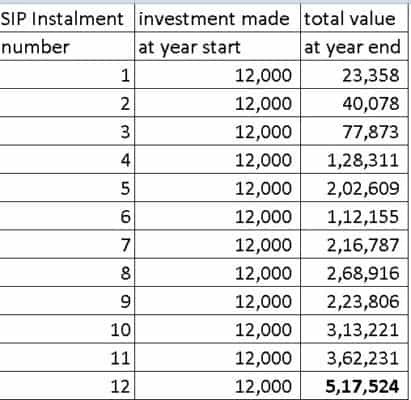
The total value after 12 years is 5,17,524
The same schedule can be viewed in a different way.
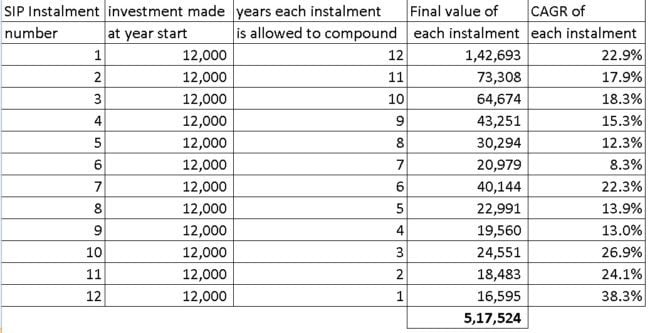
The first instalment has 12 years to grow. The second instalment has 11 years to grow, and so on.
We now calculate the final value of each instalment.
The first instalment after 12 years grows to 1,42,693 at a CAGR of 22.9%
The second instalment after 11 years grows to 73,308 at a CAGR of 17.9% and so on.
Each instalment has its own CAGR as the investment tenure varies. The total value of all the investments must be equal to 5,17,524
Instead of assigning each instalment a different CAGR, what if we assigned a common CAGR?
That is each instalment is perceived to grow at the same CAGR. The aim is to adjust this common CAGR until the total value of all the investments becomes equal to 5,17,524
How is XIRR calculated?
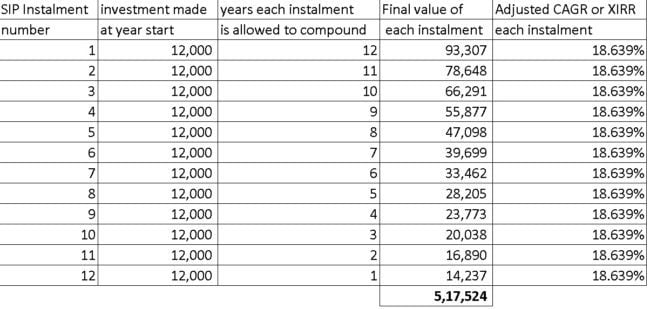
The last column is the adjusted CAGR. Now all instalments have the same CAGR and total value of all the investments is indeed equal to 5,17,524
This adjusted CAGR is known as XIRR
So our aim should be to adjust the CAGR until the total value of all the investments equals the actual total final value.
Excel does this adjustment for us automatically using an approximation technique called the Newton-Raphson method (remember that from school?). The technique is not without flaws. Read more here: IRR/XIRR : Limitations of Calculating Complex Cash Flow Returns
In the above illustration, the investments are spaced exactly 365 days apart. In an actual annual or monthly SIP, due to non-business days, the spacing will be greater/less than 365 or 30 days. The spacing does not matter for XIRR. If the spacing is exact, things become simpler and this is often known as an IRR calculation.